Hotel Mystery Shopping in 2026: Why Physical Audits Are No Longer Enough
Physical mystery shopping is a quality check on the guest experience once someone arrives. The harder question is whether enough guests make it that far.
If a paid-media landing page breaks on Tuesday, or an OTA quietly undercuts the direct rate, or an AI assistant describes the hotel incorrectly, the affected guest does not complain at reception. They close the tab, book somewhere else, or never see the hotel in the first place.
Mystery shopping still matters. A stranger staying overnight is one of the few honest ways to test the welcome, the room, the service recovery and the small human details that never show up cleanly in a dashboard. But by 2026, it is no longer enough to mystery-shop only the stay. Hotels also need to mystery-shop the booking journey that decides whether the stay happens at all.
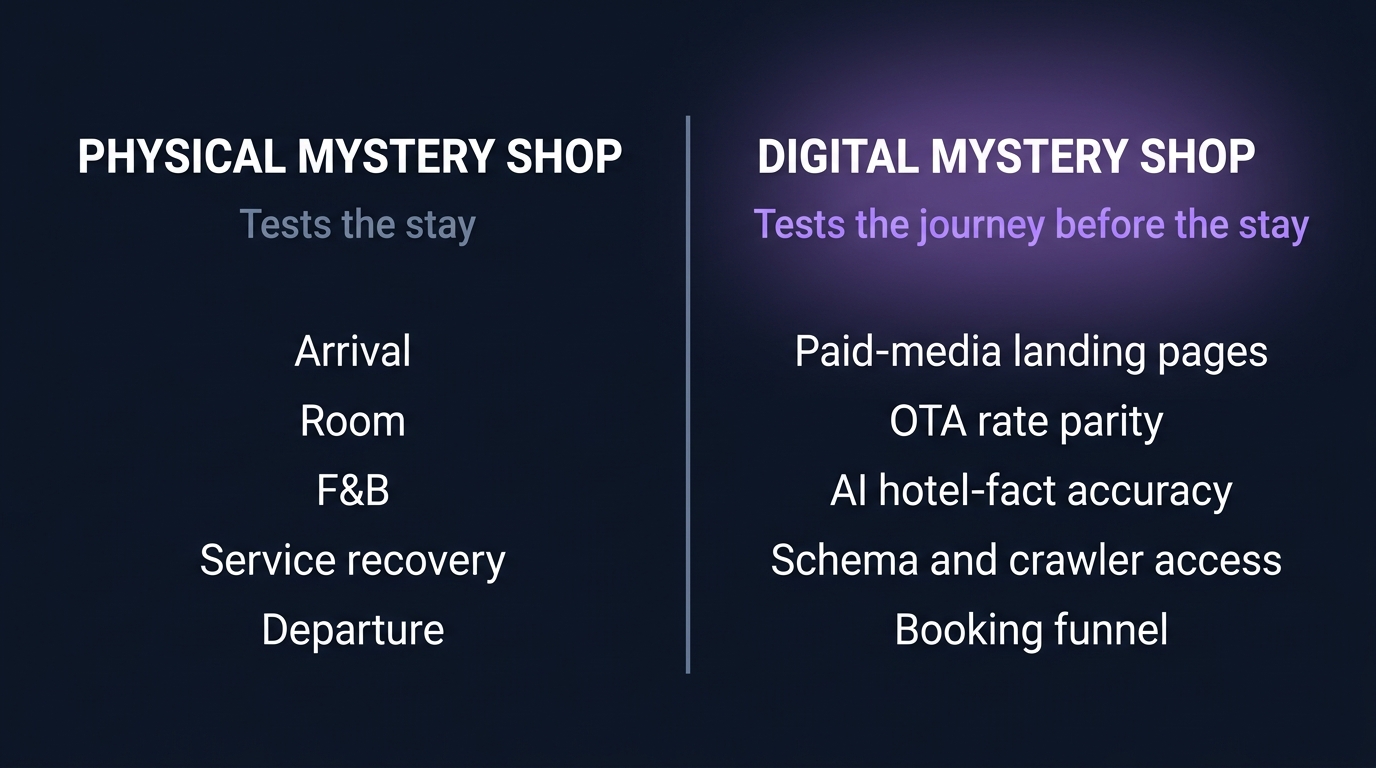
What Physical Mystery Shopping Still Does Well
A person staying in your hotel as a stranger is the only honest way to grade what your front desk delivers under no scrutiny. The arrival experience, the warmth of the welcome, the F&B service at 9pm on a Tuesday, the way housekeeping responds to a missing-pillow request, the tone of a follow-up email from your concierge: these things resist measurement and survive only because someone with a clipboard sat in the lobby and noticed.
For a hotel running quarterly overnight evaluations, the annual cost can easily run into the low thousands per property once the stay, evaluator fee, reporting and reimbursements are included. That is reasonable money for what it covers, and physical mystery shopping isn't going anywhere. But some of the most expensive breakages now happen in places a lobby-based audit will never reach.
The Mystery Shop Your Lobby Audit Cannot Run
Five recur across the hotels we look at.
Broken paid-media landing pages
Hotels spend serious money driving traffic to specific landing pages. A campaign promoting a spring rate runs for three weeks. On day six, a booking-engine update breaks the offer code. From that point until someone notices, every guest who clicked the ad lands on a page that won't price the offer. The mystery shopper, two months later, books a clean room and reports that the welcome was warm.
OTA rate parity drift
In the first half of 2025, the World Parity Monitor by 123Compare.me found that at least one OTA showed a lower rate than the hotel's official site in 75% of searches across major markets.
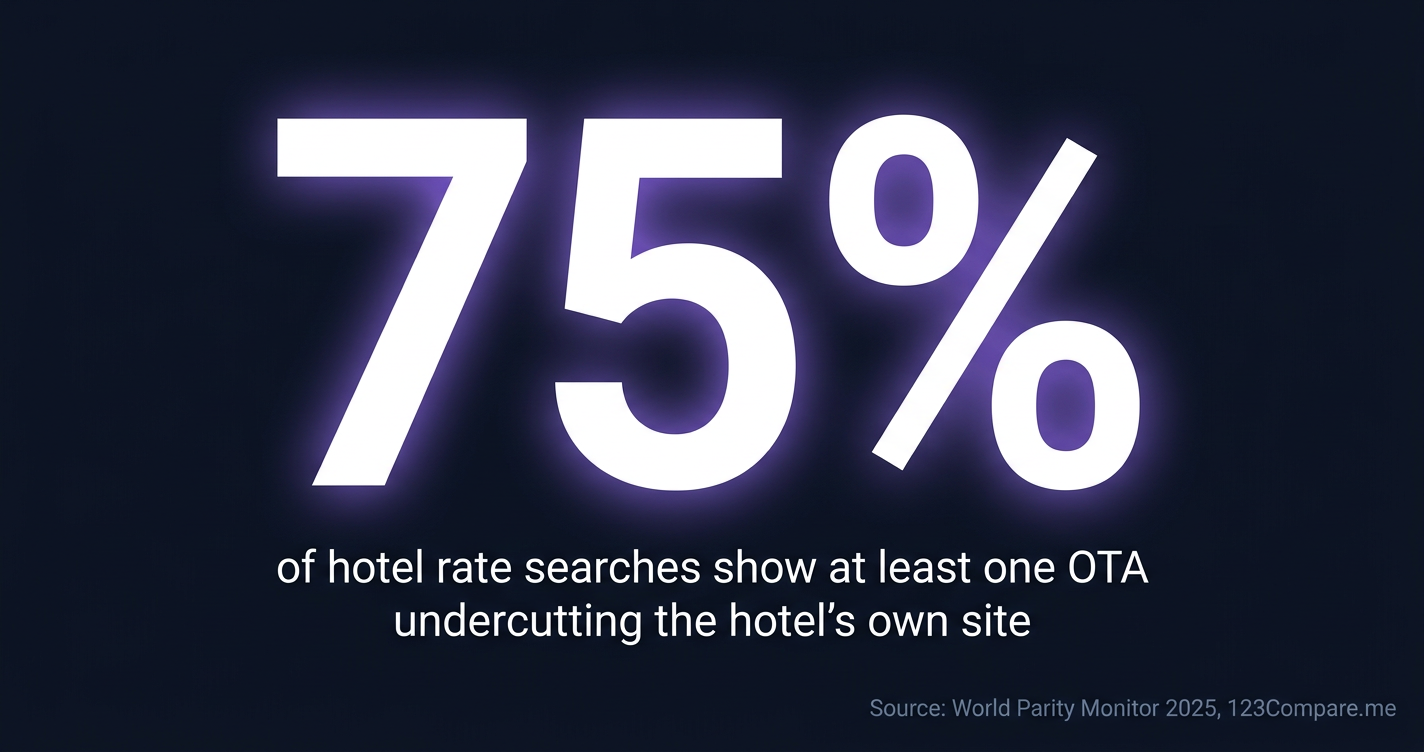
In three out of four hotel rate searches, the guest saw at least one cheaper OTA option visible against the hotel's own site. None of those guests filed a complaint. They simply booked elsewhere.
Michelle Casey at RightRevenue, writing in April 2026, called regular test bookings "one of the most effective ways to identify leakage and trace where the booking is actually landing in the PMS." A physical mystery shopper, by definition, books once.
AI giving wrong facts about your hotel
Cloudbeds analysed 145 top-ranked properties across six destinations in mid-2025 and found that OTAs are cited in 55.3% of AI hotel recommendations, while hotel websites are cited only 13.6% of the time. Tim Major, CEO of Operto, put the operating problem clearly in April 2026: "Hotels are already showing up in AI-generated travel recommendations, but most have no idea what's being said about them or what's driving those results."
A mystery shopper who books your hotel via your website doesn't ask ChatGPT first. Your guests increasingly do.
Schema and AI crawler invisibility
If GPTBot, ClaudeBot, OAI-SearchBot or PerplexityBot is blocked in your robots.txt or by your WAF, the AI travel assistants that decide which hotels to surface cannot read your site. In our own checks of major hotel brand sites, we have seen AI crawler access blocked or constrained surprisingly often, usually as a by-product of legacy bot rules, CDN settings or security policies rather than a deliberate marketing decision. The agency set it up. The CDN tightened the rules. The lobby looks the same.
Booking-funnel friction
SiteMinder's 2025 Changing Traveller research with UKHospitality found that 52% of travellers have abandoned an online hotel booking because of a bad digital experience. A mystery shopper books with a corporate card from a desktop on a stable connection. Your guest is on a phone with three bars and an eight-month-old browser.
Why Digital Mystery Shopping Should Come First
The case for running a digital mystery shop before the next physical one rests on three points: cost, cadence, and sequence.
Cost. A continuous digital mystery shop runs every day for less than the cost of a single quarterly evaluator stay. The economics are not a competition. They are a reallocation: find the digital leaks first, then send the human to test the moments software cannot grade.
Cadence. Physical mystery shopping is a quarterly snapshot. A booking funnel can break on a Tuesday afternoon and stay broken until the next scheduled audit twelve weeks later. Continuous digital monitoring catches the broken landing page on Tuesday evening. By the time the human evaluator arrives, the page is fixed and the room they are grading actually got booked.
Sequence. Physical mystery shopping evaluates the experience of guests who already booked. If the booking is silently failing because of an OTA undercut, a broken offer, an AI assistant citing the wrong facts, or a checkout that drops on step four, the physical mystery shopper is grading a room that fewer guests will ever see.
Digital first to find the gaps in the booking surface. Physical second to validate the human moments digital cannot read.
What a Digital Mystery Shop Tests
A digital mystery shop applies the same principle as the in-person original to the pre-arrival journey: behave like a guest, follow the commercial path, capture evidence, and show where the experience breaks before a booking is made. The output is a report a Director of E-Commerce can act on.
It tests:
- Paid-media landing-page integrity. Every active campaign URL, screenshotted and compared against the offer it promises. Broken codes, mispriced offers, redirect chains, 404s.
- OTA rate parity. Your direct rate compared against major OTA rates for the same room type, same date, same guest profile. Drift flagged with screenshot evidence.
- AI hotel-fact accuracy. What ChatGPT, Perplexity, Gemini and Grok say about your property: name, location, star rating, amenities, current offers. Inconsistencies surfaced with the prompt and the response.
- Schema and crawler access. Your
robots.txt, your WAF behaviour, your structured data. Whether AI crawlers can read the site, and whether the schema they read describes the hotel you actually run. - Booking-funnel completion. A simulated booking attempt across mobile and desktop, every step screenshotted, every error logged. Where does the journey break?
Each of these is a check that a person staying overnight in your hotel cannot perform.
Stiplo Mystery Shop
That is the gap Stiplo Mystery Shop is built to close.
It runs a digital mystery shop across the pre-arrival journey: paid-media landing pages, OTA parity, AI visibility, schema and crawler access, and booking-funnel completion. The output is not another analytics dashboard. It is screenshot evidence of where the guest journey breaks, what changed, and what the commercial team should fix first.
Run a free digital mystery shop for one property.
The 2026 Playbook: Digital First, Physical Second
The strongest hotel quality programmes in 2026 sequence their audits the way the funnel sequences itself.
Digital mystery shop monthly. Continuous monitoring of the booking surface. Five categories, screenshot-evidenced, flagged when something drifts.
Physical mystery shop quarterly. The narrative-tier human audit of the moments digital cannot grade. Done right, the physical mystery shopper now arrives at a property that has not been silently leaking bookings between visits.
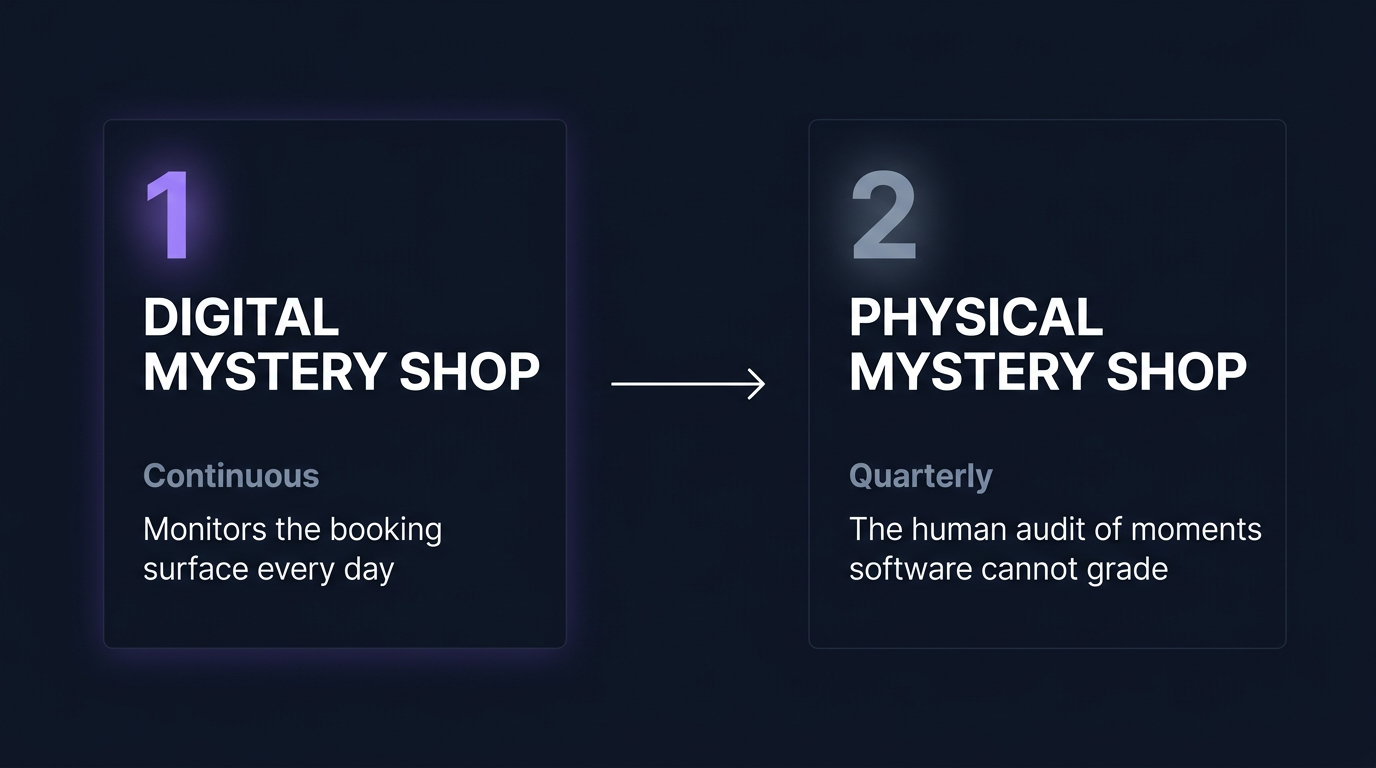
Together, they cover the journey from "the guest hears about your hotel" to "the guest leaves their thank-you note."
Frequently Asked Questions
What's the difference between digital and physical mystery shopping?
Physical mystery shopping evaluates the experience guests have once they arrive at your hotel: arrival, room, F&B, departure. Digital mystery shopping evaluates the experience guests have before they arrive: paid media, OTA rate parity, AI visibility, schema, and the booking funnel. They cover different halves of the same commercial journey and complement each other when run together.
Does digital mystery shopping replace what we already pay for?
No. The physical mystery shop programme stays. The argument is about sequence and reach. Digital first to find the leaks in the booking surface; physical second to evaluate the human moments software cannot grade.
Can a digital mystery shop test our offers and pricing?
Yes. A digital mystery shop screenshots every active offer page, compares the price against the rate the offer promises, checks parity against OTAs, and flags drift continuously rather than at quarterly intervals. Hotels typically discover broken or mispriced offers within hours of running the first scan.
How often should we run a digital mystery shop?
Continuously. The booking funnel and the AI surface change daily; a quarterly cadence misses three months of leakage. Stiplo Mystery Shop monitors continuously and alerts on changes that affect the commercial journey.
How is this different from Google Analytics or our SEO audit?
Analytics tells you traffic dropped. An SEO audit tells you why your rankings might be slipping. Neither tells you that your paid-media landing page is mispriced, that an OTA is undercutting you on Tuesday afternoons, that ChatGPT is citing the wrong star rating, or that your booking funnel breaks on step four for mobile users. A digital mystery shop is the missing diagnostic between traffic data and the room that didn't get booked.
Want to see how your hotel website performs?
A Mystery Shop checks 30 pages for commercial integrity issues in minutes.
Request a free Mystery Shop