
Most audit tools don't show their work.
This page does.
A Mystery Shop is a five-stage investigation of your website and your AI presence.
Every finding arrives with evidence: a screenshot, a line of code, or a recorded answer from an AI assistant. The same scan also surfaces the demand you are missing, handed back as a brief on what to win. See a sample opportunity brief.
5
investigation stages, from first capture to the report in your inbox
41
checks live in your report, accuracy proven on real hotel websites
87
more in calibration until we trust them enough to ship
4
AI assistants asked about your hotel, answers recorded as evidence
Start here
Three ways into the same investigation
One free Mystery Shop covers all of it. These pages are the way in if you already know which part you are worried about.
AI visibility
Whether ChatGPT, Gemini, Google AI and Perplexity can find your property, and whether the facts they repeat about you are right.
Run this auditSearch rankings
Where you show up in search and local listings, and the demand you are missing that a competitor is already answering.
Run this auditWebsite trust
Whether your site earns a guest's trust: live links, clear trust signals, a booking path that works on a phone.
Run this auditThe pipeline
Five stages. Every finding has to earn its place.
Capture
Up to 30 pages per property, screenshots and raw HTML, on a mobile viewport.
Read more ↓02Deterministic checks
Rules that return the same answer every time. No judgement calls.
Read more ↓03AI vision
The screenshot read the way a guest would read it.
Read more ↓04Cross-property
Defects only a portfolio scan can find.
Read more ↓05AI investigator
An agent that follows hunches and files only what it can prove.
Read more ↓The groundwork
Capture first. Then the rules we trust completely.
We crawl up to 30 pages per property on a mobile viewport, capturing screenshots and raw HTML. We simulate the public digital journey: we never log in, never make bookings, never touch guest or booking data. The crawler identifies itself, follows standard rate limits, and has no effect on your rankings.
Then the deterministic pass: checks that return the same answer every time. A missing sitemap is missing. An absent security header is absent. No judgement calls. This is the layer search engines and AI assistants actually read when deciding whether to surface your hotel.
AI vision
What the camera sees, the model reads.
Example. A Christmas promotion from 2024 still live on a homepage in May. No rule catches that. The vision pass does, because it reads the screenshot the way a guest would: prices, dates, booking buttons, broken layouts, placeholder text.
A visual finding never reaches you on its own. It has to be corroborated by the page code, and it has to survive a set of bright-line rules that dismiss anything the site itself contradicts.
Christmas Getaway 2024
From €189 per night. Book by 24 December 2024.
Cross-property
Defects only a portfolio scan can find.
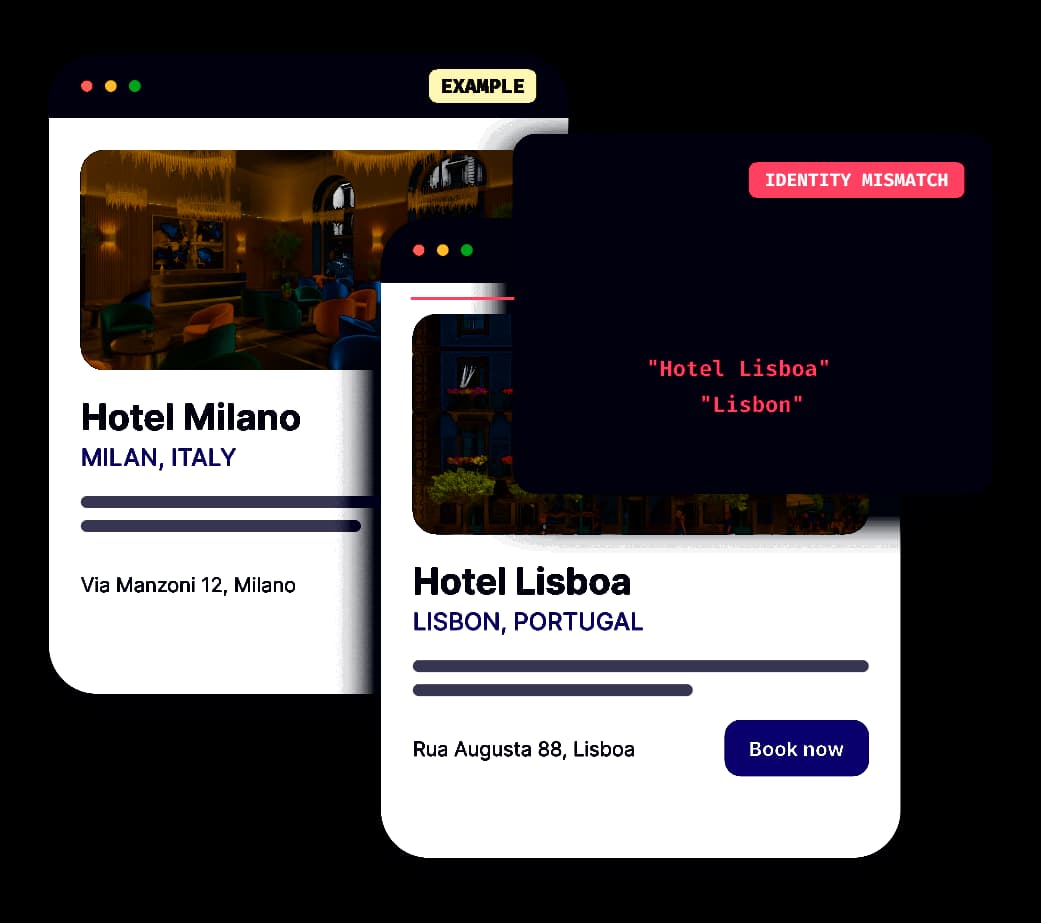
Example. On a recent scan of a European hotel group, the Milan property’s page carried the Lisbon hotel’s full identity block in its code, verbatim. Both pages looked perfect to guests. To search engines and AI assistants, Milan was Lisbon.
This stage runs when you have more than one property. It catches identity drift, copy-pasted content, missing local-language pages, and coordinates that put your hotel in the wrong country. A group’s biggest invisible risk is its properties blurring into each other.
AI investigator
The newest part, and the hardest to do well.
After the audit, an AI agent investigates what the rest of the pipeline cannot resolve on its own. It reads your site the way a consultant would: it follows hunches, fetches evidence, and only files a finding it can pin to a specific piece of proof. It is how multiple symptoms collapse into one upstream cause, and how a small bug inside a critical booking flow gets promoted to the top of your report.
It runs on hard time and spend caps, and its findings face the same evidence bar as everything else. Today it informs our team’s review of your report; its findings will appear directly in your dashboard once calibration proves their accuracy.
We don't stop at your website.
Every scan also asks the AI assistants guests actually use how they describe and recommend your hotel, and records the answers as evidence.
The trust ledger
We hold back more checks than we ship.
A check goes live the day we trust it, not the day we build it. Right now that means:
41
Accuracy proven on real hotel websites
These are the checks behind every score and every finding you see.
87
Running silently until they earn their place
They run on every scan, but only our team sees them until their accuracy is proven.
Our team keeps an eye on every scan and fine-tunes the system behind it. When a finding does not hold up, we dismiss it and tighten the check that produced it. That feedback loop is why the live column stays trustworthy as it grows.
Drawn lines
What we never do.
We never access guest or booking data.No booking engine, no PMS, no payment systems, no logins.
We never affect your rankings.The crawler identifies itself and follows standard rate limits.
We never make real bookings.And we never submit forms with invented guest details.
We never ship a check until we trust its accuracy.That is what the calibration column is for.