Most hoteliers treat AI visibility as a black box. It isn't. The three layers behind every AI recommendation, and the levers you can pull.
AI hotel recommendations are assembled in real time from three distinct layers: what the AI already knows from its training data, what it retrieves from the live web in that moment, and how it synthesises those sources into a final answer. When a traveller asks ChatGPT "best boutique hotel in Barcelona with a rooftop bar," the recommendation isn't pulled from a list, it's constructed on the spot from dozens of sources.
Understanding how AI recommends hotels is the difference between hoping you appear and knowing why you do, or don't. Most hotels treat hotel AI visibility as a black box. It isn't. The mechanism is knowable, and once you see it, the fixes become obvious.
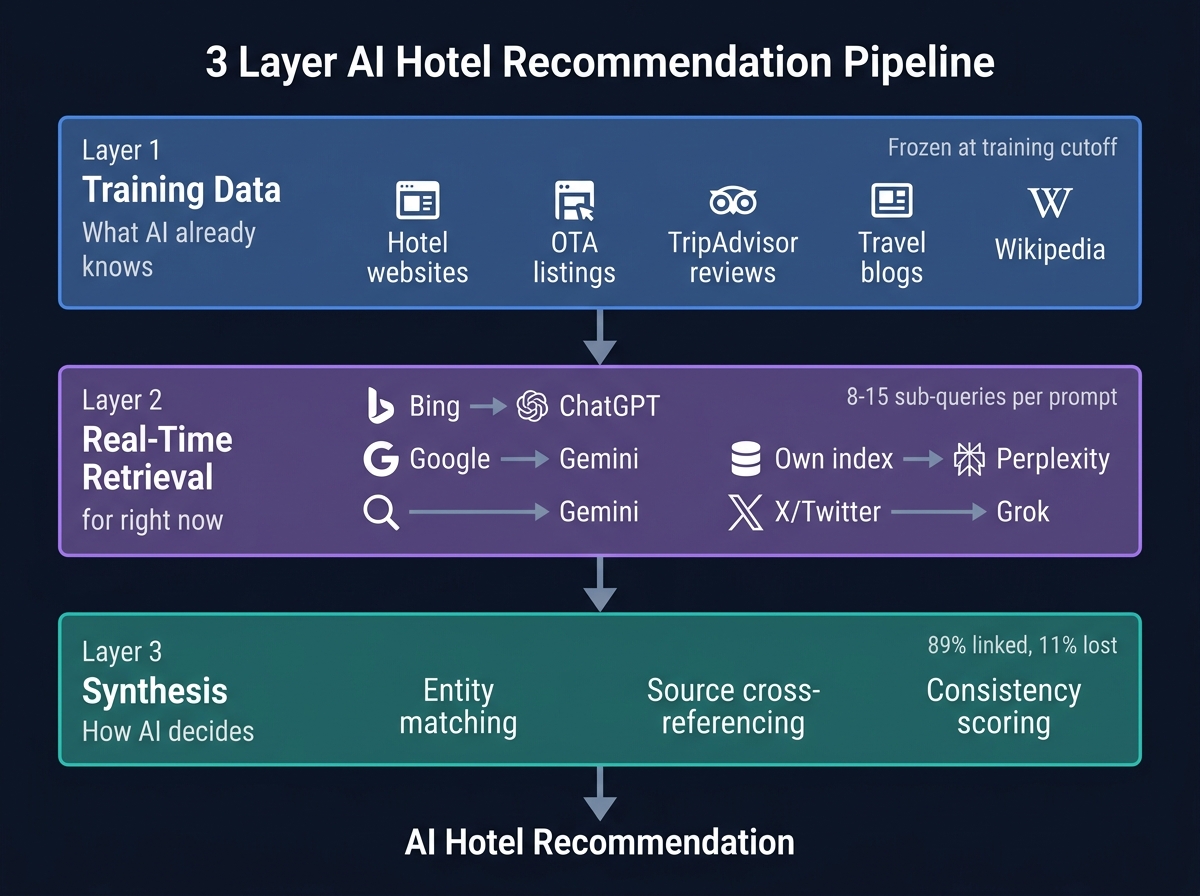
The Three Layers of AI Hotel Recommendations
Every AI hotel recommendation passes through the same three-stage pipeline: training data sets the baseline understanding of your property, real-time retrieval gathers fresh evidence from the live web, and synthesis decides what makes the final answer. Each layer has different rules, and different ways to influence it.
Layer 1: Training Data, What AI Already "Knows"
AI training data is frozen at a point in time. If your hotel renovated its restaurant, rebranded, or changed its star rating after the model's knowledge cutoff, the AI's baseline understanding of your property is wrong, it still "knows" the old version.
Every model, GPT-5, Claude, Gemini, is trained on billions of web pages crawled before its cutoff date: hotel websites, OTA listings, TripAdvisor reviews, travel blogs, Wikipedia entries, and news articles. This creates the AI's baseline "prior" about your hotel. A property like Hotel Arts Barcelona, which appears consistently across Booking.com, Lonely Planet, TripAdvisor, and its own website with the same name, star rating, and amenities, starts with a strong prior. A boutique hotel that launched last year with minimal web presence starts with almost none.
This is why real-time retrieval exists, but it only helps if AI can find current, consistent information about you on the live web.
Layer 2: Real-Time Retrieval, What AI Searches For
When you ask an AI assistant about hotels, it doesn't just consult its training data. It searches the live web using a process called Retrieval-Augmented Generation (RAG). This is where the real competition for AI hotel recommendations happens.
Each platform retrieves differently:
ChatGPT queries Bing's API in real time and fetches full page content for synthesis. It has no web index of its own, Bing is its eyes on the live web. ChatGPT's own OAI-SearchBot crawler also fetches pages directly. In March 2026, Lighthouse launched a direct booking integration bringing Booking.com and Expedia inventory into ChatGPT hotel recommendations via plugins. Despite reading from OTAs, GPT 5.2 sends 91.1% of its hotel links direct to hotel websites, it reads from intermediaries but links to the source. This makes ChatGPT hotel recommendations the most direct-booking-friendly of any AI platform.
Perplexity maintains its own search index of over 200 billion URLs, indexed at the sub-document and sentence level, with a median retrieval latency of 358 milliseconds. It also queries Google and Bing. Critically, Perplexity has a formal partnership with TripAdvisor giving it access to over 1 billion reviews. TripAdvisor content appears in 95.5% of Perplexity's hotel results. For hotels, this means your TripAdvisor review volume and recency directly shape how Perplexity describes your property, making review management a core part of AI travel recommendations strategy, not a nice-to-have.
Google Gemini has the deepest retrieval stack of any platform: Google's search index, Knowledge Graph, YouTube, Google Maps, Google Hotels, and Google Business Profile. Your GBP listing feeds directly into Gemini's understanding of your property, location, photos, reviews, amenities, hours. Google is now integrating paid hotel listings directly into AI-generated itineraries, making GBP the single most important asset for Gemini visibility.
Grok uniquely couples to X/Twitter's real-time post stream, scoring content by author influence and follower engagement. Its DeepSearch agent queries both X and the broader web. If travel influencers are posting about your hotel on X, Grok sees it in real time. Reddit threads and Facebook group discussions also feed its recommendations.
But there is a critical mechanism that makes retrieval competitive: Query Fan-Out. When you ask about hotels, AI doesn't run one search. It decomposes your query into 8-15 sub-queries simultaneously, "Barcelona boutique hotel," "rooftop bar hotel Barcelona," "Barcelona hotel reviews," "best neighbourhood Barcelona boutique stay." Each sub-query returns its own results. Pages that rank for the main query AND at least one fan-out sub-query are 161% more likely to be cited in the final answer.
Only 27% of these sub-queries remain stable across repeated searches. The other 73% change every time. This is why fewer than 1 in 100 AI runs produce the same hotel list, according to research by Rand Fishkin. AI hotel recommendations aren't a fixed ranking, they're a probabilistic outcome that shifts with every query.
Layer 3: Synthesis, How AI Decides What to Include
After retrieval, the AI reads the actual pages, extracts relevant passages, cross-references them against its training data, and assembles a recommendation. This is where entity consistency wins or loses.
HotelRank.ai's analysis of ChatGPT's hotel search architecture found that the system uses entity recognition to link hotel names to canonical Google Place IDs. 89% of hotels get successfully linked. The 11% that don't may appear as duplicates or with reduced visibility, the AI can't confidently match the hotel it found in one source with the same hotel in another.
Research on how large language models handle conflicting information shows they're highly susceptible to external evidence, when retrieved content contradicts training data, the model often trusts the retrieved source. More troublingly, a 2026 study found that LLM source preferences can be reversed by simply repeating information from less authoritative sources. An OTA listing repeated across five aggregator sites can outweigh the hotel's own website.
This means the synthesis layer doesn't necessarily choose the most accurate information. It chooses the most consistent and frequently reinforced information. If five sources say your hotel is a "4-star boutique" and your own website says "luxury collection," the AI goes with the majority.
Why OTAs Control 75% of Your AI Hotel Profile
Only around 25% of AI-generated hotel answers draw from official hotel websites. The other 75% comes from OTA profiles, review platforms, travel blogs, and other third-party sources such as Booking.com, TripAdvisor, and Google Business Profile.
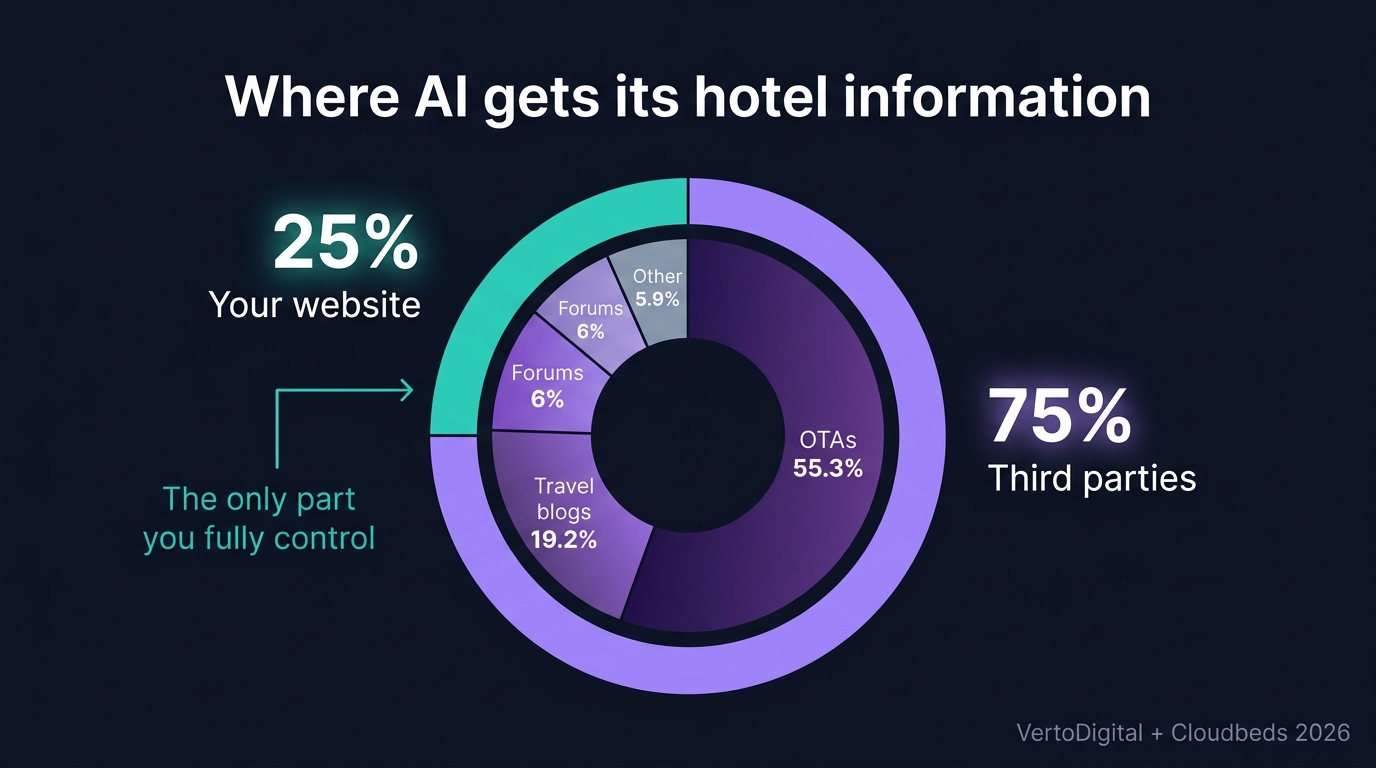
Cloudbeds' study of 145 top-ranked properties measures citation share specifically: 55.3% of all AI citations point to OTAs (TripAdvisor, Booking.com, and Expedia lead), while hotel websites account for just 13.6%. Travel blogs contribute 19.2%, and forums 6%.
Your website is the minority voice in AI's understanding of your hotel. The majority voice is controlled by OTA descriptions you set years ago, reviews from guests who stayed last month, and blog posts from travel writers who visited in 2023.
This has a direct implication: review management is GEO strategy. If you want AI to describe your hotel accurately, you need the 75% of third-party sources to agree with the 25% from your own website. That means actively managing your OTA profiles, responding to reviews (review responses are indexed by AI), and ensuring every platform, Google Business Profile, Bing Places, TripAdvisor, Booking.com, tells the same story.
Why AI Gets Your Hotel Wrong
41.1% of hotels that use structured data misclassify themselves, marking their property as a generic "Organisation" or "LocalBusiness" instead of "Hotel" in their Schema.org markup. To AI, these hotels have effectively declared they aren't hotels at all. Another 36.3% have no structured data whatsoever. Only 10.6% have good schema markup, the machine-readable data that tells AI definitively what your property is, where it is, and what it offers.
When structured data is missing or wrong, AI has to infer your hotel's attributes from unstructured text scattered across dozens of sources. And those sources frequently disagree.
As Mirko Lalli wrote in March 2026: when fundamental data, name, address, phone, amenities, policies, doesn't match across your website, Google Business Profile, OTA listings, and social profiles, "you're sending noise to a system that needs signal. Inconsistency reads as unreliability, and the penalty is quiet exclusion."
The consequences are real. 90% of AI-generated travel itineraries contain mistakes, according to Professor Anne Hardy of Southern Cross University. An AI-generated blog recommended "Weldborough Hot Springs" in Tasmania that don't exist, tourists arrived in droves, and the owner of the local hotel received "probably five phone calls a day." Hotels face the same risk: fabricated amenities, wrong star ratings, outdated pricing, and closed restaurants listed as open.
How to Optimise for ChatGPT, Gemini, Perplexity, and Grok
Each AI platform has a dominant data source. Knowing which source feeds which platform turns a generic "improve your online presence" strategy into targeted action.
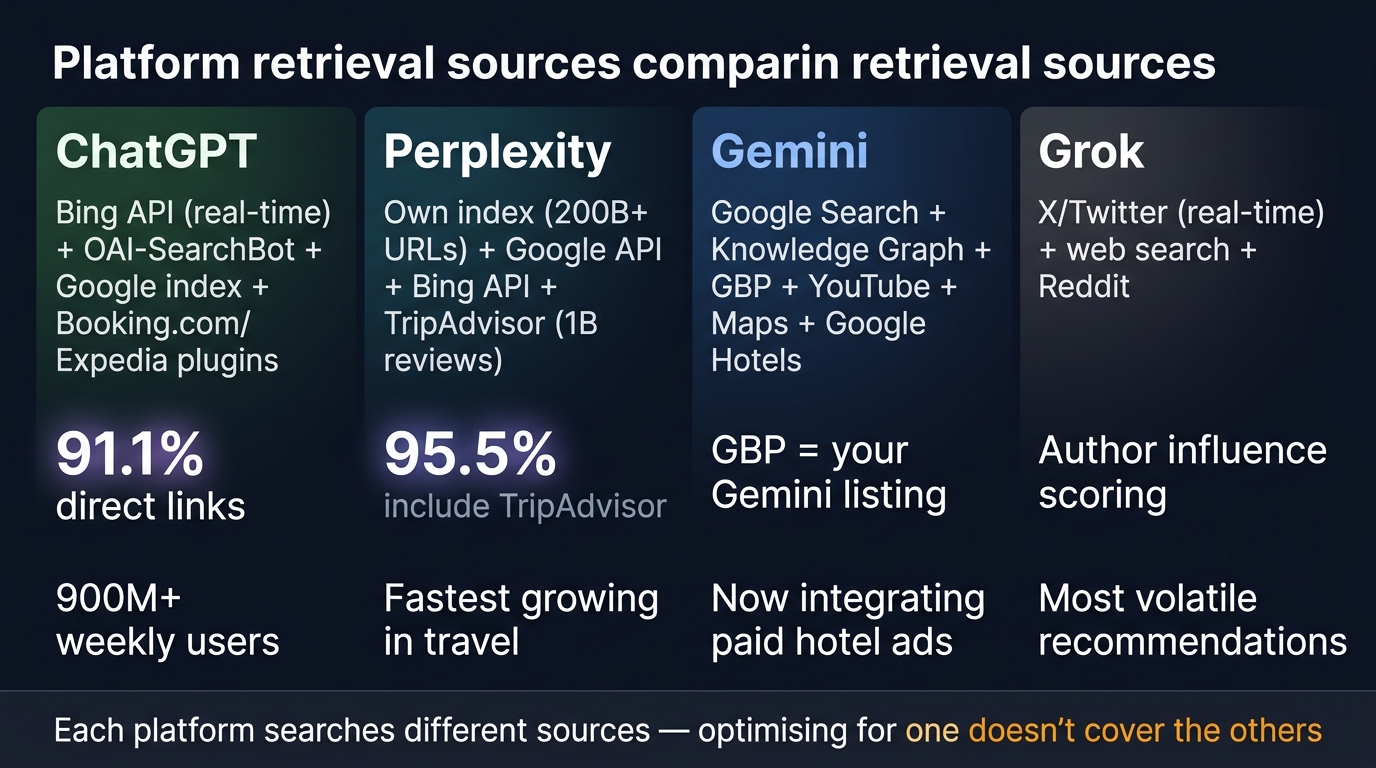
| Platform | Primary Data Source | What to Prioritise |
|---|---|---|
| ChatGPT | Bing + OAI-SearchBot + Booking.com/Expedia plugins | Bing Places listing, OTA profile accuracy, website crawlability |
| Perplexity | Own index + Google + Bing + TripAdvisor (1B reviews) | TripAdvisor review volume and recency, website content depth |
| Gemini | Google Search + Knowledge Graph + GBP + YouTube + Maps | Google Business Profile completeness, YouTube presence, Google Hotels |
| Grok | X/Twitter + web search + Reddit | Social media activity, influencer mentions, Reddit/forum presence |
ChatGPT is the largest platform with over 900 million weekly users. It sends 91% of hotel links direct. Your highest-leverage action is claiming your Bing Places listing, 15 minutes if you own the listing, longer if you have to track down ownership inside a chain. Either way it puts you in front of ChatGPT's retrieval pipeline.
Perplexity is growing fastest in travel, with TripAdvisor content in 95.5% of results. If your TripAdvisor profile is thin, outdated, or has unanswered reviews, Perplexity's recommendation of your hotel will reflect that.
Gemini draws from the deepest Google stack. Your Google Business Profile is effectively your Gemini listing. Complete every field: photos, amenity list, hours, description, and respond to recent reviews. If you have video content, put it on YouTube, Google's AI draws from YouTube directly.
Grok is the wildcard. It weights real-time social signals that other platforms ignore. A travel influencer's X post about your hotel can surface in Grok's recommendations within hours. This makes Grok the most responsive platform, and the most volatile.
Why AI Hotel Recommendations Compound Over Time
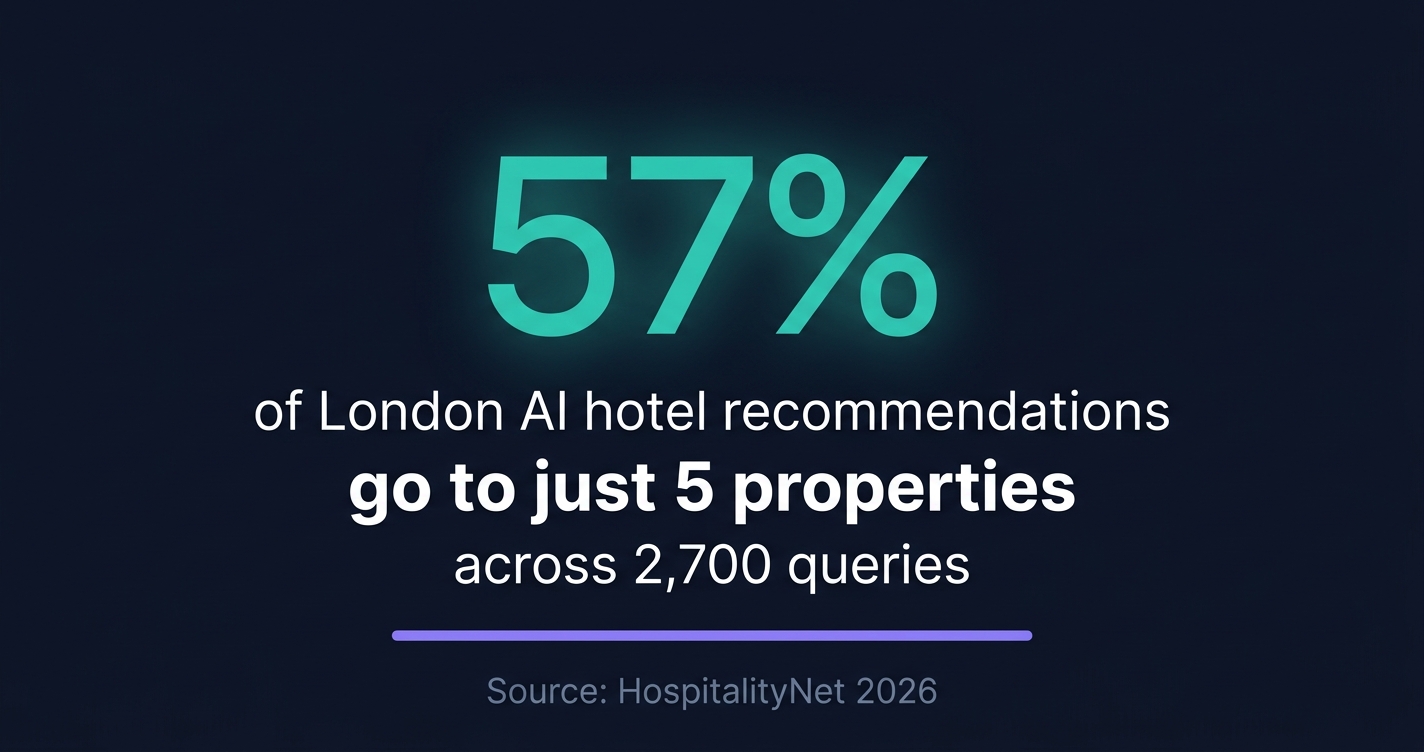
Five London luxury hotels capture 57% of all AI recommendations across 2,700 queries. Not 57% of bookings, 57% of all recommendations. AI hotel recommendations concentrate because they compound: the hotels that are visible today become more visible tomorrow, while invisible hotels fall further behind.
Here's how the flywheel works: AI recommends your hotel → travellers visit your website and book → new guests leave reviews → those reviews feed back into AI's retrieval layer → AI recommends you more confidently → more bookings → more reviews. Each cycle reinforces the next. The rich get richer.
AI traffic to hospitality websites grew 1,700% between July 2023 and February 2025, according to Loamly's analysis of Similarweb data. Revenue per visit from AI-referred traffic is 80% higher than non-AI traffic. And 83% of travellers now use or want to use AI for trip planning.
The window for early movers is closing. Major chains are investing heavily. Lighthouse launched a direct ChatGPT booking integration in March 2026. Google is integrating hotel ads into Gemini's AI-generated itineraries. The cost of catching up increases with every quarter you wait.
But here's the independent hotel advantage: 53% of AI link recommendations go to independents, versus 35-37% for chains. AI values specificity and authenticity, exactly what independents naturally offer. The flywheel rewards the distinctive, not the templated. An independent hotel with clean data, strong reviews, and consistent entity information across platforms can outperform a chain property that has none of these.
How to Improve Your AI Hotel Recommendations
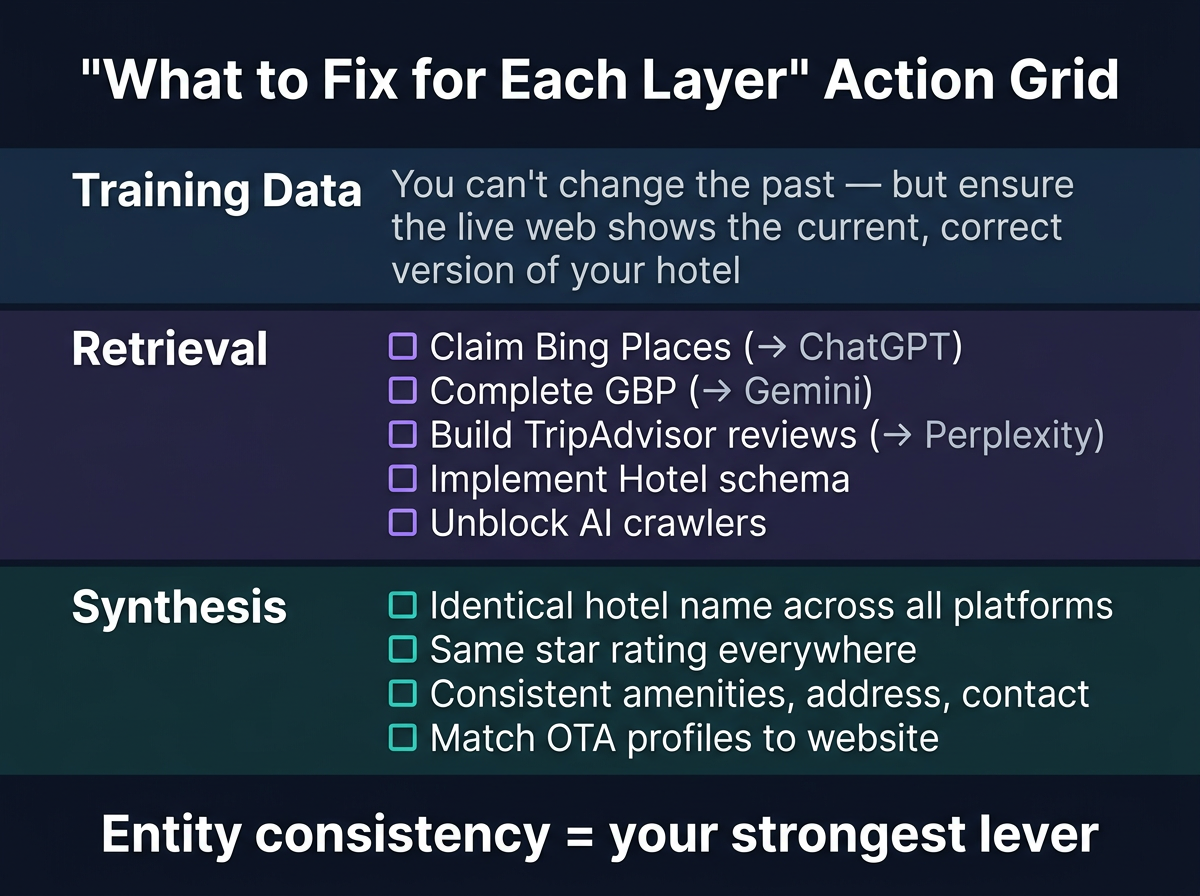
Understanding the three-layer mechanism points directly to what needs fixing:
Fix your training data gap. You can't change what's already baked into AI models. But you can ensure the live web presents the correct, current version of your hotel, so that when retrieval overrides stale training data, it overrides with accurate information. Hotels that combine traditional SEO with AI optimisation cover both retrieval pipelines.
Make your hotel findable across every retrieval source. Claim Bing Places (feeds ChatGPT). Complete your Google Business Profile (feeds Gemini). Build your TripAdvisor review volume (feeds Perplexity). Post on X (feeds Grok). Implement Hotel schema markup so AI can parse your property data, not just read your marketing copy. Ensure your robots.txt allows AI crawlers, only 3.3% of hotels block them, but if you're one of them, nothing else on this list matters.
Make entity consistency your obsession. Your hotel name, star rating, room categories, amenities, address, and contact details should be identical across your website, every OTA listing, Google Business Profile, Bing Places, and TripAdvisor. Every inconsistency gives AI a reason to choose the wrong version, or to skip you entirely.
The hotels that understand these three layers and optimise for each will dominate AI hotel recommendations. The ones that treat AI visibility as another marketing buzzword will wonder why their competitors keep appearing in answers while they remain invisible.
See What AI Actually Recommends
Mystery Shop tests what four major AI platforms actually say about your hotel, and flags every inconsistency, missing data point, and visibility gap across all three layers. It checks your structured data, your AI crawler access, your entity consistency, and the actual recommendations AI makes about your property.
It takes two minutes. It's free. And it shows you exactly where you stand in the AI recommendation pipeline.
Frequently Asked Questions
Does AI recommend independent hotels over chains?
Yes, and the data is striking. HotelRank.ai's 2026 analysis of 19,579 AI runs found that 53% of AI link recommendations go to independent hotels, compared to 35-37% for chains. AI systems value specificity and authenticity over brand scale. An independent hotel with detailed, original content about its property and destination, clean schema markup, and consistent entity data across all platforms will outperform a chain property relying on templated marketing copy. That said, Cloudbeds found that 72.4% of AI-mentioned properties are brand-affiliated, meaning chains get named more often, but independents get linked to more often. The distinction matters: mentions build awareness, links drive direct bookings.
How often does AI update what it knows about hotels?
AI knowledge has two speeds. Training data updates every few months when a model is retrained, so information baked into the model's weights can be months old. But the real-time retrieval layer searches the live web every time someone asks a question. This means your Google Business Profile update, your new TripAdvisor review, or your corrected Bing Places listing can influence AI recommendations within hours of being indexed. The practical takeaway: keep your live web presence current and consistent. Changes to your website and third-party profiles propagate to AI recommendations much faster than most hoteliers expect, but only if AI crawlers can access your site and the information is structured in a format AI can parse.
Can I control what AI says about my hotel?
Not directly, no hotel can edit AI's outputs. But you can heavily influence them by controlling the inputs. AI assembles recommendations from three layers: training data (historical), real-time retrieval (current web), and synthesis (combining sources). You control two of those three. For retrieval, ensure your website, Google Business Profile, Bing Places, OTA listings, and review platforms all present accurate, consistent information. Implement Schema.org Hotel markup so AI can parse your data without guessing. For synthesis, make your hotel the most consistent entity across all sources, when five platforms agree on your star rating, room types, and amenities, AI has no reason to improvise. The 25% of AI's understanding that comes from your own website is the part you fully control. The 75% from third parties requires active management across every platform where your hotel appears.
Why does the same AI give different hotel recommendations each time?
AI recommendations are probabilistic, not deterministic. Research by Rand Fishkin found that fewer than 1 in 100 AI runs produce the same hotel list, and fewer than 1 in 1,000 produce the same order. This happens because of Query Fan-Out: AI decomposes each question into 8-15 sub-queries, and only 27% of those sub-queries remain stable between searches. The rest change every time, different sub-queries retrieve different pages, which produce different recommendations. This means AI hotel visibility isn't about holding a fixed position (like Google rank #1). It's about being present across enough sources, with enough topical depth, that your hotel gets retrieved regardless of which sub-queries AI happens to fire. Broad, consistent, and deep beats narrow and optimised for a single keyword.