What Schema Markup Do Hotel Websites Need? The 5 Types That Matter
The five hotel schema markup types that matter most are Hotel, Offer, FAQPage, AggregateRating, and HotelRoom. Most hotel websites have none of them.
In March 2026, we audited the structured data on eight luxury hotel websites across London and Paris, properties with ADRs between GBP 300 and GBP 800, ranging from boutique independents to well-known brand flagships. Only three had any Hotel schema at all. None had FAQ markup. None had review data. None had room-level detail.
These are properties spending six figures on digital marketing. But when a traveller asks ChatGPT for “the best boutique hotel in London with a rooftop bar,” the AI has nothing structured to work with. It skips them entirely and recommends whoever gave it clean data.
Hotel schema markup is structured data added to your website that tells search engines and AI systems exactly what your property offers in a machine-readable format: your rooms, rates, amenities, reviews, and policies. Schema markup used to be a Google SEO tactic. Today it also shapes which hotels AI travel assistants recommend.
Why Hotel Schema Markup Matters More Now Than Two Years Ago
Schema markup’s primary value for hotels has shifted from Google rich results to AI platform visibility. Three shifts happened at once:
AI assistants now research hotels. 83% of travellers use or want to use AI for trip planning (TravelBoom 2026 Leisure Travel Study). ChatGPT alone has 800 million weekly active users (Customer Alliance). When they ask “best hotel near the Louvre with a pool,” the AI reads structured data to build its answer.
Google’s own rich results for hotels are limited. There is no dedicated “Hotel” rich result in Google Search. Hotels get the generic LocalBusiness treatment. FAQ rich results are restricted to government and health websites since August 2023. Self-hosted review markup won’t display star ratings. The traditional SEO case for hotel schema has actually weakened.
But AI citation has exploded. Pages with FAQ schema are 3.2 times more likely to appear in Google’s AI Overviews (Frase.io). And 75-91% of hotel links from AI assistants go directly to hotel websites, not OTAs (HotelRank.ai 2026 Index).
If your hotel’s structured data is missing or broken, you are invisible to the fastest-growing travel research channel. The five schema types below are what fix that.
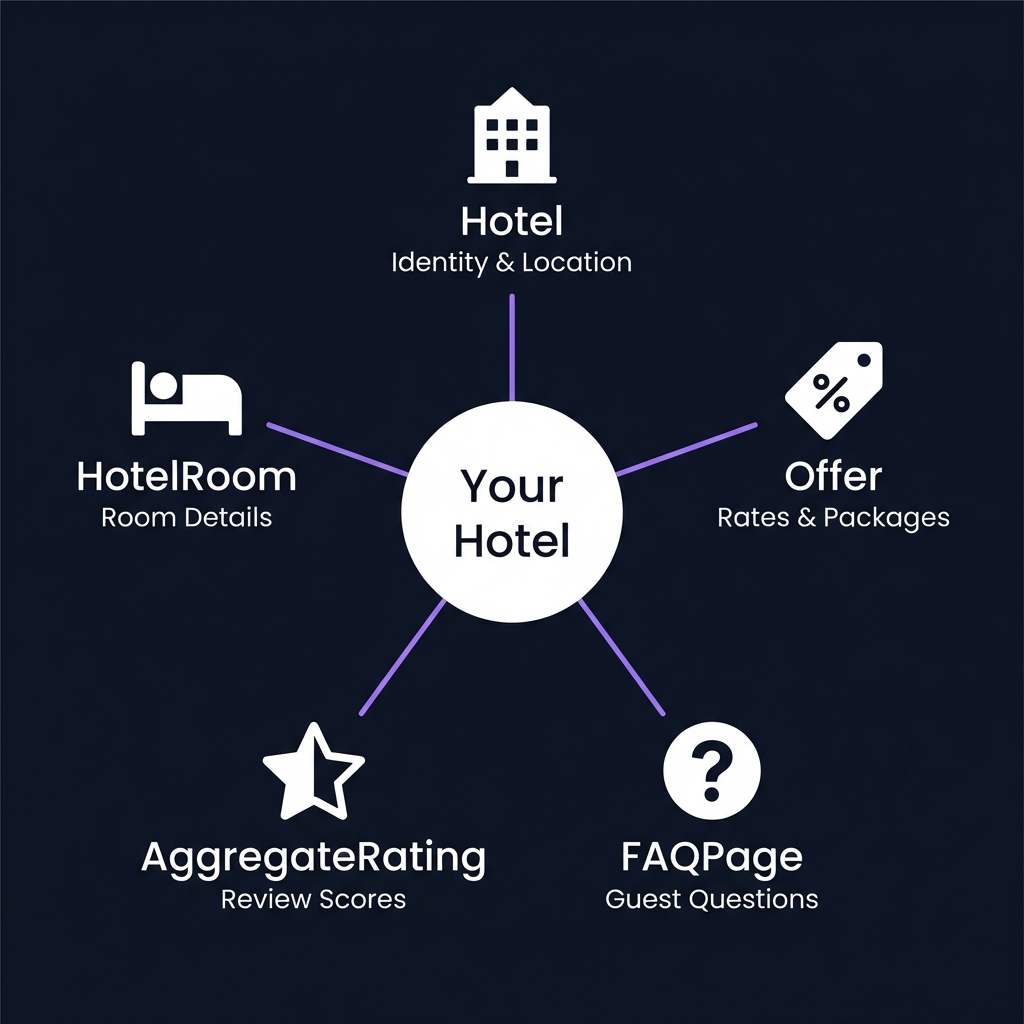
The 5 Hotel Schema Markup Types Your Property Needs
1. Hotel (Your Digital Identity)
The schema.org Hotel type is the foundation. It is a machine-readable description of what your property is, where it is, and how to contact it. Without Hotel schema, AI systems cannot reliably place your property in location-based queries.
What it tells AI: Your property name, exact location (with coordinates), contact details, star rating, check-in/check-out times, and key amenities. This is how ChatGPT knows you’re a “5-star hotel in Mayfair” and not a restaurant with the same name in another city.
{
  "@context": "https://schema.org",
  "@type": "Hotel",
  "name": "The Example Hotel",
  "starRating": { "@type": "Rating", "ratingValue": "5" },
  "address": {
    "@type": "PostalAddress",
    "streetAddress": "12 Example Street",
    "addressLocality": "London",
    "postalCode": "W1K 1AA",
    "addressCountry": "GB"
  },
  "geo": { "@type": "GeoCoordinates", "latitude": 51.5072, "longitude": -0.1276 },
  "telephone": "+44 20 1234 5678",
  "checkinTime": "15:00",
  "checkoutTime": "11:00",
  "priceRange": "GBP 300-800"
}
What most hotels get wrong:
- Missing geo coordinates. Without latitude and longitude, AI cannot place your property on a map or answer location-specific queries.
- Inconsistent naming. If your schema says “The Grand Hotel” but your Google Business Profile says “Grand Hotel London,” AI treats these as potentially different entities.
- Vague amenity descriptions. Listing “pool” instead of specifying “25-metre heated outdoor pool, open April to October” gives AI nothing specific to cite.
Why it matters: Nearly 50% of hotel brands are misclassified by AI systems (Cloudbeds). Clean Hotel schema with accurate coordinates, consistent naming, and specific amenities is the single most important step in correcting how AI understands your property.
2. Offer (Your Rates and Packages)
Offer schema tells AI what you sell and at what price point. But hotel pricing is not like selling a product with a fixed price tag. A room on a Sunday night in November costs a fraction of what it costs on Christmas Eve. Schema.org’s Offer type was designed for products with stable prices, so hotels need to use it differently.
What it tells AI: Your price range, named packages with fixed pricing, and promotional offers with validity dates. This is how AI answers “hotels in Nice under EUR 200 per night”. It needs some pricing signal to place your property in the right band.
{
  "@context": "https://schema.org",
  "@type": "Offer",
  "name": "Summer Escape Package",
  "price": "220",
  "priceCurrency": "EUR",
  "validFrom": "2026-06-01",
  "validThrough": "2026-09-30",
  "availability": "https://schema.org/InStock",
  "url": "https://www.example.com/offers/summer-escape"
}
How hotel pricing works in schema: There are three practical approaches, and choosing the right one matters:
- Price range on the Hotel type. The simplest and safest approach. Schema.org supports
priceRangedirectly on your Hotel entity (e.g., “EUR 180-450”). This tells AI “we’re in this band” without making a specific nightly rate claim that will be stale tomorrow. For most independent hotels, this is the right starting point. - Named offers with fixed dates. For specific promotions (“Summer Escape, EUR 220/night, valid June to September”), the Offer type works well because the price genuinely is fixed for that package. The
validFromandvalidThroughfields make it time-bound and verifiable. - “From” pricing. A base rate like “rooms from EUR 180/night” is acceptable and widely used. But it only works if you keep it updated and it genuinely reflects your lowest available rate. If your “from” rate was set six months ago and your cheapest room is now EUR 250, you have a broken promise in your structured data.
What you should NOT do is try to replicate your dynamic, yield-managed room pricing in schema markup. Real-time pricing is the job of your booking engine and distribution partners (Google Hotel Center, OTA feeds). Schema is for giving AI a reliable pricing signal, not a live rate.
What most hotels get wrong:
- Stale pricing. A “from EUR 199/night” claim set once and never updated. Google’s Price Accuracy Policy requires schema prices to match what’s visible on the page. AI systems that cross-reference your claims against booking platforms will flag the inconsistency.
- Missing currency codes. Is “199” dollars, euros, or pounds?
- No validity dates on promotions. A summer package still marked up in January with no
validThroughdate is a broken promise to both guests and AI. - Ambiguous pricing units. Not specifying per-night vs per-stay.
Why it matters: Price accuracy is a trust signal. When AI systems cite your rates, they stake their own credibility on that information being correct. Using price ranges and date-bound offers, rather than specific nightly rates that change daily, gives AI something reliable to work with. Properties that get this right earn a reliability signal that influences future recommendations.
3. FAQPage (The Questions Travellers Ask)
Hotel FAQ schema is the single highest-impact structured data type for AI visibility. It’s also the one almost no hotel implements.
What it tells AI: Direct, quotable answers to the questions travellers actually ask. Can I bring my dog? Is parking free? What’s the cancellation policy? What time is check-in? Is the pool open year-round?
{
  "@context": "https://schema.org",
  "@type": "FAQPage",
  "mainEntity": [
    {
      "@type": "Question",
      "name": "Does the hotel allow dogs?",
      "acceptedAnswer": {
        "@type": "Answer",
        "text": "Yes. We welcome dogs up to 15 kg for a EUR 30 per night charge."
      }
    }
  ]
}
Google restricted FAQ rich results in search to government and health websites in August 2023, so many SEO advisors stopped recommending it. This was a mistake. While FAQ schema no longer generates a Google rich snippet for hotels, it is 3.2 times more likely to appear in AI Overviews (Frase.io). The question-and-answer format is exactly how AI systems structure their responses: pre-formatted, self-contained, and citable without interpretation.
What most hotels get wrong: Most simply don’t have it. Of the eight luxury hotels we audited in March 2026, zero had FAQ schema. The ones that have FAQ pages on their websites haven’t marked them up with structured data, so the content exists for humans but is invisible to AI’s structured data parsers.
Why it matters: When a traveller asks ChatGPT “does The Grand Hotel allow pets?”, the AI needs a clean, extractable answer. If your FAQ page says “Yes, we welcome dogs up to 15kg for a EUR 30 per night supplement” AND that’s marked up as FAQ schema, the AI can quote it directly and link to your website. Without the markup, it has to guess from your page text, and may guess wrong, or not find it at all.
4. AggregateRating (Your Reputation Signal)
Hotels without AggregateRating schema are missing from AI’s “best of” comparisons. Review data in your structured markup directly influences which hotels AI recommends.
What it tells AI: Your average rating, the number of reviews, and the rating scale. When ChatGPT compiles a “top 5 hotels in Barcelona” list, it synthesises rating data from structured sources. Properties with clear, consistent AggregateRating data are easier to rank and recommend.
{
  "@context": "https://schema.org",
  "@type": "Hotel",
  "name": "The Example Hotel",
  "aggregateRating": {
    "@type": "AggregateRating",
    "ratingValue": "4.6",
    "bestRating": "5",
    "ratingCount": "847"
  }
}
The Google paradox: Google will not display star ratings for hotels that mark up their own guest reviews. It considers this “self-serving.” This means your schema review stars will never show in Google search results. But AI systems have no such restriction. They read and use AggregateRating data regardless of where it’s hosted. So the schema has no Google value but significant AI value, the exact opposite of what most SEO guides tell you.
What most hotels get wrong:
- Rating scale mismatches. Marking up a 9.0/10 rating without specifying the scale, so AI interprets it as 9.0/5 (impossibly high) or 9.0/100 (mediocre).
- Mismatched counts. Schema says 847 reviews but the page shows 1,200, so AI cannot trust the data.
- Not implementing it at all because “Google won’t show it.”
Why it matters: AI travel recommendations are heavily influenced by review signals. Having accurate, well-structured rating data in your schema, even if Google ignores it, gives AI systems a reliable trust signal when constructing hotel recommendations.
5. HotelRoom (Your Product Detail)
Room-level schema tells AI what you actually sell. Without it, AI can describe your hotel but cannot answer specific questions about your rooms, and cannot match your property to queries like “hotels in London with a king bed suite for a family of four.”
What it tells AI: Room type names, bed configurations, occupancy limits, floor sizes, and room-specific amenities.
{
  "@context": "https://schema.org",
  "@type": ["HotelRoom", "Product"],
  "name": "Deluxe King Suite",
  "occupancy": { "@type": "QuantitativeValue", "maxValue": 3 },
  "bed": { "@type": "BedDetails", "typeOfBed": "King", "numberOfBeds": 1 },
  "floorSize": { "@type": "QuantitativeValue", "value": 52, "unitCode": "MTK" },
  "offers": { "@type": "Offer", "price": "450", "priceCurrency": "EUR" }
}
What most hotels get wrong:
- Treating rooms as standalone products. In schema.org, a hotel room needs to be declared as both a HotelRoom (a physical space) and a Product (something you sell) simultaneously. Most implementations miss the Product side, which means pricing and availability data cannot be attached properly.
- Plain text amenities. Listing “minibar, wifi, air con” instead of structured amenity objects that AI can parse and compare.
- Missing occupancy limits. Prevents AI from answering family-size queries.
- No bed configuration details. Prevents AI from answering bed-type queries.
Why it matters: The more specific your room data, the more specific queries AI can match you to. A hotel with “Deluxe King Suite, 52 sqm, king bed, sleeps 3, balcony with sea view” in structured data wins queries that a hotel with just “Deluxe Room” cannot.
Why You Need All Five, Not Just One
These schema types work together. Sites that combine 3-4 schema types on a single page benefit from a compounding effect. AI cross-references structured facts within the same page context. A Hotel type with Offer pricing, FAQ answers, AggregateRating scores, and HotelRoom details gives AI a complete, trustworthy entity profile. Each type alone helps; all five together make your property the one AI recommends with confidence.
What Happens When Hotel Structured Data Is Missing
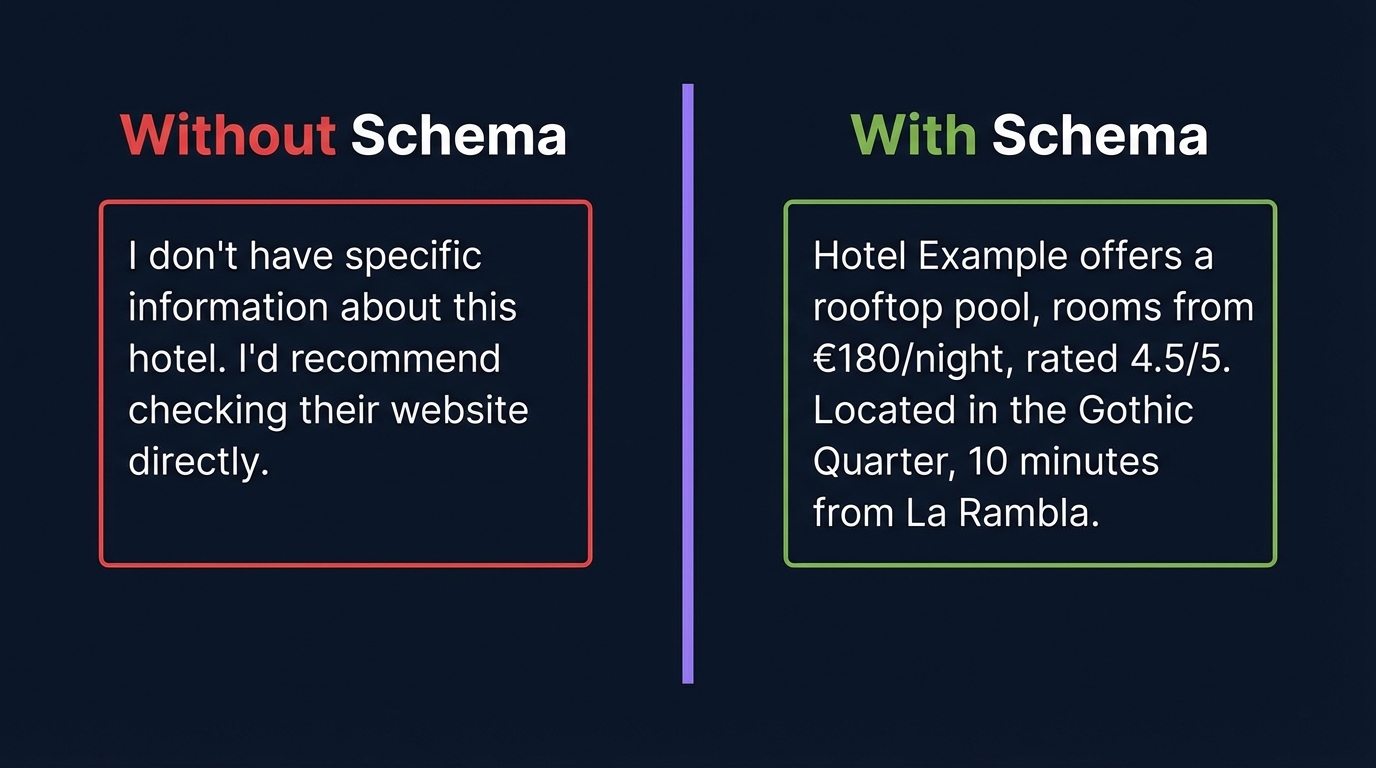
Hotels without structured data get hedged, generic AI responses that generate zero bookings. Here’s the pattern we see:
Without structured data, AI responds: “I don’t have specific information about Hotel Example’s amenities or pricing. I’d recommend checking their website directly.” The traveller moves on.
With structured data, AI responds: “Hotel Example offers a rooftop pool, rooms from EUR 180/night, rated 4.5/5 on Google. Located in the Gothic Quarter, 10 minutes from La Rambla.” The traveller clicks through.
One generates a direct booking lead. The other generates nothing.
And the gap compounds. A property that shows up in AI recommendations earns more bookings and more reviews, and those reviews strengthen the third-party signals AI leans on. Hotels that start early build a lead that gets harder for rivals to close.
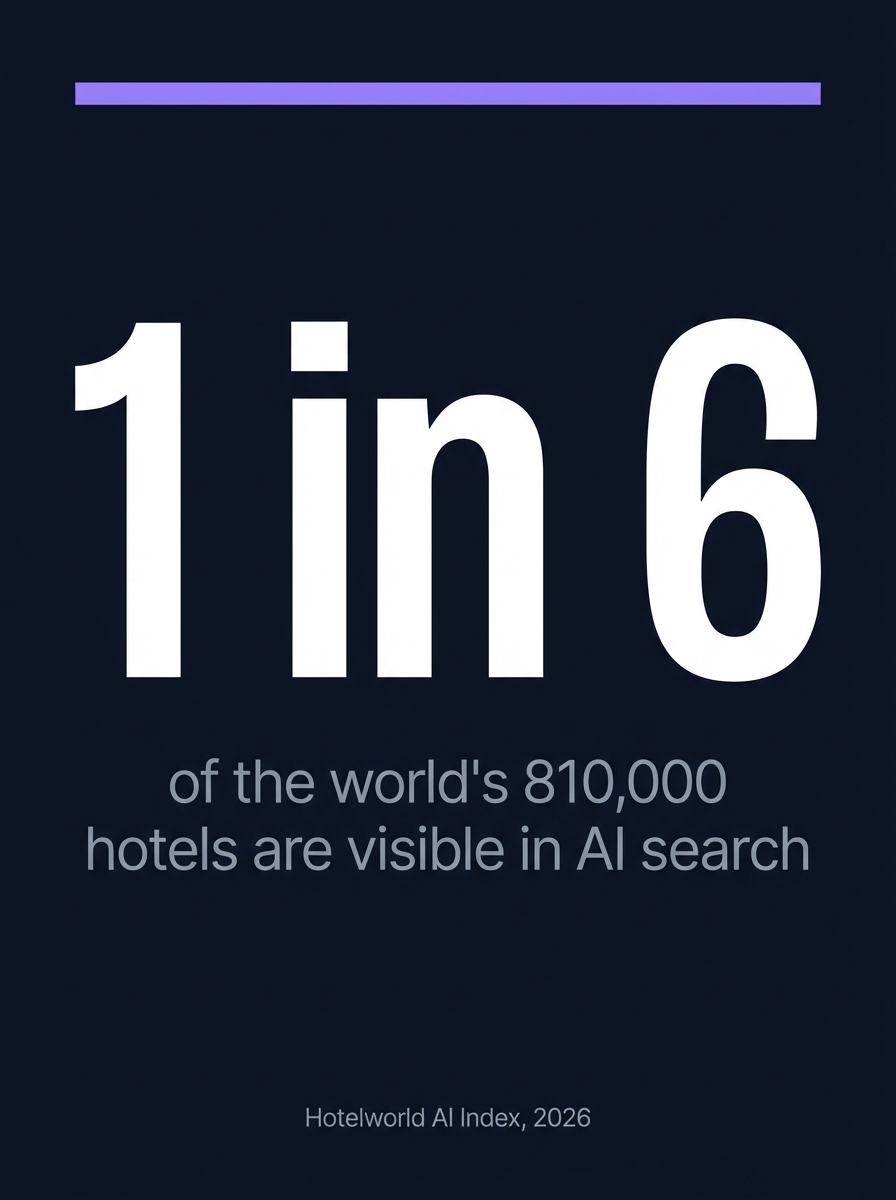
Only 1 in 6 of the world’s 810,000 hotels are currently visible in AI search (Hotelworld AI Index). Most have not started, which makes now the cheap time to get ahead.
How To Add Schema Markup to Your Hotel Website
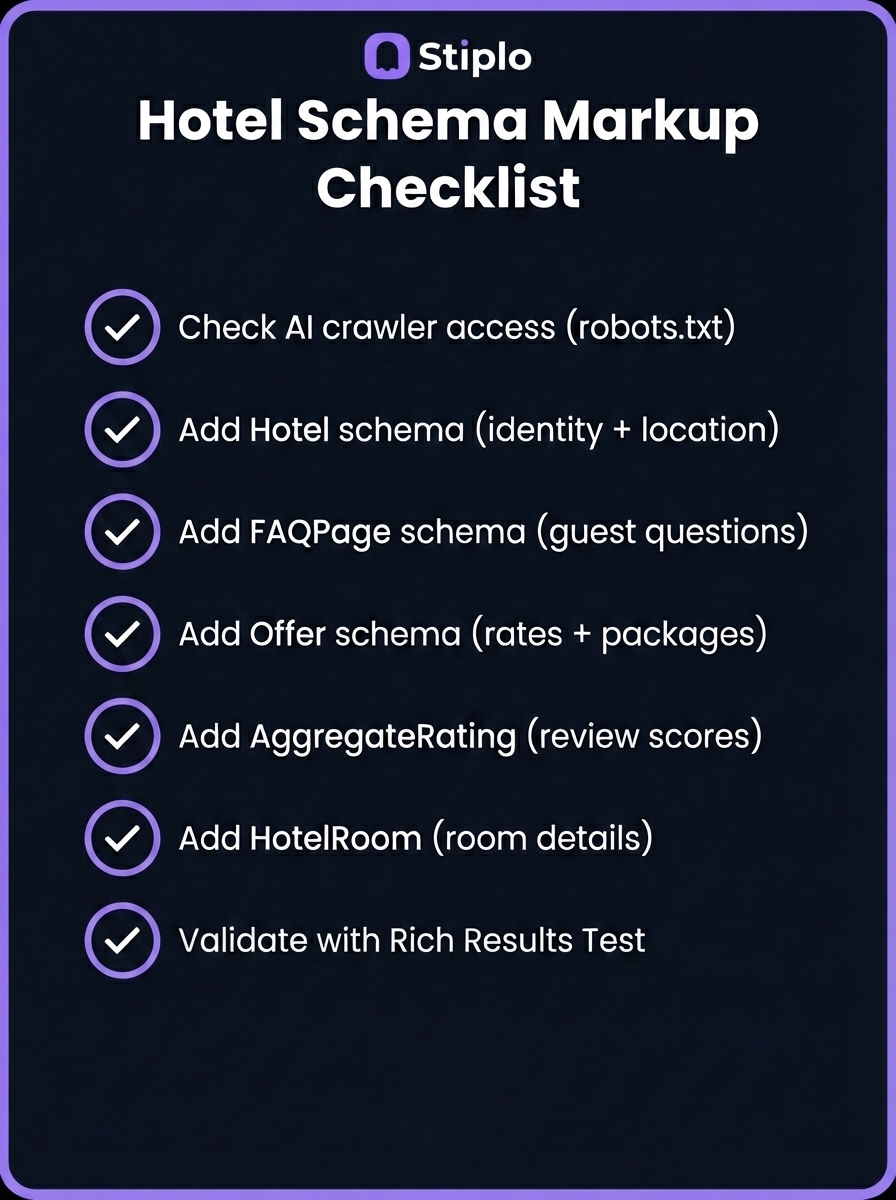
You don’t need to understand JSON-LD to act on this. Here’s what to brief your developer or agency:
-
Check your AI crawler access first. Before any schema work, verify your robots.txt doesn’t block GPTBot, ClaudeBot, PerplexityBot, or OAI-SearchBot. If AI crawlers are blocked, none of the structured data below will matter. AI simply cannot reach your pages. Also claim your Bing Places listing. Bing’s index feeds ChatGPT, Copilot, and Perplexity, and claiming it is free and takes 10 minutes.
-
Audit what you have. Ask your developer to check your homepage source code for hotel JSON-LD markup, look for
application/ld+jsonscript tags. If there’s nothing, you’re starting from zero, which puts you in the same position as most hotels. You can also run a free Mystery Shop to check your structured data across 30 pages automatically. -
Start with Hotel and FAQPage. These two types cover your identity and your most-asked questions. They’re also the fastest to implement. A developer can add both in an afternoon.
-
Add Offer schema for your main rate. Even a single “rooms from EUR X/night” offer gives AI something to work with for price-based queries. Make sure it matches your actual booking page price.
-
Implement AggregateRating. Even though Google won’t display it, AI systems will use it. Pull your rating from TripAdvisor or Google Reviews and mark it up consistently.
-
Add HotelRoom for your top 3 room types. Cover your most-booked categories with bed type, size, occupancy, and amenities. AI needs specifics, not marketing copy.
-
Validate and monitor. Schema breaks silently. A site redesign, a CMS update, or a booking engine change can wipe your structured data without anyone noticing. Test with Google’s Rich Results Test after every change, or use a tool like Mystery Shop to monitor your structured data automatically.
Why Hotel Structured Data Is a Competitive Moat
Schema markup is ongoing website maintenance, not a one-time SEO task. It is the structured-data layer of your site, and it decides how accurately AI assistants can read and recommend your property.
It’s also worth noting: your on-site structured data is only part of the picture. AI pulls roughly 30% of what it knows about a hotel from the hotel’s own website and 70% from third-party sources: reviews, OTA profiles, editorial mentions, and community discussions. Schema markup is the 30% you fully control. Getting it right ensures that when AI cross-references your claims against third-party data, everything matches.
The hotels that implement accurate hotel schema markup now will compound their AI visibility advantage over the next 2-3 years. The hotels that wait will spend that time wondering why ChatGPT keeps recommending their competitor down the street.
The good news: most of your competitors haven’t done this yet. Our audit data is clear. Even luxury brands with sophisticated marketing teams have gaps in their structured data. The opportunity is there. The question is whether you’ll take it before they do.
Mystery Shop audits hotel structured data across all five schema types on up to 30 pages, identifying missing markup, broken schema, and stale pricing claims. Run a free scan and see where your property stands.
Frequently Asked Questions
What schema markup does a hotel website need? The five essential schema types for hotel websites are Hotel (property identity and location), Offer (rates and packages), FAQPage (guest questions and answers), AggregateRating (review scores), and HotelRoom (room types with bed, size, and amenity details).
Does FAQ schema still work for hotels after Google's August 2023 change? Google restricted FAQ rich snippets to government and health websites, so hotels no longer get FAQ rich results in Google Search. However, pages with FAQ schema are 3.2 times more likely to appear in Google's AI Overviews, making it the single highest-impact schema type for hotel AI visibility.
Should hotels use AggregateRating schema if Google won't show star ratings? Yes. Google considers hotel self-hosted reviews "self-serving" and won't display star ratings. But AI systems like ChatGPT, Gemini, and Perplexity read and use AggregateRating data regardless. The schema has limited Google value but significant AI visibility value.
How does schema markup affect AI hotel recommendations? AI travel assistants read structured data to build hotel recommendations. Hotels with detailed schema markup give AI specific, verifiable facts to cite: room types, pricing, ratings, and amenities. Hotels without structured data get generic, hedged responses or are excluded from recommendations entirely.
What happens if a hotel has no structured data? Without structured data, AI assistants respond with hedged, generic answers like "I'd recommend checking their website directly." With structured data, AI can give specific recommendations with pricing, ratings, and amenities, generating direct booking leads instead of nothing.
Want to see how your hotel website performs?
A Snapshot checks 30 pages for commercial integrity issues in minutes.
Get a free Snapshot