Of the world's 810,000 hotels, only one in six is visible to AI travel assistants. The rest don't exist, not to ChatGPT, not to Gemini, not to Perplexity.
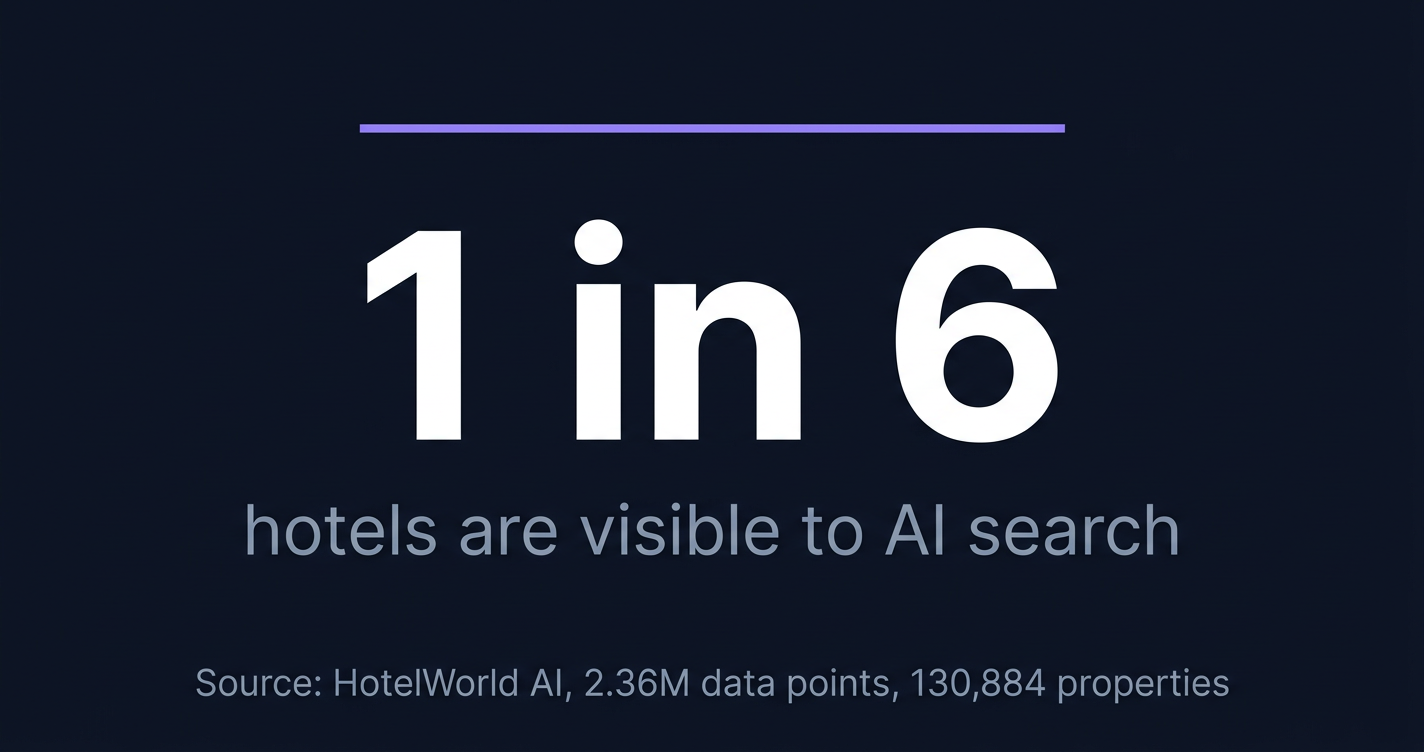
That finding comes from HotelWorld AI's "World's Best at AI" Index, the most comprehensive analysis of hotel AI visibility ever conducted: 2.36 million data points across 130,884 properties in 30 countries. Five out of six hotels simply don't surface when travellers ask AI where to stay. Those that do convert at 11.4%, more than double organic search.
Meanwhile, 83% of travellers now use or want to use AI tools to plan their trips. ChatGPT alone has over 900 million weekly users as of March 2026. And 86% of travellers have already used AI to find or book accommodation. Hotel AI visibility is now a booking channel, and five out of six properties are missing from it.
The question for every hotel commercial director is no longer "should we think about AI?" It's "does AI think about us?"
Hotel AI Search in 2026: The Numbers That Matter
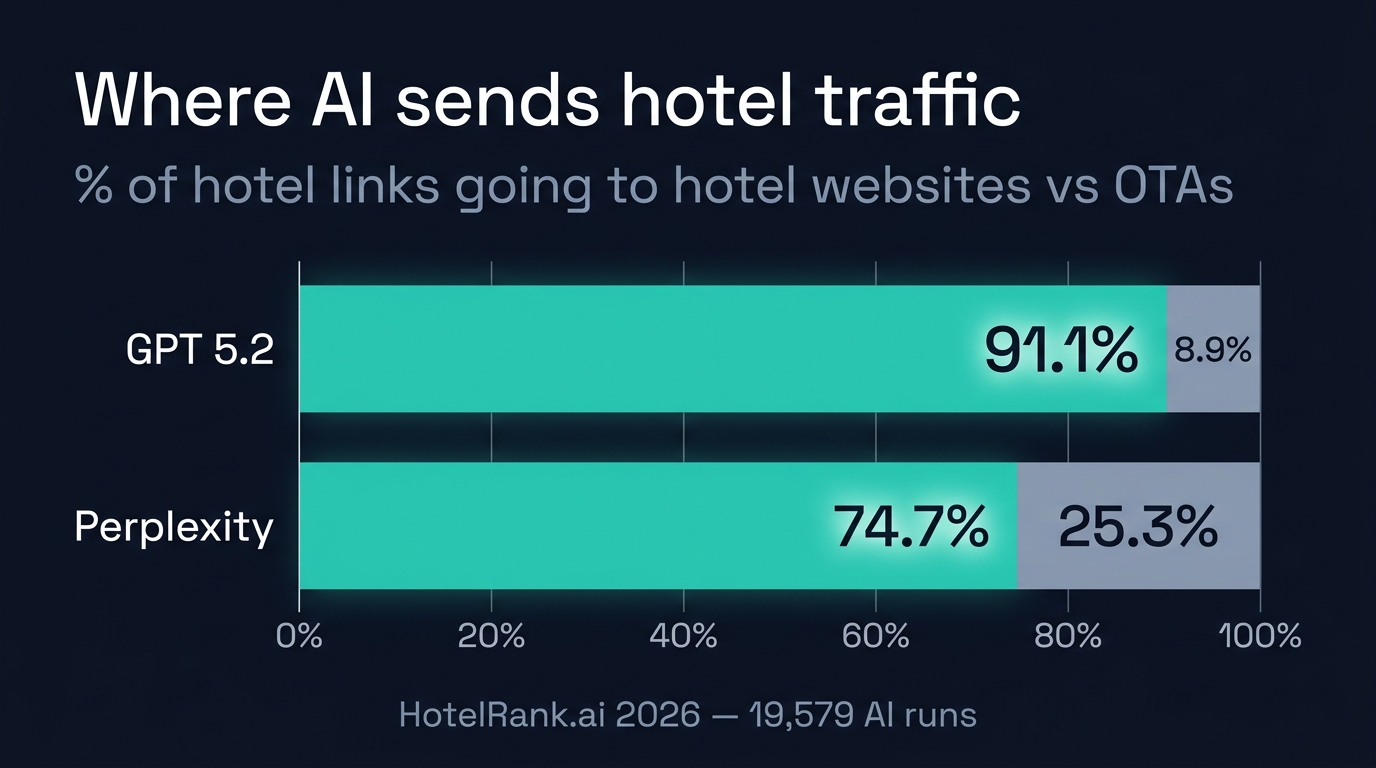
AI-referred hotel visitors convert at 11.4%, more than double the 5.3% rate from organic Google search. And 75-91% of hotel links from AI assistants go directly to hotel websites, not to OTAs. Hotel AI search is not a niche channel. It is becoming the default way travellers research where to stay.
GPT 5.2 sends 91.1% of its hotel links direct. Even Perplexity, the most OTA-friendly platform, sends 74.7% direct. AI is the first major travel channel that actively favours your own website over the intermediaries, a direct booking advantage no other channel offers.
And it favours independents. 53% of AI hotel recommendations go to independent hotels, versus 35-37% for chains. If you run an independent property, AI is the most level playing field you've had in a decade.
The 810,000 hotels fighting for visibility on Google and paying 15-25% OTA commissions now have a channel that sends traffic direct, converts at double the rate, and doesn't charge a commission. But only if AI knows you exist.
Why Most Hotels Are Invisible (It's Not What You Think)
Most hotels are invisible to AI not because they block AI crawlers (only 3.3% do) but because their websites lack the structured data AI needs to understand them. A 2026 study of 105,002 hotel websites across seven countries found that 96.7% are fully accessible to ChatGPT, Claude, Gemini, and Perplexity. The door is wide open. The problem is what's behind it.
The Real Problem: Structured Data
Only 10.6% of hotels have good schema markup: the Schema.org structured data that tells AI what your property is, where it is, and what it offers. 36.3% have no structured data whatsoever: no Hotel type, no location coordinates, no star rating, no amenities in a format AI can parse. Another 41.1% of those that do use JSON-LD use the wrong schema type entirely, marking themselves as a generic "Organisation" or "LocalBusiness" instead of a "Hotel."
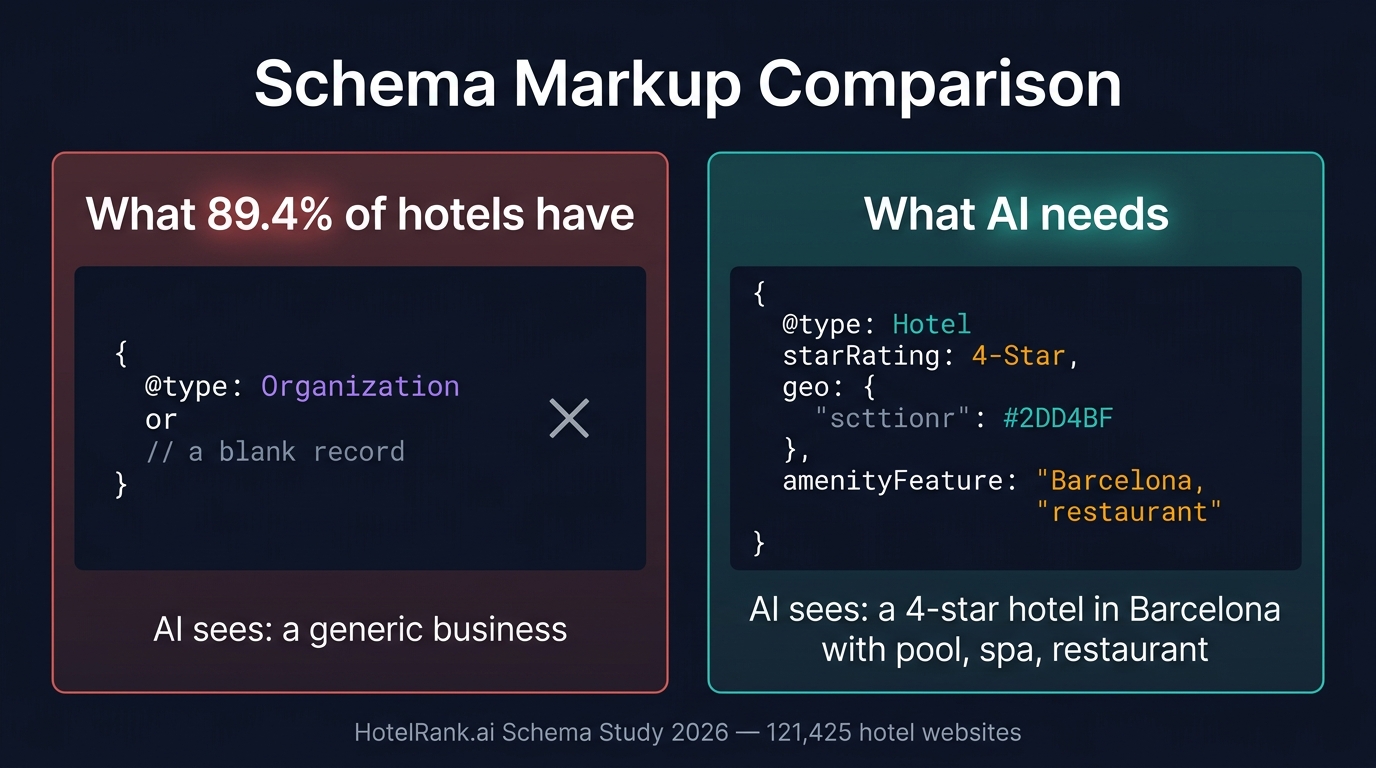
AI can visit your website. It just can't understand it. Think of it like this: your hotel has left the front door unlocked, but there's no signage in the lobby, the room numbers are missing, and the front desk is unstaffed. A guest might wander in, but they won't book.
The Entity Consistency Problem
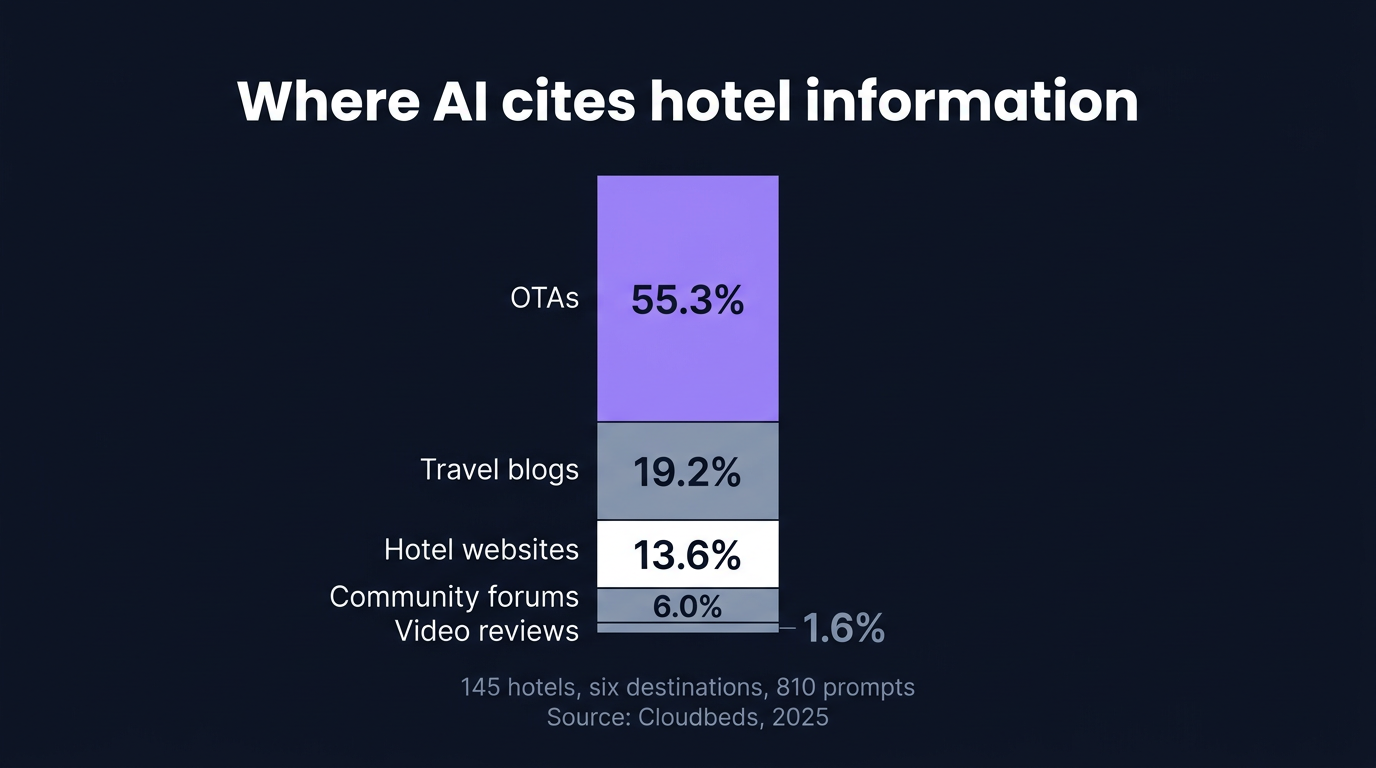
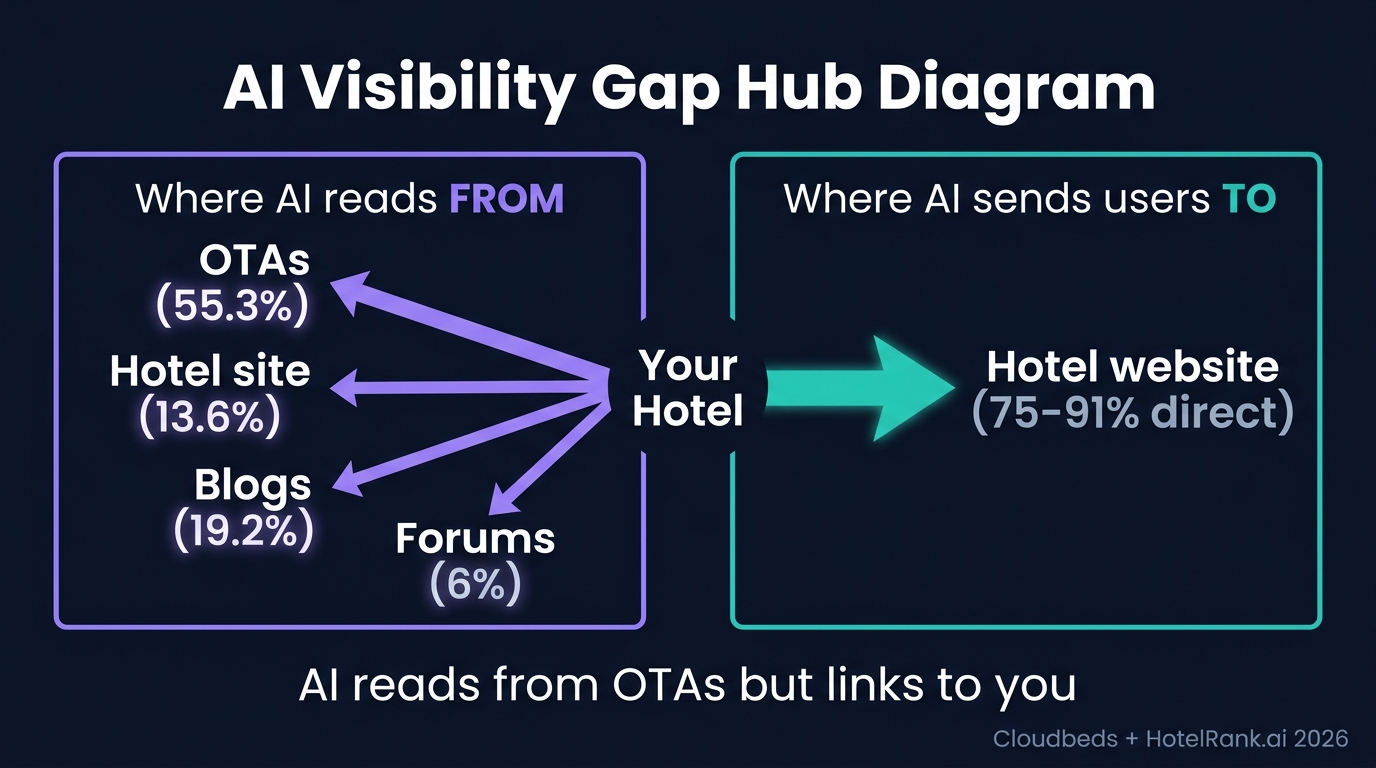
AI doesn't just read your website, it reads everything about you. Industry analysis suggests roughly 30% of what AI knows comes from your own site, while 70% comes from OTAs, review platforms, directories, and Google Business Profile. If your star rating on Booking.com says 4-star, your website says "luxury boutique," and your Google Business Profile says 3-star, AI averages the confusion. Nearly every hotel has some version of this entity inconsistency problem. Most don't know it.
The 5-Minute Self-Check
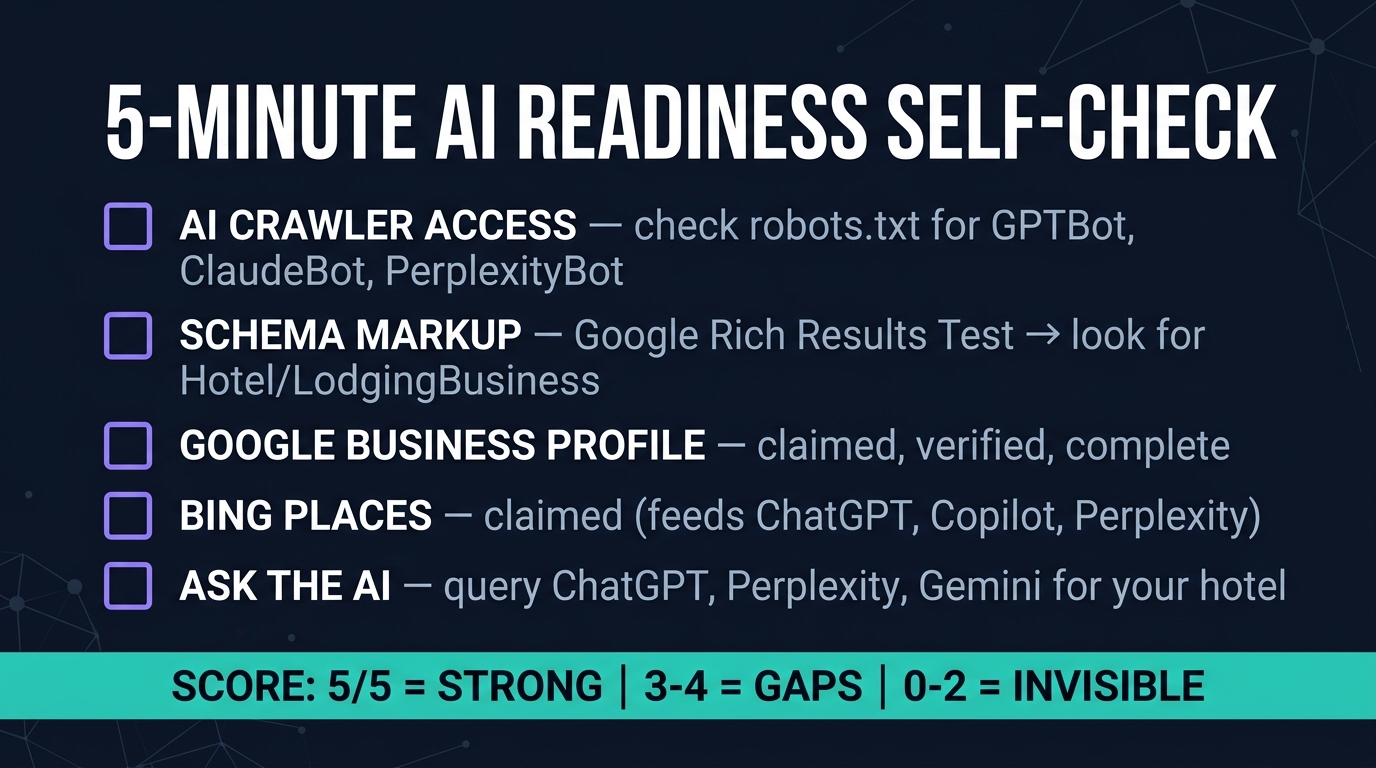
You can check if AI recommends your hotel right now. It takes five steps and five minutes. Here's how to assess your hotel AI visibility without any technical knowledge.
Check 1: AI Crawler Access
Visit yourhotel.com/robots.txt in your browser. This file tells search engines and AI systems what they're allowed to read.
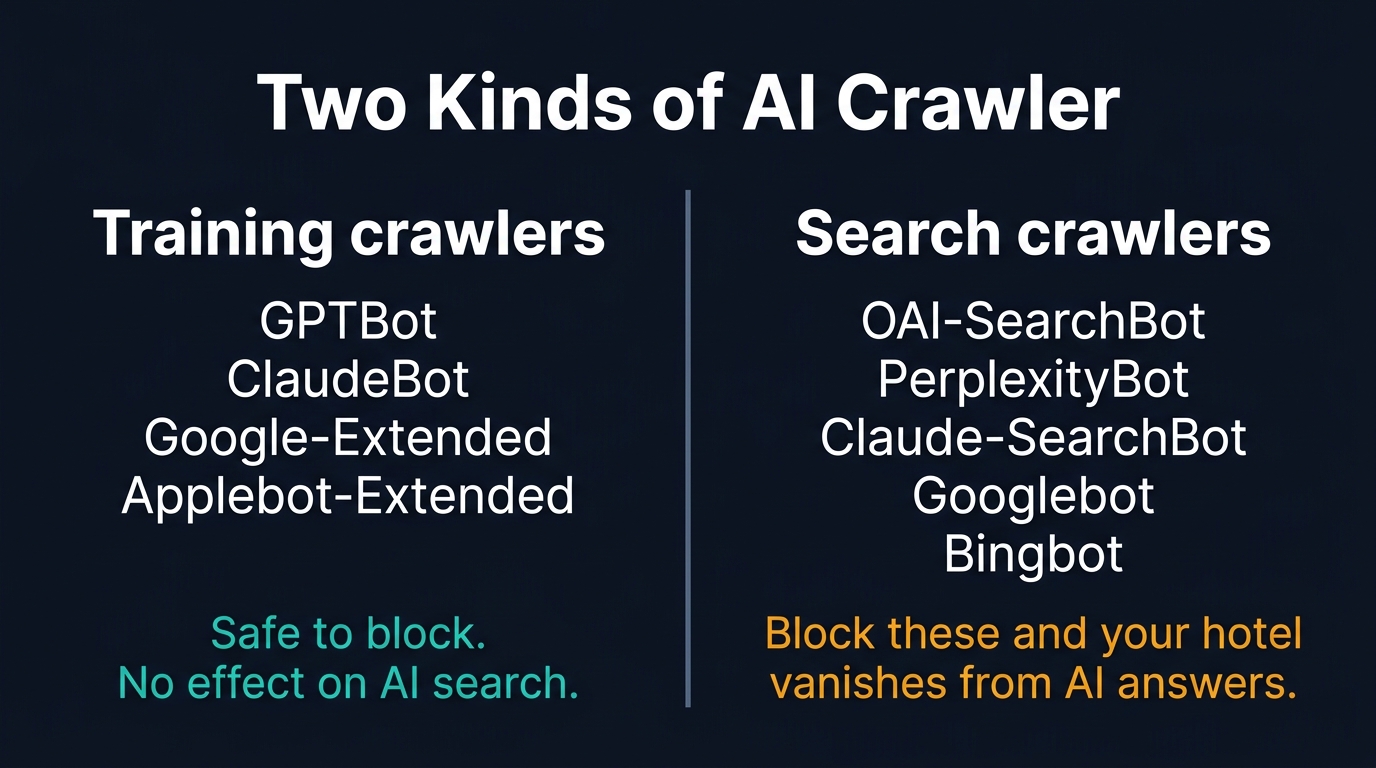
Look for these names: GPTBot, OAI-SearchBot, ClaudeBot, PerplexityBot, Googlebot-Extended. If any of them appear next to a Disallow: / rule, that AI system is blocked from reading your site.
Only 3.3% of hotels have this problem, but if you're one of them, nothing else on this list matters. An AI that can't read your site can't recommend it.
One nuance: some hotels deliberately block AI training crawlers (like GPTBot) while allowing search crawlers (like OAI-SearchBot and PerplexityBot). Aman Hotels blocks GPTBot and CCBot in their robots.txt but explicitly allows OAI-SearchBot and PerplexityBot, ensuring AI recommendations use current website content rather than stale training data. If you choose to block training crawlers, make sure you're allowing search crawlers. They're different things.
Check 2: Schema Markup
Go to Google's Rich Results Test and paste your homepage URL. Look for Hotel or LodgingBusiness in the results.
If you see "Organisation" or "LocalBusiness" instead (or nothing at all) AI has no structured understanding of your property. It doesn't know your star rating, your coordinates, your amenities, or your room types in a machine-readable format.
89.4% of hotels have significant room for improvement with their hotel schema markup. If you want the full guide, we wrote a detailed breakdown of the five schema types every hotel needs.
Check 3: Google Business Profile
Is your Google Business Profile claimed, verified, and current? Check your photos, amenity list, hours, description, and contact details.
This matters because Google's AI (Gemini) draws directly from your Business Profile. An outdated or incomplete profile means Gemini either skips you or recommends you with wrong information.
Check 4: Bing Places
This is the one most hotels miss. Bing Places feeds ChatGPT, Microsoft Copilot, and Perplexity. Claiming your hotel Bing Places listing takes 15 minutes and costs nothing.
ChatGPT is the largest AI platform on earth. It uses Bing as a primary data source. If you're not on Bing Places, your hotel ChatGPT visibility is effectively zero, invisible to 900 million weekly users.
We covered this in detail in our earlier post on why Bing may be the secret to appearing on ChatGPT.
Check 5: Ask the AI
Open ChatGPT, Perplexity, Google Gemini, and Claude. Ask each one: "Recommend a [your hotel's category] hotel in [your city] near [your location]."
Are you mentioned? Are the facts correct? Is your star rating right? Are the amenities accurate? Is the description something you'd recognise?
If you're not mentioned at all, you have a visibility problem. If you are mentioned but the facts are wrong, you have an accuracy problem. Both cost bookings.
Score Yourself
- 5/5: Strong AI presence. Focus on accuracy and monitoring.
- 3-4/5: Gaps to close. Start with schema markup and Bing Places: highest impact, lowest effort.
- 0-2/5: Invisible to AI. Your hotel AI visibility needs urgent attention. Prioritise this before your next marketing spend.
What AI Gets Wrong About Hotels
AI systems present false hotel information more often than most hoteliers realise: wrong star ratings, fabricated amenities, expired pricing, and restaurants listed as open years after closing. Google AI Overviews, ChatGPT, and other platforms all draw from fragmented sources, and when those sources disagree, AI fills the gaps with its best guess.
The Journal of Consumer Behaviour published research in 2026 showing that when AI errors lead to wasted time or financial loss, users' trust and intention to reuse the system collapse. The stakes are real, for travellers and for the hotels AI misrepresents.
A family-owned pizzeria in Missouri, Stefanina's, had Google's AI Overviews generate fake promotional deals ("buy one small pizza, get a second for $4") that never existed. Customers arrived angry, demanding discounts the restaurant had never offered. The owner posted on Facebook: "Please do not use Google AI to find out our specials."
Hotels face the same risk at a larger scale. Wrong star ratings. Restaurants listed as open when they closed two years ago. Fabricated amenity lists. Pricing from an OTA that hasn't been updated since last season.
Your defence is entity consistency. When your website, your OTA profiles, your Google Business Profile, and your Bing Places listing all agree (same name, same star rating, same amenities, same contact details) AI has less room to improvise. When they disagree, AI fills in the gaps with whatever it finds, and it doesn't always find the truth.
Why Hotel AI Visibility Compounds Over Time
Hotel AI visibility compounds: hotels that get recommended generate more bookings, more reviews, and a stronger AI presence, a flywheel that rewards early movers and penalises late ones. AI systems learn from engagement, and the gap between visible and invisible hotels widens with every query.
75-91% of AI traffic goes direct to hotel websites. Independent hotels get recommended more often than chains. Conversion rates are double organic search. And unlike Google Ads or OTA placements, AI visibility doesn't require ongoing ad spend, it requires getting your digital presence right.
This window is temporary. Major chains are investing heavily. Lighthouse launched a direct ChatGPT booking integration in March 2026. Grok is indexing social media signals from Facebook groups and Reddit threads to inform travel recommendations. The gap between hotels that are visible to AI and hotels that aren't will only widen.
If you scored 3 or below on the self-check, the time to act is now, not next quarter.
See What AI Actually Says About Your Hotel
Mystery Shop runs all five of the checks above automatically, plus over 50 more across AI visibility, website credibility, and offer accuracy. It tests what three major AI platforms actually say about your property and flags every inconsistency.
It takes two minutes. It's free. And it shows you exactly what your future guests see when they ask AI where to stay.
Frequently Asked Questions
How do I know if my hotel is visible to AI?
Test five things: your robots.txt file for AI crawler blocks (visit yourhotel.com/robots.txt and look for GPTBot, ClaudeBot, or PerplexityBot with Disallow rules), your hotel schema markup via Google's Rich Results Test, your Google Business Profile completeness, your Bing Places listing status, and what ChatGPT, Perplexity, and Gemini actually say when asked to recommend a hotel like yours in your city. If you're not mentioned, you have a hotel AI visibility gap. If you are mentioned but with incorrect information, you have an accuracy problem. Both cost bookings. For a comprehensive automated assessment, Mystery Shop tests over 50 AI visibility factors across three major AI platforms and produces a detailed report with screenshots.
Which AI platforms matter most for hotels?
Four platforms drive AI-assisted hotel discovery in 2026. ChatGPT is the largest with over 900 million weekly users and sends 91% of its hotel links direct to hotel websites. It pulls from Bing, Google, and its own OAI-SearchBot crawler. Google Gemini draws from Google Business Profile and Google's search index, making your GBP the single most important asset for Gemini visibility. Perplexity is growing fastest in travel, with TripAdvisor content appearing in 95.5% of its hotel results. Grok draws heavily from social media: Facebook groups and Reddit threads influence its recommendations. Optimising for all four requires Bing Places (feeds ChatGPT and Microsoft Copilot), Google Business Profile (feeds Gemini), strong review presence across TripAdvisor and Booking.com (feeds Perplexity), and active social media presence (feeds Grok).
Is GEO the same as SEO?
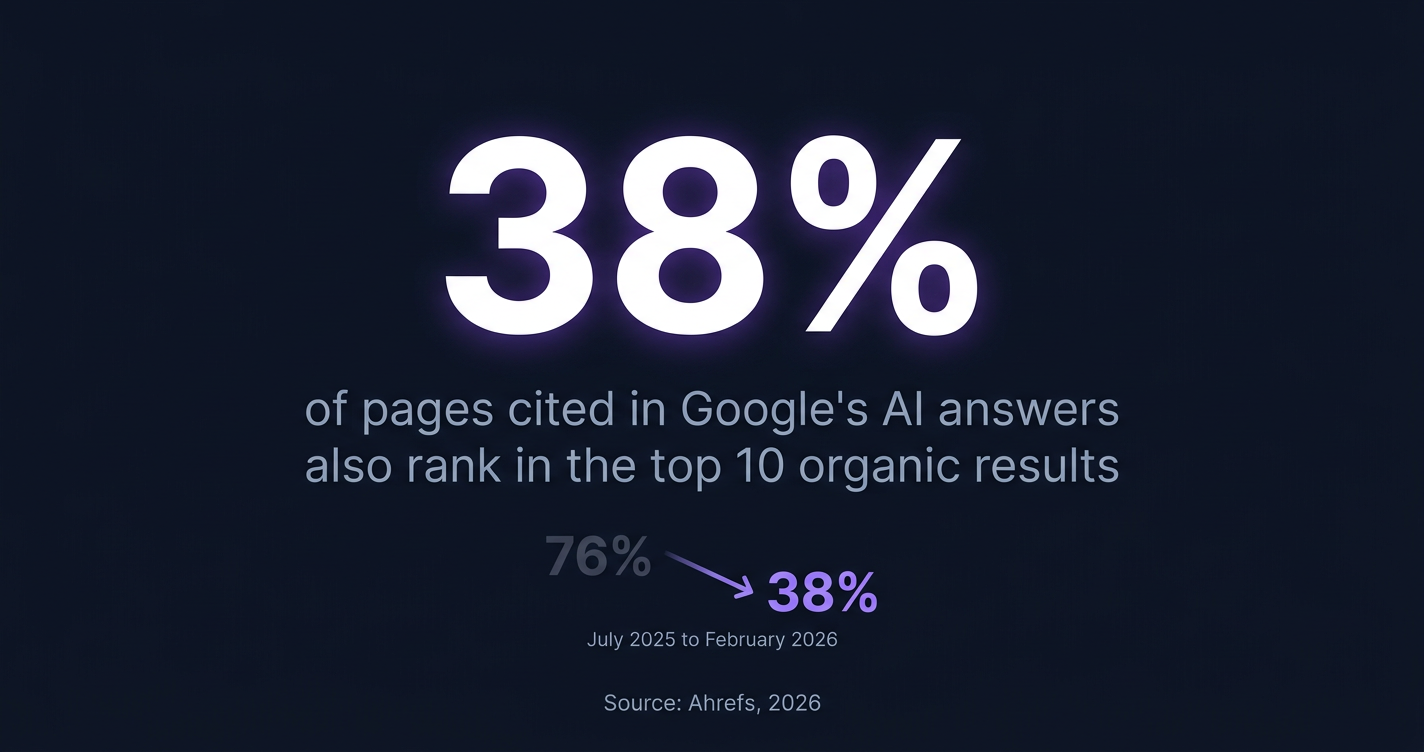
No. Generative Engine Optimisation (GEO) and Search Engine Optimisation (SEO) overlap by about 62%, according to a 2026 ChatOptic study of 1,000 matched queries across five sectors. That means 38% of websites that rank well on Google are still invisible to AI, a significant gap. GEO focuses on structured data, content answerability, entity consistency, and AI crawler access, factors that traditional hotel SEO doesn't fully address. For example, SEO doesn't require a Bing Places listing, but hotel GEO does because Bing feeds ChatGPT's retrieval system. Hotels need both: hotel SEO gets you into the results AI searches through, and hotel GEO ensures AI accurately represents you when it finds you.
How long does it take to improve AI visibility?
Quick wins take minutes: claiming your hotel Bing Places listing (15 minutes) immediately puts you in front of ChatGPT's 900 million weekly users. Fixing AI crawler blocks in your robots.txt takes another 15 minutes if your web team has access. Hotel schema markup implementation (adding the Schema.org Hotel type with coordinates, star rating, and amenities) typically takes a developer one to two days depending on your CMS; pages with FAQ schema are 3.2x more likely to appear in Google AI Overviews. Entity consistency work (aligning your hotel's information across your website, OTAs, Google Business Profile, and Bing Places) is a focused one-week project. A full GEO strategy, including content restructuring for AI answerability, is ongoing but yields compounding returns as AI engagement reinforces future recommendations.
Do independent hotels have a chance against chains in AI search?
Yes, and the data suggests they have an advantage. HotelRank.ai's 2026 research found that 53% of AI link recommendations go to independent hotels, compared to 35-37% for chains. AI systems value specificity, authenticity, and unique positioning, exactly what independents naturally offer. Chains tend to produce templated marketing content across hundreds of properties; independents produce specific, authentic descriptions of unique experiences. What makes AI recommend a hotel is the quality and consistency of its data, not the size of its brand. An independent hotel with clean schema markup, consistent entity data across all platforms, and a claimed Bing Places listing will outperform a chain property that has none of these. The playing field has never been more level.