GEO for Hotels: The Complete Guide to AI Search Visibility
Ask ChatGPT to recommend a hotel in your city tonight. It will not hand back ten blue links. It may name a handful of properties, say why each one fits, and send the traveller straight to a hotel's website.
Your hotel might be in that answer. It might not be. The part most hotel teams miss is the third possibility: it might be in the answer and described wrongly. A spa that closed. A pet policy that changed last season. An offer that expired in March. AI states all of it with the same confidence, and the traveller has no reason to doubt a word.
That is the real GEO problem for hotels, and it is not only about visibility. It is about accuracy. For two decades the commercial job was to rank: get onto page one of Google, protect direct traffic, keep OTA dependence down. AI search adds a layer hotel teams do not yet manage. Travellers now ask an assistant to shortlist hotels before they ever touch a website, and that assistant forms its opinion from your site, the OTAs, review platforms, Google Business Profile, Reddit and travel blogs.
Generative Engine Optimisation, or GEO, is the work of making sure AI can find your hotel, trust what it finds, and describe the property correctly. Here is how it works, and where to start.
What GEO actually means for hotels
GEO is not rebranded SEO. SEO earns you a ranking, a position in a list of links. GEO has to earn two separate things. The first is inclusion: whether AI mentions you at all. The second, the one hotels underrate, is accuracy: whether what AI says about you is true and current. A property can be highly visible in AI answers and still be misdescribed, and a wrong fact delivered at the point of intent is a broken promise before the guest has even seen your website.
It matters now because the volume is real, not speculative. ChatGPT reached 900 million weekly active users in February 2026 (OpenAI). Around 40% of travellers use AI tools somewhere in trip planning, and the share runs higher among younger guests (Operto, 2026). A meaningful and fast-growing slice of hotel research now happens inside a conversation rather than on a results page.
For hotels there is a commercial twist worth pausing on. When an AI assistant points a traveller at a hotel, the link it gives is usually the hotel's own website, not an OTA. In HotelRank.ai's 2026 dataset, GPT 5.2 sent 91.1% of its hotel links direct to the property; even Perplexity, the most OTA-friendly of the major models, sent 74.7% direct. A link is not a booking on its own. But it puts your own site, rather than a commission-charging intermediary, in front of the guest at the moment they are deciding where to stay. The hotels missing from those answers never reach the shortlist the traveller actually sees.
How AI decides which hotels to recommend
AI assistants do not rely only on memory. For a query with commercial intent, a recommendation or a comparison, an assistant will often run a live search before answering. It does this through query fan-out: it takes one human question and breaks it into a cluster of narrower searches. "Quiet boutique hotel in Lisbon near the old town with good breakfast" becomes eight to twelve separate searches, sometimes more. The assistant reads all of them, then synthesises a single answer.
That changes what you optimise for. Your property does not need to rank for the exact phrase a guest typed. It needs to surface across the sub-queries underneath it. A study reported by Search Engine Land found that pages ranking for the main query and at least one fan-out sub-query are 161% more likely to be cited in the AI answer than pages ranking for the head term alone. Breadth of specific, well-structured content beats one strong keyword.
Each assistant retrieves a little differently, and that shapes where you spend effort. ChatGPT combines model knowledge with live retrieval; in practice that means OpenAI's own search crawler, Bing indexation and Google Business Profile all influence whether a hotel is found and described correctly. We made the Bing case in full in Why Bing May Be the Secret to Your Hotel Appearing on ChatGPT. Perplexity runs a real-time search on effectively every query and leans heavily on TripAdvisor. Google's AI Overviews and AI Mode draw on Google's own index and Knowledge Graph, with AI Mode pushing users toward a synthesised answer and away from the traditional blue links. Grok leans hardest on OTAs and review aggregators.
You do not need a separate tactic for each. A 2026 study of 34,234 AI responses found ChatGPT and Perplexity overlap on only about 11% of the domains they cite, so chasing one platform will not win the others. The efficient move is to get the few shared inputs right: Google Business Profile, Bing Places, your schema and your OTA listings feed all of them. We pulled the mechanics apart in How AI Hotel Recommendations Work.
SEO gets you found. GEO decides what AI says about you
A strong Google ranking no longer guarantees AI visibility, and the gap is widening fast. Ahrefs analysed 863,000 keywords and found only 38% of the pages cited in Google's AI Overviews also rank in the traditional top ten organic results. A year earlier that overlap was roughly 76%. In hotels the gap is wider still: a 2026 ChatOptic study of 1,000 matched queries found brands on Google's first page appeared in ChatGPT only 58% of the time in the hotel-booking category, the weakest of every sector it tested.
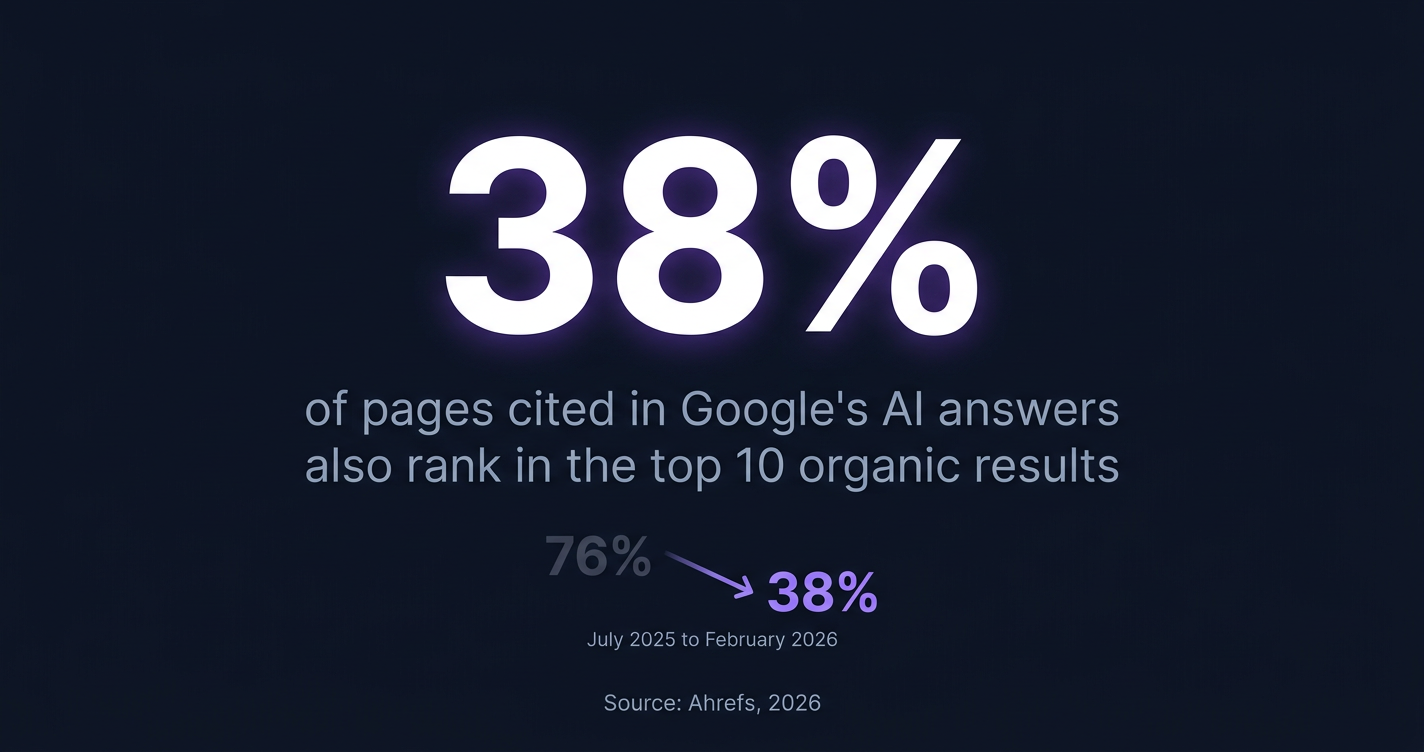
None of this retires SEO. A fast, crawlable, well-structured site is the floor that AI retrieval runs on, and the work behind it still counts. What has changed is that ranking is no longer the finish line. SEO gets your site into the pool of sources AI reads. GEO decides whether AI picks you out of that pool and what it says about you when it does. We covered the transition in Hotel SEO in the Age of AI.
The six levers of hotel GEO
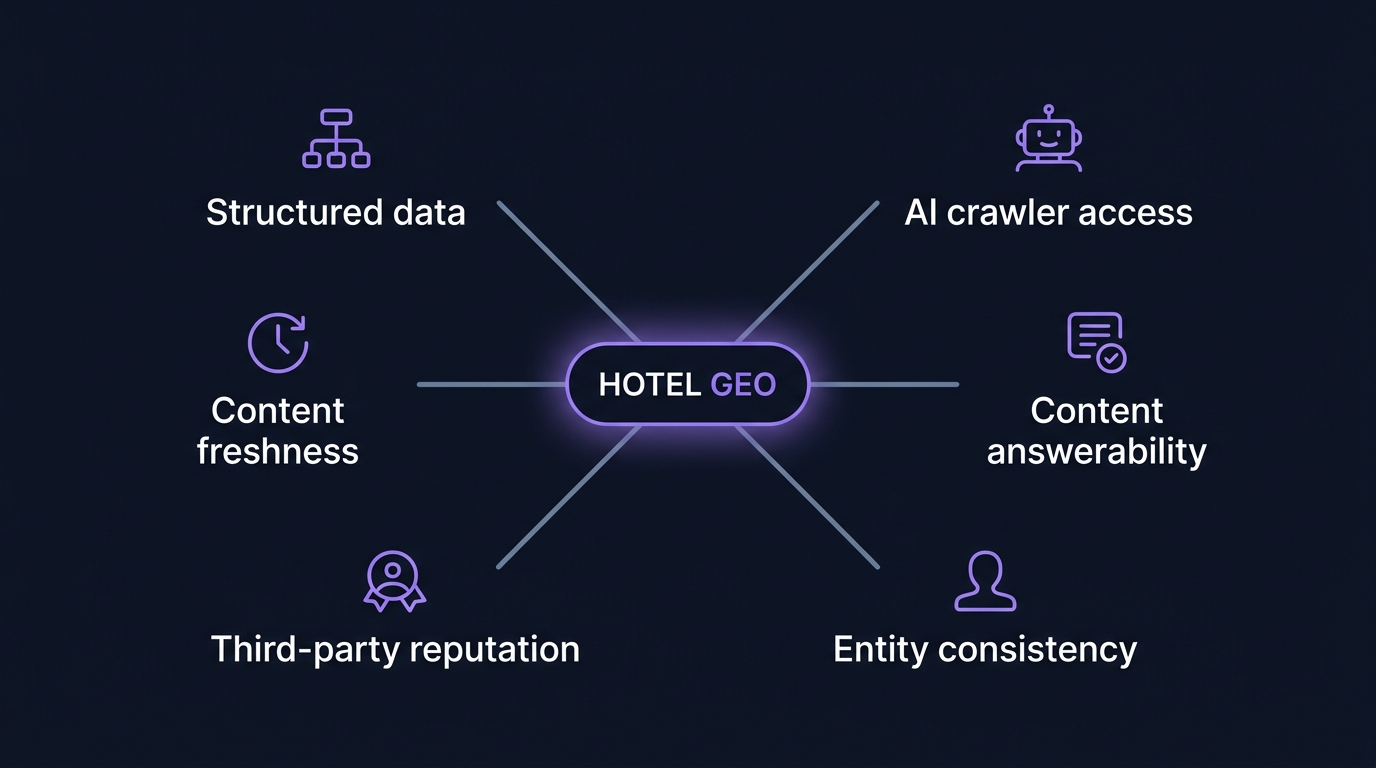
Improving how AI sees your hotel comes down to six things. None needs a large budget. Most are corrections to assets you already own and have simply never been told to check.
| Lever | What it controls | The common hotel failure |
|---|---|---|
| Structured data | How AI identifies your property | Wrong schema type (41.1% of hotels with schema) |
| AI crawler access | Whether AI can read your site at all | Accidental blocks by security or CDN tools |
| Content answerability | Whether AI can quote you | Answers buried inside brand prose |
| Entity consistency | Whether AI describes you correctly | Facts that disagree across listings |
| Third-party reputation | What AI says about you | Thin reviews and external coverage |
| Content freshness | Whether AI trusts your information | Expired offers and stale pages |
Structured data. Schema markup is code that states your facts in a format machines read without guessing: this is a hotel, here is its star rating, address, price range and amenities. The common failure is not missing schema, it is the wrong schema. HotelRank.ai found that 41.1% of hotels with structured data mark themselves up as a generic Organisation or LocalBusiness instead of Hotel or LodgingBusiness, which drops the fields AI specifically looks for in accommodation. Our hotel schema markup guide covers the types every property needs.
AI crawler access. For an AI system to read your site, its crawler has to be allowed in, and that is governed by your robots.txt file. There are two kinds of AI crawler, and they are not the same decision. Training crawlers, such as GPTBot and ClaudeBot, collect data to train future models; blocking them is a defensible brand-control choice. Retrieval crawlers, such as OAI-SearchBot, PerplexityBot and Claude-SearchBot, fetch your pages so AI can cite them in answers; block one of those and AI can no longer read your site directly. Deliberate blocking is rare, only 3.3% of hotels block anything (HotelRank.ai, 105,002 sites). The real risk is a security plugin or CDN doing it for you without anyone noticing. A faster version of this check is in the 5-minute AI visibility check.
Content answerability. AI answers questions, so content written as a direct answer gets quoted, and content that buries the answer inside brand prose does not. Lead each section of a page with the answer, then add the detail. Keep a genuine FAQ covering what guests actually ask: parking cost, distance to the station, pet policy, cancellation terms. A page that answers "is parking free" in one clean line can be cited directly; a vague page sends the assistant to an OTA listing instead. Our hotel FAQ schema guide covers how to structure this so machines parse it cleanly.
Entity consistency. AI builds a single picture of your hotel by reconciling every source it can find: your website, Google Business Profile, Bing Places, Booking.com, Expedia, TripAdvisor. When those sources disagree, there is no authoritative version for AI to settle on, and it can surface the wrong one. Most hotels claim Google Business Profile and ignore Bing Places, which is a direct miss, because Bing indexation is one of the main routes into ChatGPT's search results. Claim both, complete both, and keep your name, address, star rating and core facts identical across every listing. We covered the cost of getting this wrong in Why AI Gets Your Hotel Facts Wrong.
Third-party reputation. Most of what AI says about your hotel does not come from your hotel. An analysis of 21,311 brand mentions found roughly 85% of brand citations come from third-party sources rather than the brand's own domain. Reviews, travel blogs, local press and community forums are what AI reads to decide both whether to recommend you and how to describe you. That makes review management core GEO work, not a reputation afterthought. None of this means your own website stops mattering. It means the site has to be the cleanest source of truth you have, so that the third-party sources corroborate it rather than contradict it.
Content freshness. Retrieval-based AI leans on recently crawled, current pages, and stale content carries less weight. An offers page still advertising last winter's package, room descriptions that predate a refurbishment, a news feed that stops in 2024: each one tells AI your information cannot be trusted as current. Keep offers, rates, seasonal content and property facts up to date, and remove what has expired rather than leaving it to sit.
Can independent hotels compete with the chains?
Yes, and current data suggests independents now hold the edge. In HotelRank.ai's 2026 dataset, GPT 5.2 recommended independent hotels in 53.9% of its hotel link recommendations against 37.2% for chains, with a similar skew across Gemini and Perplexity. One caveat: a Cloudbeds study a year earlier found the opposite, a skew toward branded and large-group properties. The likeliest reading is that the picture moved fast, and the two studies used different prompts, markets and samples. Treat the independent edge as a current signal, not a fixed rule.
The logic behind it holds, though. AI tends to give distinctive, specific, well-matched recommendations rather than repeat the chain names a traveller already knows. An independent hotel with clean structured data, a clear identity and good third-party reviews is exactly the kind of answer an assistant wants to give. The chains' old advantage was brand recognition and budget. In an AI answer, being clearly described and well corroborated counts for more than either. We made the wider case in Only 1 in 6 Hotels Are Visible to AI Search.
Measure what AI says about you
You cannot manage what you cannot see, and none of this appears in standard hotel reporting by default. Three things are worth tracking.
Visibility: build a list of 20 to 50 buyer-intent prompts a real guest might use ("best boutique hotel in [city]", "family hotel near [landmark] with a pool"), run them monthly across ChatGPT, Perplexity, Gemini and Grok, and note how often you appear and whether the facts are right. Traffic: GA4 buries AI referrals in the generic "Referral" bucket, so a custom channel group for the AI hostnames, about ten minutes of setup, makes that traffic visible. Revenue: once AI traffic is tagged, track its conversion rate and bookings against your other channels.
One honest limit. This is sampling, not full coverage. There is no console that reports every answer AI has given about your hotel. That blind spot is the argument for a structured audit rather than occasional spot-checks.
Where to start
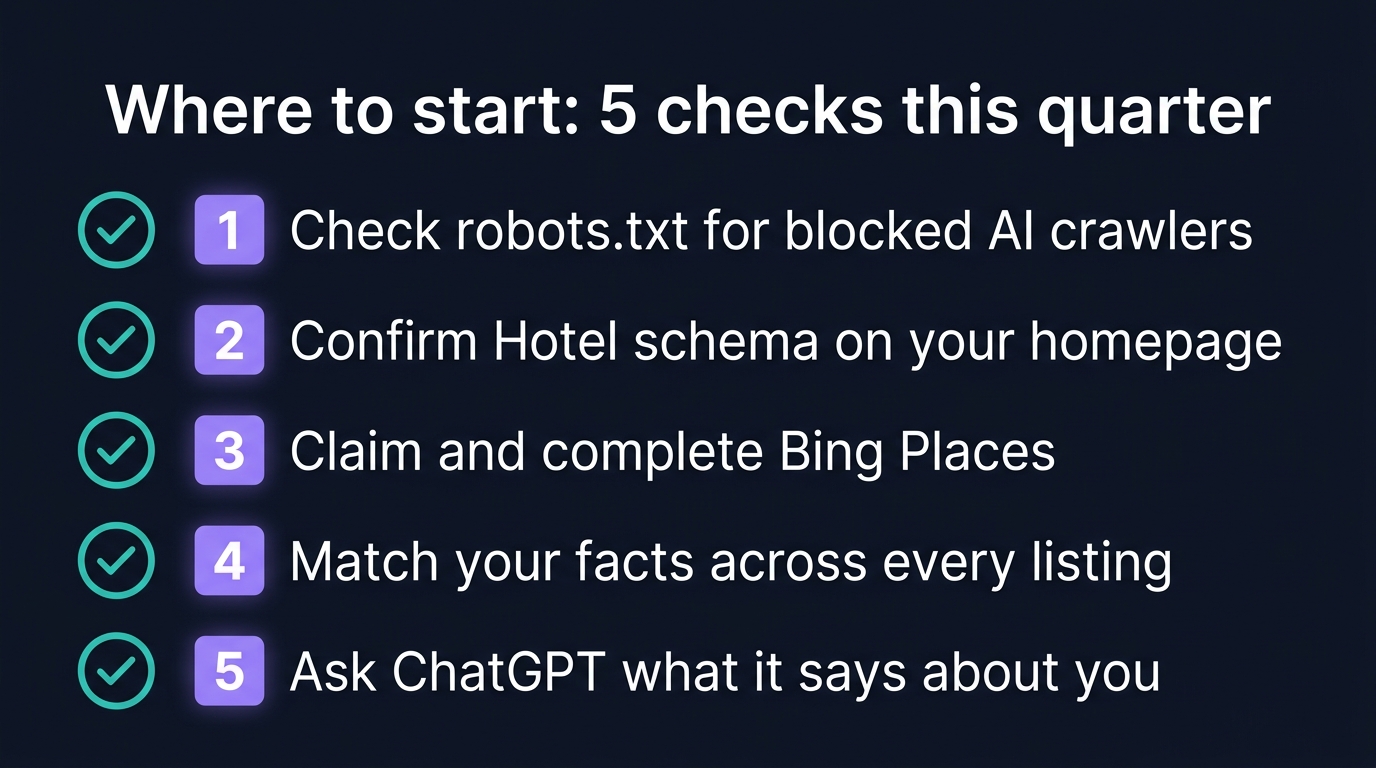
If you do nothing else this quarter, do these five things, in order.
- Open your robots.txt and confirm no AI retrieval crawler is blocked.
- Check your homepage schema is typed as Hotel or LodgingBusiness, with star rating, amenities and coordinates filled in.
- Claim and complete Bing Places, and reconcile it with your Google Business Profile.
- Make your name, address and core facts identical across your site, both profiles and your OTA listings.
- Ask ChatGPT, Perplexity and Gemini to recommend a hotel like yours in your city, and read carefully what they say about you.
That last step is the one that tends to change minds. Most hotel teams have never actually looked at what AI tells travellers about their property. Some find they are not mentioned. Plenty find they are, and that a detail is wrong.
Doing that properly, across every assistant and every page of your site, is slow by hand and easy to get wrong. That is the gap Stiplo Mystery Shop closes. It audits your hotel the way an AI system reads it, compares what ChatGPT, Perplexity and Gemini say about your property against what is actually on your website, and shows you the mismatches with evidence. Run a free Mystery Shop and see what AI is telling your guests before they do.
Frequently Asked Questions
Is GEO replacing SEO for hotels?
No. GEO sits on top of SEO, it does not replace it. AI assistants retrieve from the same web infrastructure that SEO has always served, so a crawlable, fast, well-structured site still matters. What has changed is that ranking well no longer guarantees you appear in the AI answer that now sits above the rankings. You need both: SEO to get your site into the pool of sources AI reads, GEO to be selected from it and described correctly.
How much does hotel GEO cost?
The core work is mostly free. Correcting your schema type, auditing your robots.txt, claiming Bing Places and reconciling your listings are configuration tasks, not media spend. They cost time and attention, usually from your web agency or marketing team. The part that does cost money, ongoing review management, is work most hotels already do for other reasons. GEO is more about redirecting existing effort than adding new budget.
Can a small independent hotel compete with the chains in AI search?
Yes. Current data points to independents holding an edge, because AI tends to favour specific, well-matched recommendations over familiar chain names. A distinctive property with clean structured data and good reviews is the kind of answer an assistant wants to give, regardless of how big the brand behind it is.
How long does GEO take to work?
Some changes register quickly. Once a retrieval crawler can reach a corrected page, that page can be cited within weeks. Entity consistency and third-party reputation move more slowly, over months, because AI has to re-encounter the corrected information across multiple sources before it updates its picture of your hotel. GEO is a steady discipline rather than a one-time campaign, which is also why early movers compound an advantage that gets harder to catch.
Want to see how your hotel website performs?
A Mystery Shop checks 30 pages for commercial integrity issues in minutes.
Request a free Mystery Shop