Hotel FAQ Schema (FAQPage): The 2026 Guide to AI Overview Citations
Last updated: 1 May 2026.
TL;DR. Hotels with FAQPage schema are associated with materially higher AI Overview citation rates than hotels without. The fix is one JSON-LD block in your site's <head> containing 12 standard hotel questions (check-in time, parking, cancellation, pets, breakfast, pool hours, and so on) with self-contained answers. Most hotels removed FAQ schema after Google's August 2023 change. That was a mistake.
In March 2026, we audited the structured data on eight luxury hotel websites in London and Paris. None had FAQPage schema. Not one.
These were not neglected websites. They had expensive photography, polished design systems, conversion-tested booking CTAs, beautifully animated menus, and cookie-consent banners with bespoke iconography. But when a guest, or an AI assistant, asked a basic question like "does this hotel allow dogs?" or "is breakfast included?", the answer was often buried in prose, hidden in an accordion, or missing from the machine-readable layer altogether.
That matters because hotel discovery is changing. Guests are no longer only scanning Google results; they are asking AI assistants direct booking questions. AI systems prefer clean, self-contained answers they can understand, verify, and cite. FAQPage schema is not a magic ranking hack. It is something simpler and more useful: a way to make your hotel's most important guest answers explicit.
This guide covers why FAQ schema is back, how AI actually uses it, the 12 questions every hotel FAQ should answer, two production-ready JSON-LD examples, and the five mistakes that quietly break the schema in real-world hotel CMSs.
Why FAQPage Schema Is One of the Highest-Leverage Hotel Schema Moves in 2026
FAQPage schema wraps your guest-question answers in a JSON-LD format AI systems can extract verbatim. The reason it punches above its weight is mechanical, not editorial.
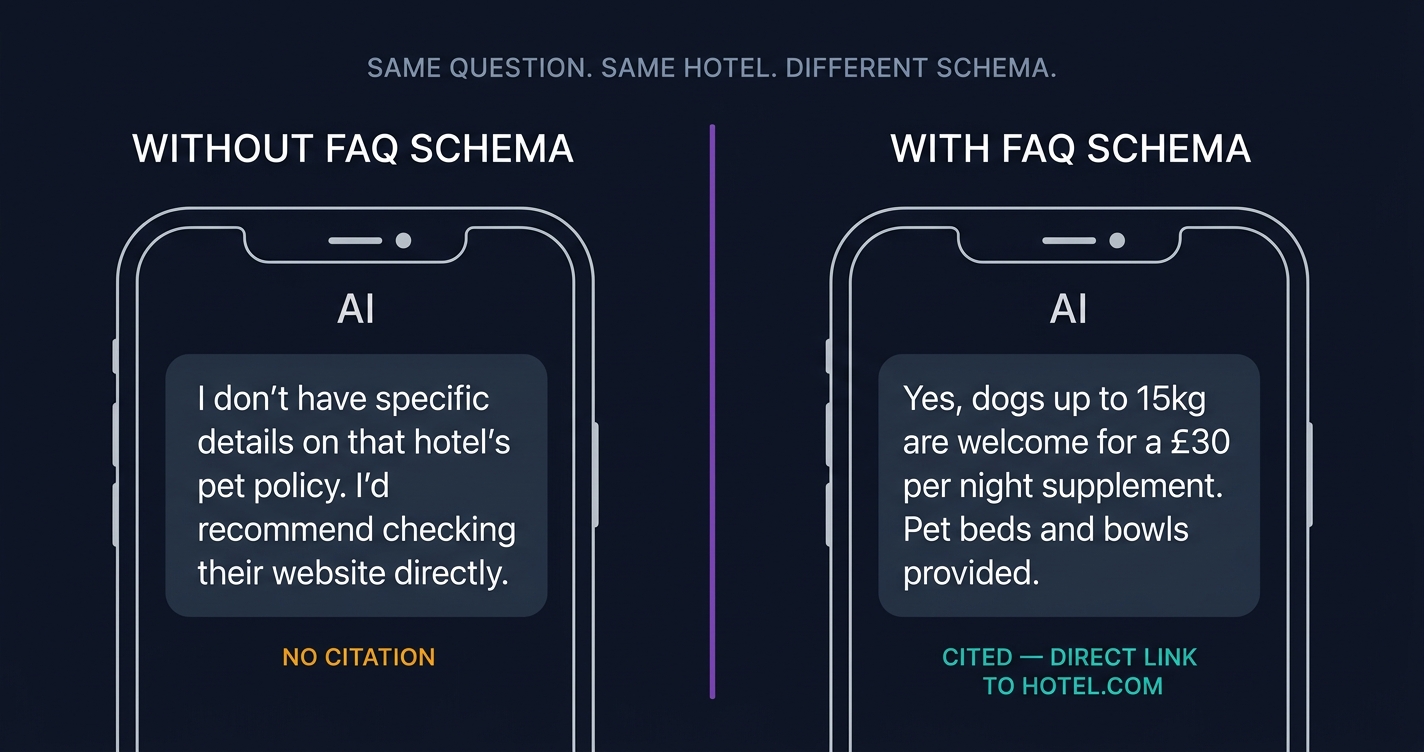
When ChatGPT answers "does The Grand Hotel allow pets?", it doesn't read your whole page. It looks for a structured Q&A block where the question matches and the answer is self-contained. If your page has FAQPage JSON-LD with mainEntity[].name = "Are pets allowed?" and an answer of "Yes, dogs up to 15kg, £30/night", the AI can extract that answer reliably and cite your domain. If it doesn't, the AI either guesses from your prose (often wrong) or skips your property entirely and quotes a competitor that did the work.
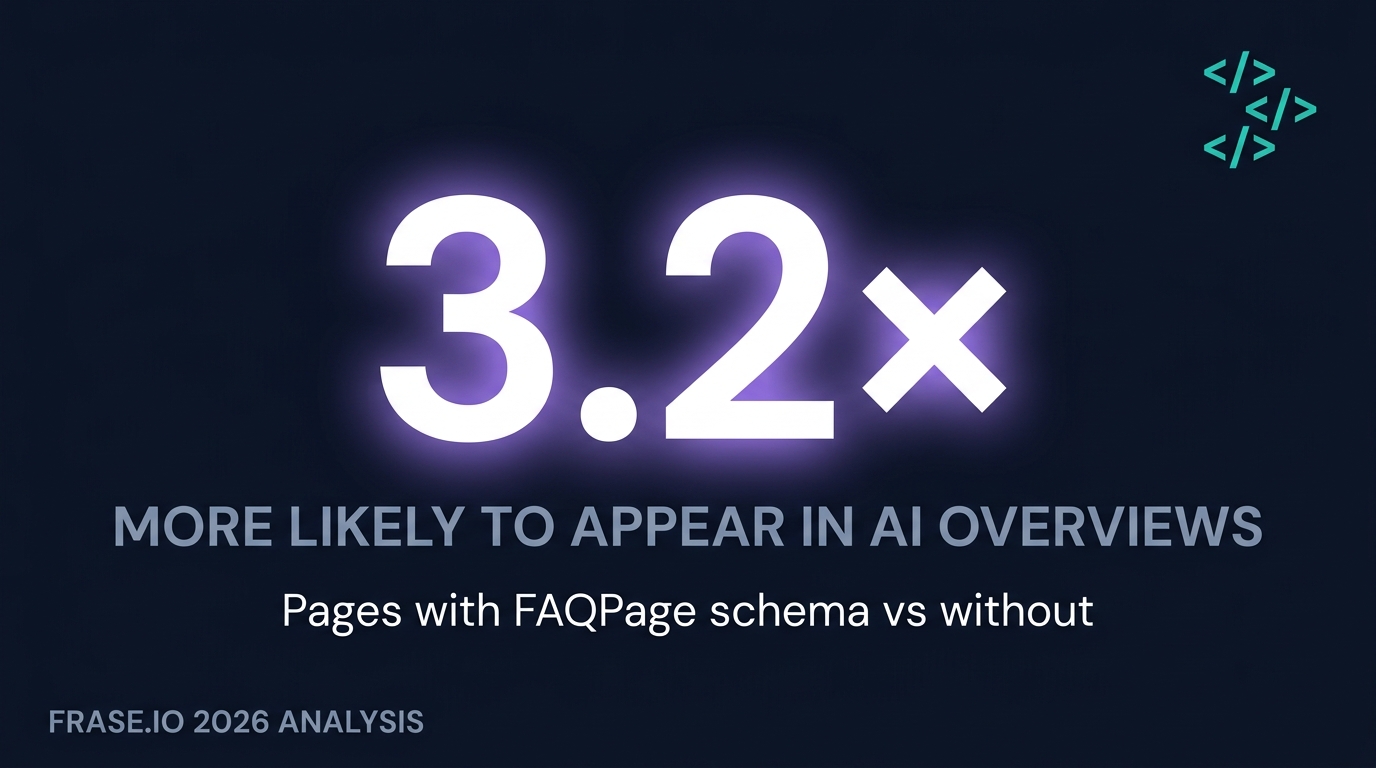
Search Engine Land's 2025 analysis of AI Overview citation patterns found that pages with FAQPage schema are 3.2 times more likely to appear in Google AI Overviews than pages without, even when controlling for content quality. Three other signals reinforce why this is the move worth shipping first.
91.1% of GPT 5.2 hotel link recommendations go directly to hotel websites, per HotelRank.ai's 2026 analysis (75% to 91% across all major AI models). The traffic AI sends is already disintermediated; it just needs your page to be parseable when the AI looks. Sam Altman confirmed at OpenAI's October 2025 Dev Day that ChatGPT has 800 million weekly active users, and 83% of travellers are using or interested in using AI for trip planning, per the TravelBoom 2026 leisure travel study. The questions you'd answer at the front desk are the same ones being typed into AI chat boxes a hundred million times a week.
The first hotel in your city to ship comprehensive FAQ schema doesn't get a small advantage. It gets cited every time a competitor doesn't.
The August 2023 Google Story (and Why Most SEO Advisors Got It Wrong)
In August 2023, Google announced that FAQ rich results in classic search would be restricted to government and health websites. Hotels, along with everyone else, would no longer see those expandable Q&A panels under their listings.
The SEO industry concluded FAQ schema was finished. Articles were written. Audit checklists were updated. CMS templates that had FAQ schema enabled by default had it removed. We see the residue every day in Mystery Shops: hotels that had FAQ schema in 2022 don't have it in 2026, because someone "cleaned it up" after Google's announcement.
That was a category error. Google removed the FAQ rich snippet from a single surface, classic blue-link search results. They did not remove the structured-data signal from the broader ecosystem. And in the eighteen months that followed, AI Overviews launched, AI search exploded, and FAQ schema turned out to be highly valuable for any AI system trying to construct a clean, citable hotel answer.
To be clear: hotels removing FAQ schema today will not get classic FAQ rich snippets back in Google's search results. Google was explicit about that. What they will get is materially better representation in AI Overviews and in third-party AI assistants like ChatGPT, Perplexity, and Gemini. The replacement value is enormously larger than the loss.
If your developer or agency removed FAQ schema in 2023 or 2024, getting it back is one of the highest-leverage commercial moves you can make this quarter.
How ChatGPT and AI Overviews Read Your Hotel FAQ Page
AI systems extract content in passages of 134 to 167 words, per Wellows' 2026 analysis of 15,847 AI Overview results. A typical FAQ Q&A pair is exactly that length. The format is, in effect, pre-extracted. The AI doesn't have to interpret your prose; it can extract your answer with full context attached.
That same Wellows analysis found content scoring 8.5/10 or higher on semantic completeness is 4.2 times more likely to be cited. A well-written FAQ Q&A pair scores 10/10 by definition: complete question, complete answer, no interpretation needed. Plain HTML can still be crawled, but it forces machines to infer which text is the question, which is the answer, and whether the answer is official. FAQPage schema removes that ambiguity.
The fan-out behaviour of AI search amplifies this further. When a traveller asks ChatGPT "best family hotel in Barcelona near the beach", the system decomposes the query into many sub-queries and searches each in parallel. Sub-queries like "Barcelona hotel kids club", "family room sleeps 4 Barcelona", "Barcelona beach hotel cancellation policy" each have a high probability of matching a question in your FAQ. Each match is a citation opportunity. A property with twelve well-structured FAQ questions has roughly twelve more chances to surface in any given AI answer than a property with none.
Most hotel FAQ pages don't get cited because they exist as plain HTML, with answers scattered across <h3> and <p> tags. The content is there for human readers but the AI's structured-data parser has to guess which paragraphs are answers. Adding FAQPage JSON-LD around the same content, without rewriting a single word, makes the answers explicit.
The 12 Questions Every Hotel FAQ Should Answer
The questions worth marking up are the ones with high booking-decision impact and high search volume. Across hundreds of Stiplo Mystery Shops, twelve recur consistently as the highest-leverage set:
- What time is check-in and check-out? Universally asked, universally important.
- Is parking available, and is it free? Decisive for road-trip and family bookings.
- Do you allow pets? Filters out unsuitable bookings; pet owners search this verbatim.
- Is breakfast included in the room rate? Frequent friction point at booking.
- What is the cancellation policy? Key trust signal; AI cites this directly.
- Is there a pool, and what are its hours? Family and leisure-segment defining.
- Do you have a fitness centre or spa, and what are the hours? Wellness-segment defining.
- Is there Wi-Fi, and is it free? Still asked surprisingly often.
- Do you offer airport transfers? Direct booking signal; OTAs rarely surface this.
- What is the smoking policy? Health-sensitive guests filter on this.
- Are children welcome, and is there a children's club? Family-segment qualifier.
- Do you offer late check-out? High-intent booking-extension signal.
These twelve are the floor, not the ceiling. Properties with distinctive amenities (private beach access, on-site mooring, helipad, Michelin-starred restaurant) should add property-specific questions on top. AI is more likely to cite specific, anchored answers than generic ones. "Yes, the spa is open daily 7am to 10pm with an indoor 25m pool, hammam, and four treatment rooms" beats "Yes, we have a spa" every time.
Hotel FAQPage JSON-LD: Minimal Example
Here's the smallest piece of FAQ schema that will register correctly with Google's Rich Results Test, ChatGPT, Perplexity, and Gemini. Drop it into your page's <head> exactly as written:
<script type="application/ld+json">
{
  "@context": "https://schema.org",
  "@type": "FAQPage",
  "mainEntity": [
    {
      "@type": "Question",
      "name": "What time is check-in?",
      "acceptedAnswer": {
        "@type": "Answer",
        "text": "Check-in is from 3pm. Early check-in is available on request, subject to availability."
      }
    },
    {
      "@type": "Question",
      "name": "Are pets allowed?",
      "acceptedAnswer": {
        "@type": "Answer",
        "text": "Yes, we welcome dogs up to 15kg for a £30 per night supplement. Please notify us at booking."
      }
    }
  ]
}
</script>
Test it at Google's Rich Results Test. If it parses without errors, AI systems can read it.
Hotel FAQPage JSON-LD: Production Example
For production use, expand the question set and anchor every answer with specifics. Place the markup where the same Q&A content is actually visible to the user, typically your dedicated FAQ page, and on key commercial pages where the questions are directly relevant (a pet-policy block on a pet-friendly rooms page, parking details on a stay-and-park package page). Avoid blanket duplication of the same Q&A block across every page on the site, per Google's published FAQ guidance.
<script type="application/ld+json">
{
  "@context": "https://schema.org",
  "@type": "FAQPage",
  "mainEntity": [
    {
      "@type": "Question",
      "name": "What time is check-in and check-out?",
      "acceptedAnswer": {
        "@type": "Answer",
        "text": "Check-in is from 3pm; check-out is by 11am. Early check-in and late check-out are available on request, subject to availability and a possible supplement."
      }
    },
    {
      "@type": "Question",
      "name": "Is parking available?",
      "acceptedAnswer": {
        "@type": "Answer",
        "text": "Yes. Self-parking is £25 per night and valet parking is £40 per night. Both are subject to availability; we recommend reserving in advance."
      }
    },
    {
      "@type": "Question",
      "name": "Is breakfast included?",
      "acceptedAnswer": {
        "@type": "Answer",
        "text": "Breakfast is included in our Bed & Breakfast rate plan. Other rate plans can add breakfast for £28 per person at booking, or £32 walk-in."
      }
    },
    {
      "@type": "Question",
      "name": "What is your cancellation policy?",
      "acceptedAnswer": {
        "@type": "Answer",
        "text": "Flexible-rate bookings can be cancelled up to 48 hours before arrival without charge. Advance-purchase rates are non-refundable. Full terms are confirmed at the booking step."
      }
    },
    {
      "@type": "Question",
      "name": "Do you allow pets?",
      "acceptedAnswer": {
        "@type": "Answer",
        "text": "Yes, we welcome dogs up to 15kg for a £30 per night supplement. Pet beds, bowls, and treats are provided. Please notify us at booking."
      }
    }
  ]
}
</script>
The pattern: Question.name is exactly the question a guest would type into ChatGPT. Answer.text is a single self-contained paragraph that resolves the question without requiring the AI to read anything else on the page.
Five Mistakes That Quietly Break Hotel FAQ Schema
Most hotel FAQ schema we see in Mystery Shops is technically present but silently broken. Five common failure modes, in roughly the order we encounter them:
1. HTML-encoded attributes from CMS leaks. Some hotel CMS templates and page builders output rel="..." instead of rel="..." inside JSON-LD blocks. Browsers tolerate the malformed markup; structured-data parsers reject the entire block. The fix is a developer task, but you'll never spot it without running a validator. (Stiplo Mystery Shop flags this as rel_attr_html_encoded.)
2. Q&A schema vs FAQPage confusion. Schema.org has two related types: FAQPage (your hotel's official answers) and QAPage (forum-style content where the community answers). They are not interchangeable. If your developer used QAPage, AI systems treat your answers as user-generated content and weight them lower. Always use FAQPage for hotel-authored Q&As.
3. Stale answers. "Our rooftop pool is open daily 7am to 10pm" marked up in January, when the pool is closed for renovation until April, is a broken promise to AI and to guests. Google's Price Accuracy Policy applies analogically: if your schema says one thing and your live page says another, AI systems flag the inconsistency and can downrank you. Review FAQ answers at every seasonal change.
4. JavaScript-rendered FAQ content. If your FAQ accordion is rendered client-side after page load, common with React, Vue, and Webflow CMS templates, many AI crawlers don't execute the JavaScript and never see the questions. Server-side rendering or static HTML is required. The JSON-LD must be present in the page source as delivered by the server, not injected by the browser.
5. Missing or truncated answer text. A surprising number of hotel FAQs say "Yes" or "Please contact reception" as the entire answer. AI systems need a complete, self-contained answer of 25 to 100 words to extract reliably. "Yes" is not citable. "Yes, dogs up to 15kg are welcome for a £30 per night supplement; pet beds and bowls are provided on request" is.
How to Validate Hotel FAQ Schema (and Monitor It Long-Term)
Schema breaks silently. A site redesign, a CMS plugin update, a CDN configuration change can wipe your structured data without a single visible signal in your CMS.
Three practical steps to keep FAQ schema healthy:
- Test with Google's Rich Results Test after every release. Paste the URL, look for FAQPage in the detected items, and check that every question and answer parses without warnings.
- Cross-validate with Schema.org's validator. Google's tool can be lenient; the schema.org validator catches issues Google ignores.
- Monitor automatically. Manual checks fail the moment your team gets busy. Run a free Mystery Shop and we'll audit your FAQ schema across up to 30 pages, flag missing markup, broken JSON-LD, and stale answers, and alert you when anything changes.
Where FAQ Schema Sits Alongside the Other Hotel Schema Types
FAQ schema is the fastest single move with the largest visible payoff, but it works best as part of a complete structured-data layer. The five hotel schema types every property needs, Hotel, Offer, FAQPage, AggregateRating, and HotelRoom, reinforce each other inside the same page context. A Hotel block establishes who you are. FAQ answers resolve specific guest questions. AggregateRating supplies the trust signal. HotelRoom data answers room-level queries. AI cross-references them when constructing recommendations.
A hotel with FAQ schema and nothing else still gets cited more often than a hotel with no structured data. A hotel with all five tends to get cited as the authoritative source.
If you're starting from zero, ship FAQ schema first. It's the fastest to implement, easiest to validate, and most directly aligned with how guests actually ask AI assistants for help. Then come back for the rest.
Run Mystery Shop to See Whether Your Answers Are Visible to Machines
Mystery Shop audits your hotel website's structured data, including FAQPage schema, on up to 30 pages. It flags missing markup, identifies broken JSON-LD, and catches the silent failure modes above. Two minutes. Free. Run it on any hotel including yours.
Frequently Asked Questions
Does FAQ schema still work for hotels after Google's August 2023 change?
Yes, but with a caveat. Google restricted FAQ rich snippets in classic search results to government and health websites, so hotels no longer see expandable FAQ panels under their listings, and that won't come back. What did change is everything outside classic Google search. Pages with FAQ schema are materially more likely to appear in Google AI Overviews and are better aligned with how AI answer engines extract concise, factual answers. The Google rich-snippet loss is small; the AI citation gain is larger.
Can I add FAQ schema to my homepage, or does it need a separate FAQ page?
Both can work, with care. Schema.org's FAQPage type is named for the page-level surface, but in practice AI systems read FAQ JSON-LD wherever it is present. Google's published guidance is to mark up FAQ content where the same Q&A is actually visible to the user. We recommend the dedicated FAQ page as the primary surface, plus the most relevant commercial pages (pet-friendly rooms, family packages, parking add-ons) where the question maps directly to the page's purpose. Avoid duplicating the same Q&A block across every page on the site.
How many questions should a hotel FAQ schema include?
Twelve to twenty is the practical sweet spot. The twelve questions in this guide cover the universal-impact set; properties with distinctive amenities should add property-specific questions on top. Below twelve, you leave AI citation opportunities on the table. Above twenty-five, you risk diluting answer quality and including questions guests don't actually ask.
Is FAQ schema enough on its own, or do I need other hotel schema types too?
FAQ schema is the fastest single move with the most visible AI payoff, but the full benefit comes from implementing all five hotel schema types: Hotel, Offer, FAQPage, AggregateRating, and HotelRoom. AI systems cross-reference structured data within a page; a complete schema layer compounds the citation lift. Start with FAQ schema if you're starting from zero, then add the others.
Does FAQ schema work for boutique hotels and B&Bs, or only for chains?
The schema.org FAQPage type is independent of property size or category. Independent and boutique properties often benefit more from FAQ schema than chains, because AI tends to favour specific, authentic content over templated marketing copy. A well-written FAQ from an owner-operator reads as more authentic than a generic chain Q&A.
Want to see how your hotel website performs?
A Mystery Shop checks 30 pages for commercial integrity issues in minutes.
Request a free Mystery Shop