Google rankings still matter, but 38% of page-one brands are invisible to ChatGPT. What Query Fan-Out, GEO, and AI citations mean for hotel SEO in 2026.
Everything you know about hotel SEO still matters. But in 2026, it's no longer enough.
Google rankings used to be the finish line. If your hotel appeared on page one for "boutique hotel Paris" or "luxury resort Bali," you won. Guests clicked, they booked, the funnel worked. That model isn't broken, but it's now incomplete.
AI search engines don't just check who ranks on Google. They decompose every query into 8-15 sub-queries, search them all in parallel, and synthesise an answer from passages scattered across dozens of sources. Your hotel page might rank #1 for the main keyword and still be invisible to AI, because you don't rank for the sub-queries AI actually fires.
This is the shift hotel commercial directors need to understand. Traditional hotel SEO gets you into the index. Generative Engine Optimisation (GEO) gets you into the answer.
The 62% Problem
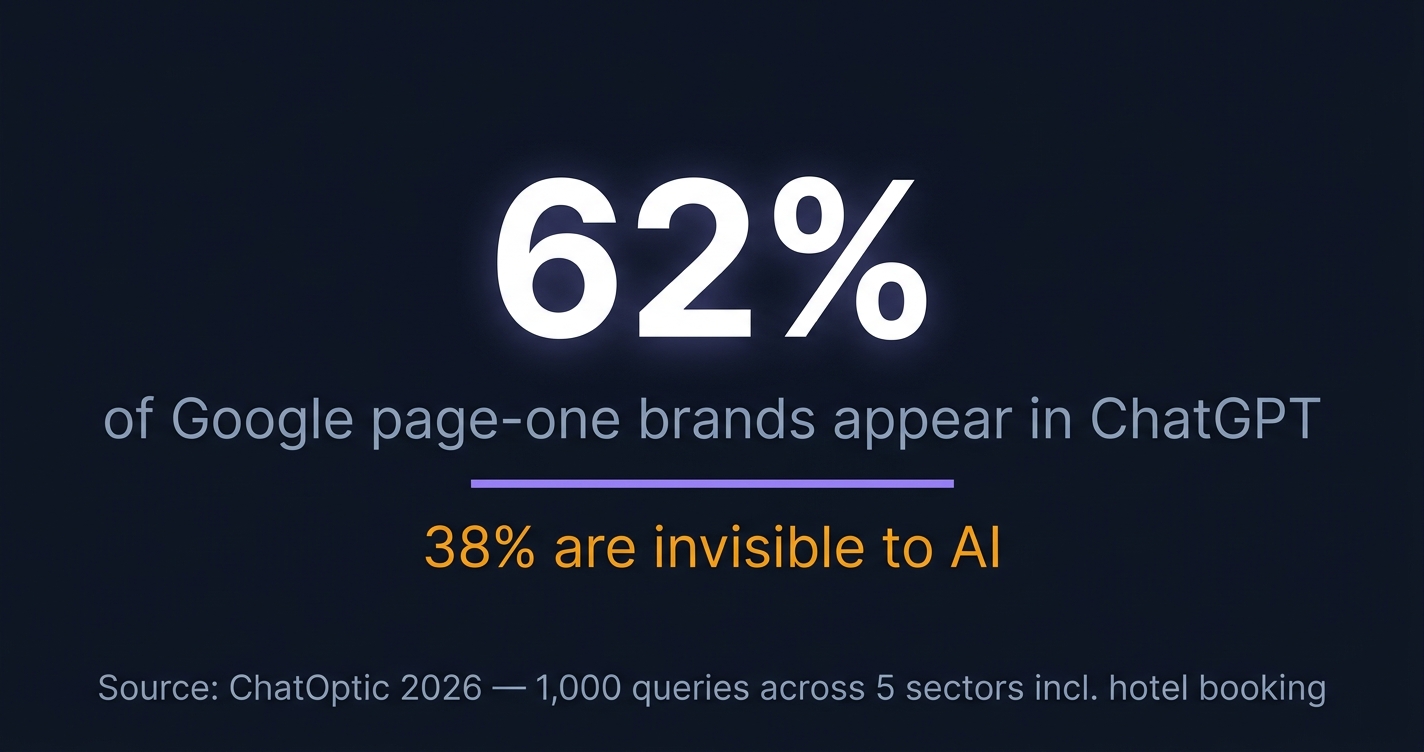
Brands ranking on Google's first page appear in ChatGPT answers only 62% of the time. That's from a study of 1,000 matched queries across five competitive sectors, including hotel booking, led by ChatOptic in 2026, testing GPT-5 with and without web access.
Turn that around: nearly 4 out of 10 first-page brands, including hotels, are completely invisible to ChatGPT. And turning on ChatGPT's browsing capability increased alignment by just 1%. Google rankings alone don't guarantee AI visibility.
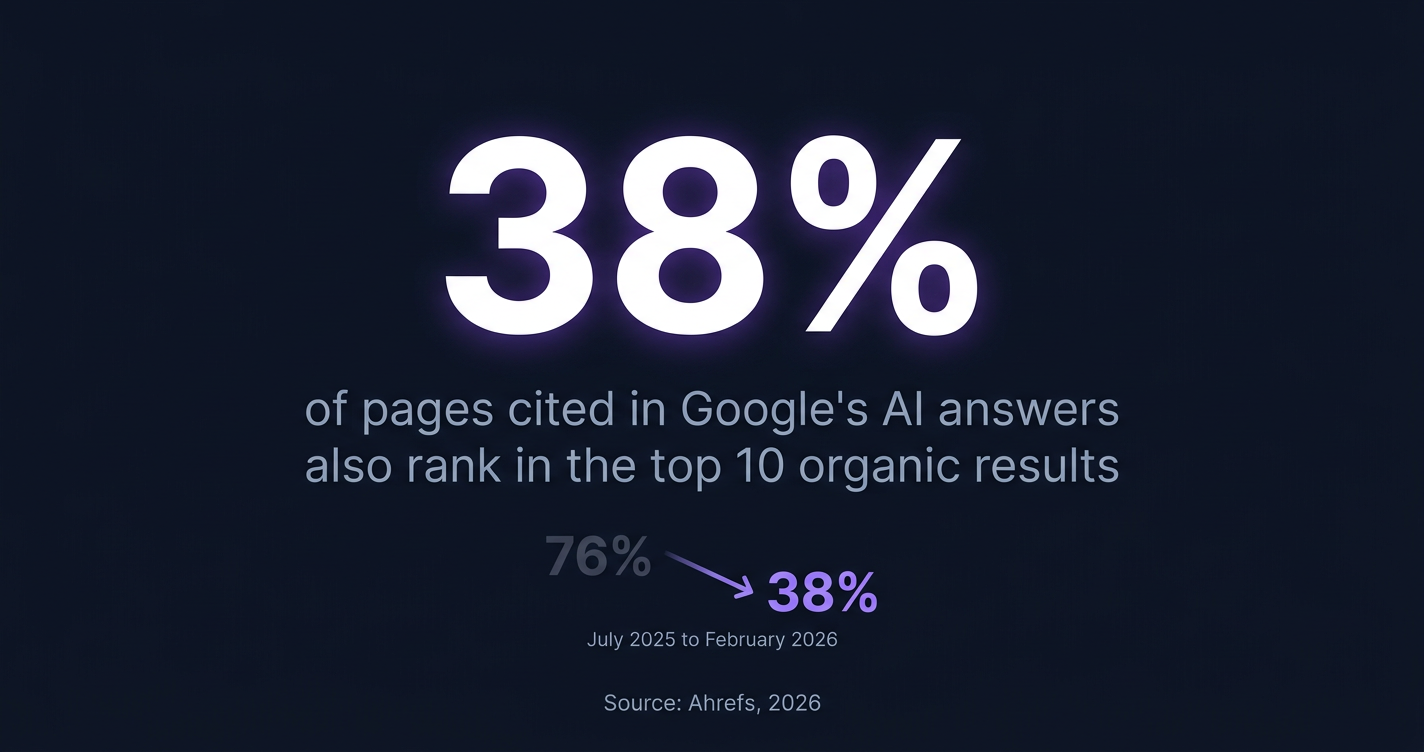
Meanwhile, AI Overview citations from Google's top 10 results have dropped from 76% to roughly 40% in under a year. Google's own AI is increasingly pulling from pages outside the traditional top 10, pages that answer sub-queries, not just the main keyword.
For hotels, this means your SEO investment still pays dividends. But it's no longer the whole picture. The other 38-40% of the picture is GEO.
How AI Actually Finds Your Hotel
When a traveller asks ChatGPT "best family hotel in Barcelona near the beach," the system doesn't run one search. It fires 8-15 sub-queries simultaneously, a process called Query Fan-Out (QFO).
Those sub-queries might include:
- "family-friendly hotels Barcelona beach"
- "Barcelona beachfront hotel with kids club"
- "best family hotel Barceloneta reviews"
- "Barcelona hotel kids pool family room"
- "Barcelona beach hotel safety family neighbourhood"
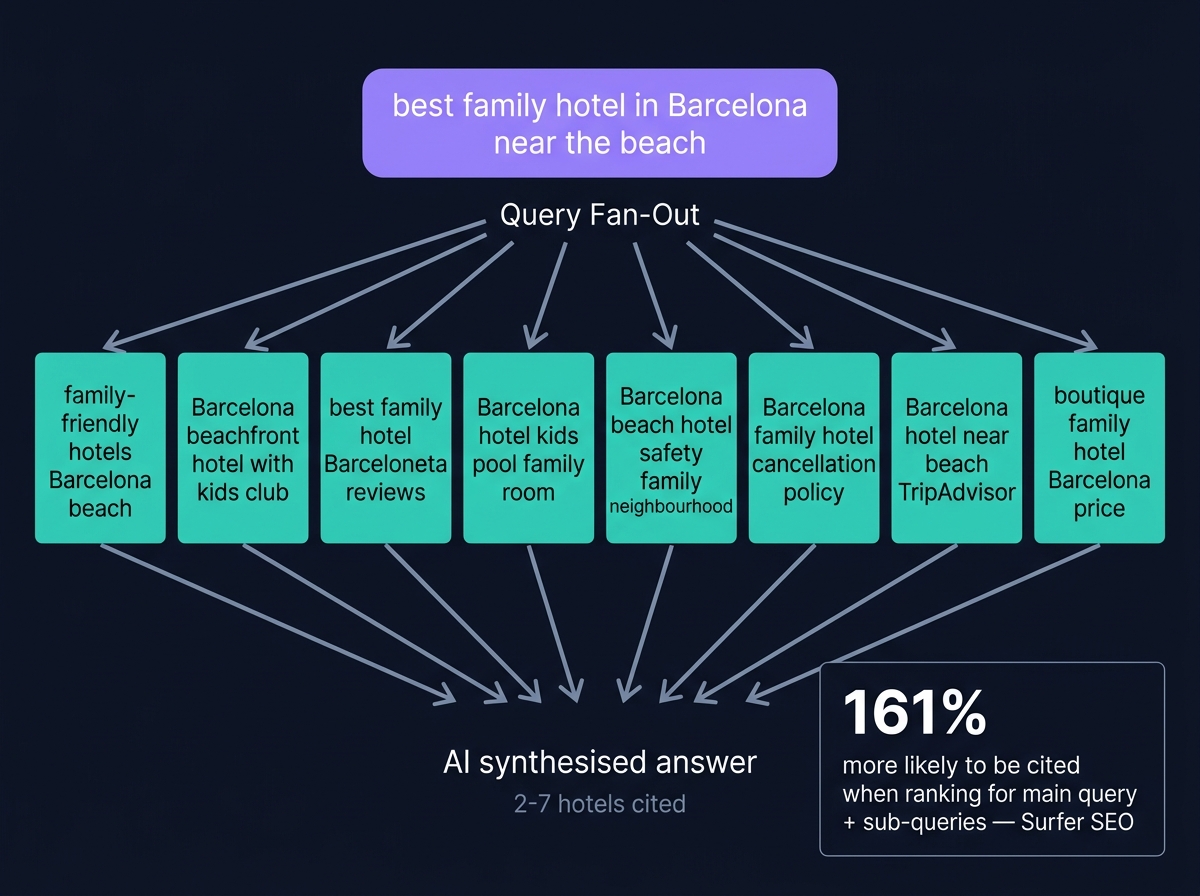
Each sub-query returns its own set of results. AI then reads the actual pages, extracts relevant passages (optimally 134-167 words per passage), cross-references them, and synthesises a recommendation.
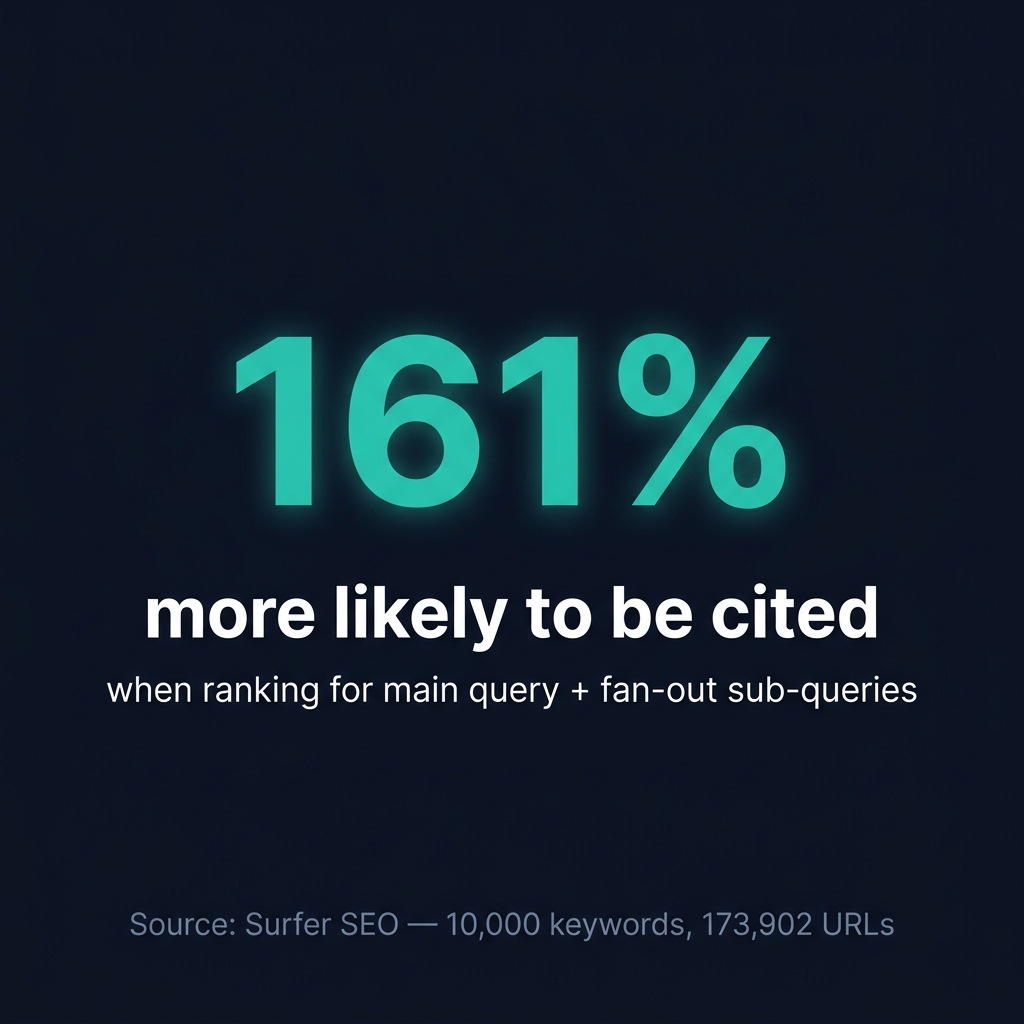
Pages that rank for the main query AND at least one fan-out sub-query are 161% more likely to be cited in AI answers, according to Surfer SEO's analysis of 10,000 keywords and 173,902 URLs.
Here's the catch: only 27% of sub-queries remain stable across repeated searches. The other 73% change every time. You can't game this by targeting specific sub-queries, you need broad topical coverage that catches the net wherever it falls.
What Still Works: Traditional Hotel SEO
The fundamentals haven't changed. They've become the foundation that everything else builds on.
Technical SEO
Your site needs to be crawlable, fast, and well-structured. Core Web Vitals still matter, pages that load in under 3 seconds, shift minimally, and respond quickly to interaction. Internal linking that helps both Google and AI crawlers understand your site hierarchy. Clean URL structures. Proper redirects. An XML sitemap that's current.
None of this is new. But without it, nothing else on this list works, neither for Google nor for AI.
E-E-A-T (Experience, Expertise, Authority, Trust)
96% of AI citations come from pages with strong authority signals. For hotels, this means:
- Experience: First-party content about your property, your neighbourhood, your guests' experiences. AI values content that couldn't have been written by a copywriting agency with a stock photo library.
- Expertise: Detailed, specific information about your rooms, amenities, dining, and destination. Vague marketing copy doesn't get cited.
- Authority: Backlinks, brand mentions, and presence across trusted platforms (TripAdvisor, Booking.com, Google Business Profile).
- Trust: Consistent information across all your digital touchpoints. When your website, your OTA listings, and your Google Business Profile agree, AI trusts you more.
Local SEO
For hotels, local SEO is non-negotiable. Your Google Business Profile, Bing Places listing, and Apple Maps presence feed directly into AI retrieval systems. Gemini draws from your GBP. ChatGPT and Microsoft Copilot draw from Bing. Perplexity cross-references multiple platforms.
If you haven't claimed your Bing Places listing, do it today, 15 minutes of work that's a prerequisite for showing up when any of ChatGPT's 900 million weekly users asks for a hotel.
What's New: The GEO Layer
GEO is the set of optimisations that make your content citable by AI, not just indexable by Google. Here's what changes.
Structured Data That AI Can Parse
Only 10.6% of hotels have good schema markup. Pages with structured data are 73% more likely to be selected by AI systems. For hotels, this means implementing Schema.org's Hotel type with:
- Property name, star rating, coordinates
- Room types and amenities as structured fields
- FAQ schema on key pages (pages with FAQ schema are significantly more likely to appear in Google AI Overviews)
- Aggregate ratings and review counts
We covered this in depth in our hotel schema markup guide.
Content Answerability
AI doesn't read your page like a human. It extracts passages, 134-167 word blocks that can stand alone as complete answers. Content scoring 8.5/10 or higher on semantic completeness is 4.2x more likely to be cited.
What this means in practice:
- Lead every section with the answer. Don't build up to your point, state it first, then elaborate. AI extracts the first sentences of a passage, not the last.
- Write self-contained paragraphs. Each H2 section should make sense if read in isolation, without the rest of the page.
- Use specific numbers, dates, and named sources. Adding statistics increases AI visibility by 22%. Adding quotations from named experts increases it by 37%.
- Answer the questions your guests actually ask. Not "About Our Hotel", but "What's the best area to stay in Barcelona for families?" and "Is this hotel walking distance from the beach?"
Entity Consistency Across Platforms
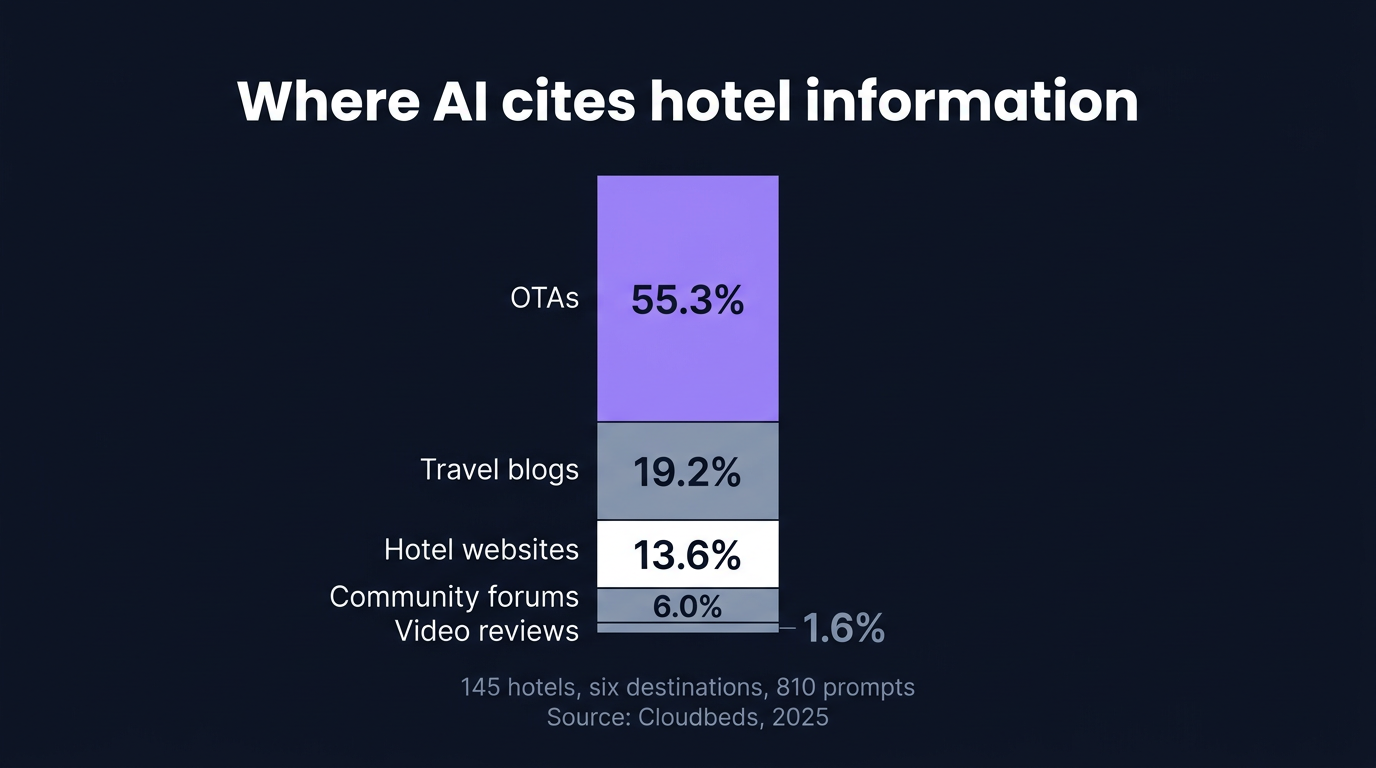
Most of what AI knows about your hotel doesn't come from your website. It comes from third-party sources, OTAs, review platforms, directories, and Google Business Profile. If your property name, star rating, room categories, or amenity list differs between sources, AI has to choose which version to trust. Often, it chooses wrong.
Audit your presence on Google Business Profile, Bing Places, TripAdvisor, Booking.com, and Expedia. Every field should match your website exactly. This is not a one-time task, it's ongoing maintenance, like updating rates.
Multi-Platform Distribution
Publishing only on your own website limits AI citations. Brands that publish on 3 or more external platforms see 325% more AI citations compared to those that publish only on their own site.
For hotels, this means:
- Maintaining rich, current OTA profiles (not just rate feeds)
- Contributing destination content to travel publications
- Responding to reviews on TripAdvisor and Google (review responses are indexed)
- Keeping YouTube content current, YouTube captures 23.3% of all AI citations, more than any other single platform
The Two-Masters Framework
In 2026, your hotel website serves two masters: Google's crawler and AI's retrieval pipeline. The good news is that roughly 62% of the work overlaps. The bad news is that 38% doesn't.
Here's how to think about the split:
| What serves Google | What serves AI | What serves both |
|---|---|---|
| Keyword density and placement | Passage-level answerability | Quality, original content |
| Backlink profile | Entity consistency across platforms | Schema markup |
| Title tags and meta descriptions | Self-contained H2 sections | E-E-A-T signals |
| Internal linking structure | Multi-platform distribution | Technical performance |
| URL structure | FAQ schema + natural language | Google Business Profile |
| Page experience signals | Content freshness signals | Mobile-first design |
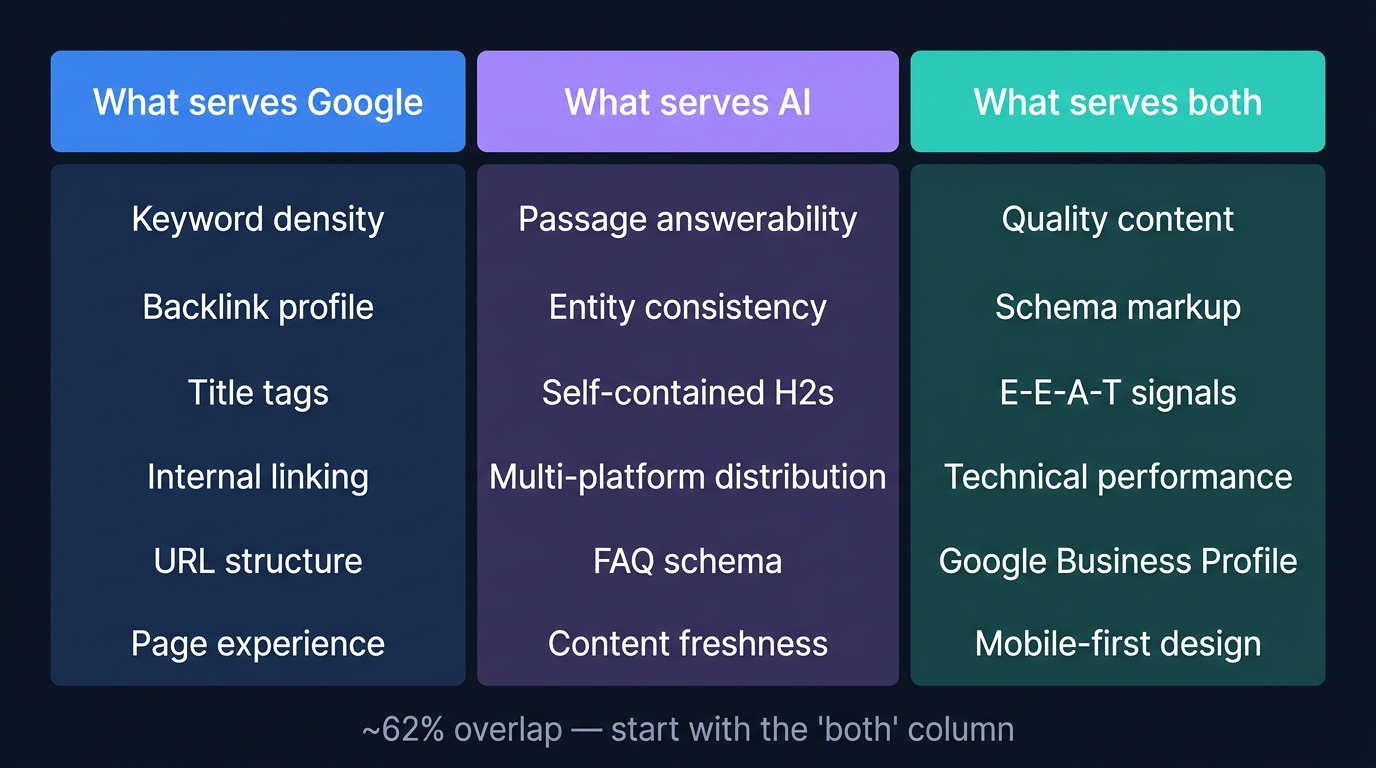
The most efficient hotel SEO strategy in 2026 is to start with the "both" column. If your schema markup is solid, your content is genuinely useful, your technical SEO is clean, and your E-E-A-T signals are strong, you're already 80% of the way there for both Google and AI.
The remaining 20% is GEO-specific work: restructuring content for passage extraction, ensuring entity consistency across every platform, implementing FAQ schema, and distributing content beyond your own website.
Where to Start
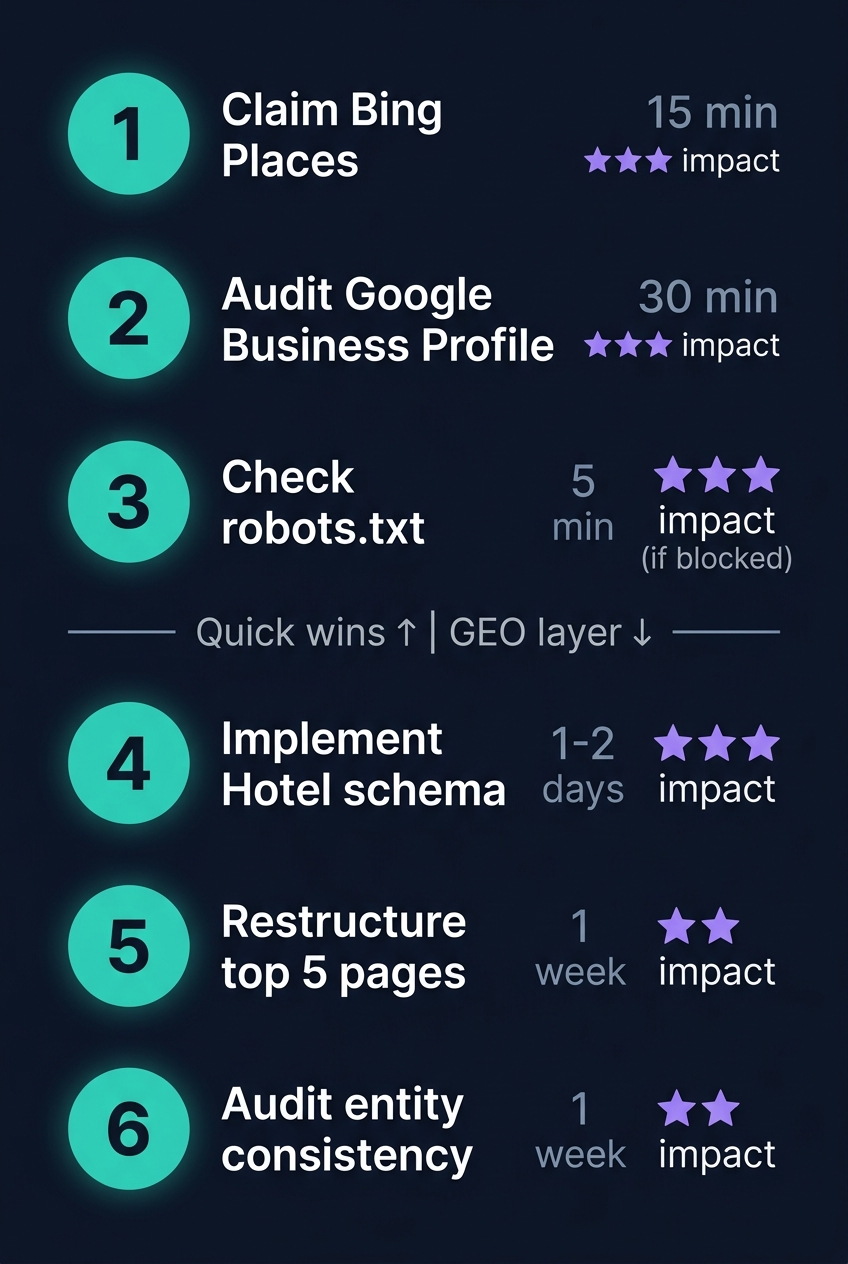
If you're a hotel commercial director looking at this and thinking "that's a lot," here's the priority order:
- Claim Bing Places (15 minutes). Feeds ChatGPT and Microsoft Copilot. Most hotels haven't done this.
- Audit Google Business Profile (30 minutes). Complete every field. Add fresh photos. Respond to recent reviews.
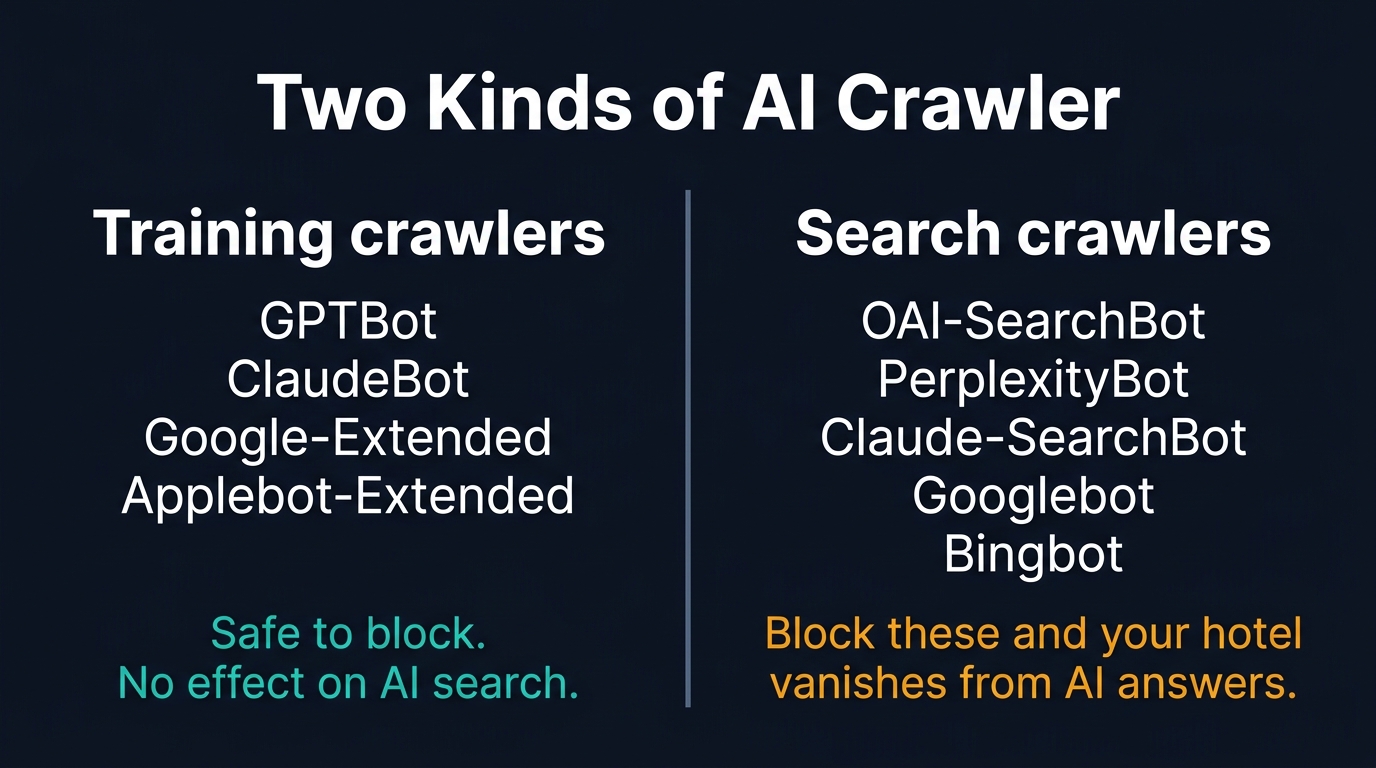
- Check your robots.txt (5 minutes). Make sure you're not blocking GPTBot, ClaudeBot, or PerplexityBot. Only 3.3% of hotels block AI crawlers, but if you're one of them, nothing else matters.
- Implement Hotel schema (1-2 days with a developer). The single highest-impact GEO investment.
- Restructure your top 5 pages for answerability (1 week). Add FAQ sections, lead with answers, ensure each section is self-contained at 134-167 words.
- Audit entity consistency (1 week). Align your name, star rating, amenities, and contact details across all platforms.
Items 1-3 are quick wins. Items 4-6 are the GEO layer that separates visible hotels from invisible ones.
The Bottom Line
Hotel SEO in 2026 isn't dead, it's necessary but insufficient. Google rankings remain the foundation: they determine which pages AI retrieves when it fires those 8-15 sub-queries. But ranking alone doesn't guarantee citation.
What makes AI recommend a hotel is the quality, structure, and consistency of its data, across its own website, across third-party platforms, and in a format AI systems can extract and cite. That's GEO.
The hotels that invest in both will compound their advantage. The ones that treat SEO and GEO as separate projects, or ignore GEO entirely, will watch their competitors appear in AI answers while they remain invisible.
Mystery Shop tests your hotel's AI visibility, website credibility, and offer accuracy across 50+ checks, including schema markup, AI crawler access, and what ChatGPT, Gemini, and Perplexity actually say about your property. It's free and takes two minutes.
Frequently Asked Questions
Is hotel SEO still worth investing in for 2026?
Yes, hotel SEO remains essential because it determines which pages AI retrieval systems find when processing queries. When ChatGPT or Google's AI Overviews fire 8-15 sub-queries to answer a travel question, they search Google and Bing's indexes. Pages that don't rank well for these sub-queries never enter AI's consideration set. However, ranking alone is no longer sufficient. Only 62% of brands on Google's first page appear in ChatGPT answers, meaning nearly 4 in 10 top-ranking hotels are invisible to AI. The most effective hotel SEO strategy in 2026 combines traditional optimisation (technical SEO, E-E-A-T, local SEO) with GEO-specific work: structured data, content answerability, and entity consistency across platforms.
What is GEO and how is it different from SEO for hotels?
Generative Engine Optimisation (GEO) is the set of practices that make your hotel's content citable by AI systems, not just indexable by search engines. While hotel SEO focuses on ranking in Google and Bing results, hotel GEO focuses on being extracted and cited in AI-generated answers from ChatGPT, Gemini, Perplexity, and Google AI Overviews. The two overlap by roughly 62%: quality content, schema markup, and E-E-A-T signals serve both. The 38% that differs includes passage-level answerability (structuring content in 134-167 word self-contained blocks), entity consistency across all platforms (not just your website), FAQ schema implementation, and multi-platform content distribution. Hotels need both SEO and GEO working together.
What is Query Fan-Out and why should hotels care?
Query Fan-Out (QFO) is how AI search engines decompose a single user question into 8-15 simultaneous sub-queries. When a traveller asks "best family hotel in Barcelona near the beach," AI doesn't run one search, it fires parallel queries for family-friendly hotels, beachfront locations, kids' amenities, neighbourhood safety, and guest reviews. Pages that rank for the main query AND at least one fan-out sub-query are 161% more likely to be cited in AI answers. Hotels should care because only 27% of sub-queries are stable, the rest change each time. Broad, detailed content that covers your property's destination, amenities, and guest experience catches more sub-queries than narrow keyword targeting.
How do I optimise my hotel website for both Google and AI?
Start with what serves both: implement Schema.org Hotel markup with star rating, coordinates, room types, and amenities. Ensure your Google Business Profile and Bing Places listing are complete and current. Write detailed, original content about your property and destination. Build strong E-E-A-T signals through authentic guest content, expert destination guides, and consistent information everywhere. Then add the GEO layer: restructure top pages so each H2 section is a self-contained 134-167 word passage that AI can extract independently. Add FAQ sections with natural-language questions your guests actually ask. Audit entity consistency across your website, OTA listings, Google Business Profile, TripAdvisor, and Bing Places, every field should match. Publish on 3+ external platforms beyond your own site, as this increases AI citations by 325%.
Which AI platforms use Google rankings to find hotels?
All major AI platforms rely on traditional search indexes as part of their retrieval pipeline. ChatGPT uses Bing as a primary data source plus its own OAI-SearchBot crawler. Google Gemini and Google AI Overviews draw from Google's search index and Google Business Profile. Perplexity maintains its own index but also queries Google and Bing. Microsoft Copilot uses Bing. Even Grok incorporates search results alongside social media signals. This means your Google rankings directly influence whether AI can find your pages, but each platform also has unique data sources (Gemini prioritises Google Business Profile, ChatGPT prioritises Bing Places, Perplexity blends multiple indexes), so optimising for one search engine alone won't maximise AI visibility across all platforms.