Your Hotel Website Has Two Audiences Now
In late January 2026, Accor's CEO told Skift the company had launched its booking engine inside ChatGPT. A few months later, at the Phocuswright AI Summit, Marriott's marketing leadership confirmed they're now running parallel SEO and GEO programs as separate workstreams.
That's the chain side of the story. The independent side looks different.
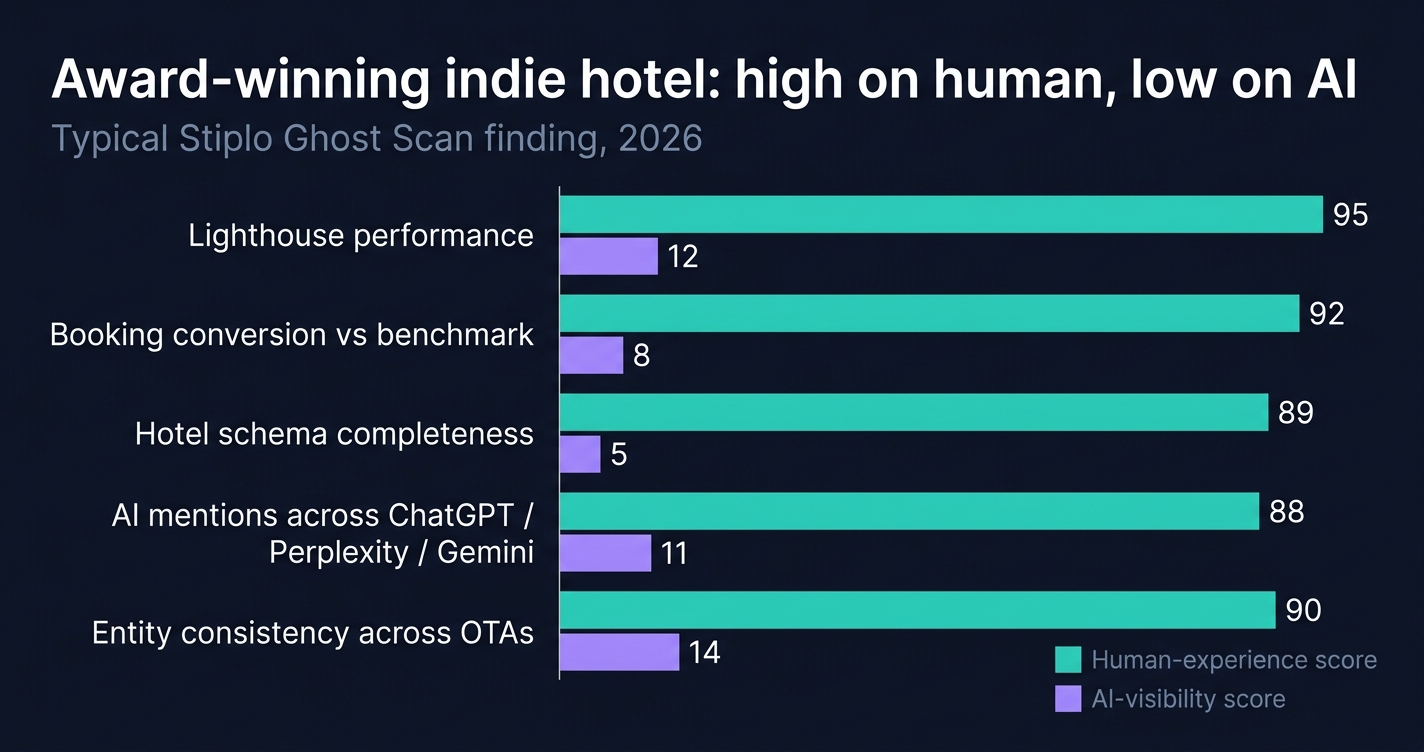
We recently reviewed a redesigned boutique hotel site in Lisbon. Visually, it was excellent: fast, polished, mobile-friendly, clearly built by a serious agency. Across a set of AI recommendation prompts, the property was barely visible. The site had been optimised for the guest who had already arrived, not for the systems increasingly deciding which hotels get considered in the first place.
That gap is now the most expensive thing on most hotel websites. Hotel website optimization used to mean speed, design, and conversion rate. It now means optimizing for two evaluators (human guests and AI systems) and the gap between hotels that do this and hotels that don't is widening.
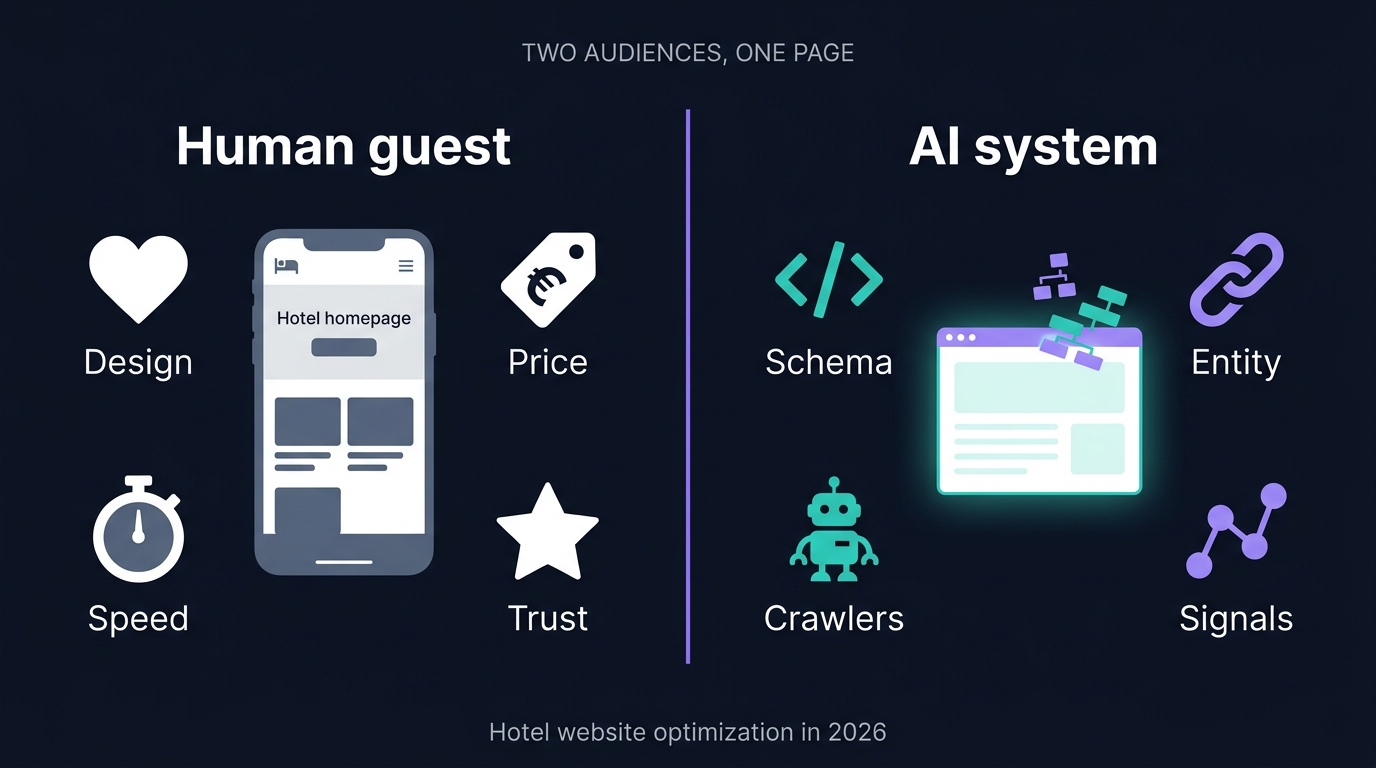
The Two Audiences Are Real
Every modern hotel website has two distinct evaluators: human guests who judge it visually in seconds, and AI systems (ChatGPT, Gemini, Perplexity) that read it mechanically through schema, entity matching, and crawlability. AI isn't really an audience in the conversational sense. It's a discovery and interpretation layer that decides which hotels enter consideration before a human ever clicks. But it acts on the same page, in parallel, and judges different things.
A human reaches your homepage, evaluates your design, scans your offers, and decides whether to book. The decision points are emotional and visual: do I trust this place, are the images consistent with the price, is the booking flow obvious.
AI systems may decompose the same query into several related searches, retrieve information from search indexes, structured web content, partner data, and their own model memory, then synthesise a recommendation. The decision points are mechanical: is there Hotel schema, does the entity match across sources, are amenities specified, is the third-party reputation consistent.
ChatOptic's 2026 study of 1,000 queries across five sectors found only 62% overlap between Google rankings and LLM visibility, 58% in the hotel booking subset. Of well-ranked sites, 38% are absent from AI answers. Inversely, sites AI cites confidently sometimes don't crack Google's top 10. The two evaluators are using different filters.
A hotel can now have a high-converting website and still be underrepresented at the point where guests are deciding which hotels to consider.
Commercial Integrity: One Root Problem, Two Failures
The working definition of commercial integrity is the alignment between what your hotel says about itself, what third parties say about it, and what guests actually experience.
For human guests, that shows up as: prices match across pages, offers are current, photos are accurate, the booking flow is honest, the cancellation terms are clear.
For AI systems, it shows up as: schema matches your marketing copy, OTA listings match your website, Google Business Profile matches your TripAdvisor profile, your name and category and amenities are identical across every retrievable surface.
These two failure modes look unrelated on the surface (broken offers vs missing schema) but they share one root cause: nobody owns the data layer end-to-end. A hotel that misrepresents itself to AI is usually misrepresenting itself to guests too, just less visibly. AI surfaces the contradiction faster because it reads every source in parallel and registers the inconsistency immediately. A guest may shrug it off, bounce to an OTA, or book and leave a one-star review three weeks later because the room they got didn't match the room they expected.
The same data hygiene problem now affects both conversion and discovery. A hotel that fixes its data so AI can read it accurately tends to clean up the same data its human guests have been quietly tripping over for years.
What Breaks for Guests
Human guests are likely to abandon when:
- Offers are broken. The "Spring Sale" banner still up in November, the rate code that's expired, the package page that 404s when clicked.
- Pricing is inconsistent. The room shown at €240 on the rates page that becomes €310 in the booking engine after taxes appear.
- The journey has friction. A booking widget that takes nine seconds to load, a date picker that doesn't accept the dates the visitor came to book, a chat widget that hijacks scroll on mobile.
- Trust signals are missing or stale. Outdated photos, missing cancellation terms, broken language switchers, contact pages with phone numbers that go to a fax line.
These failures don't lose visibility. They lose the booking after the click. Guests who don't trust the site bounce to Booking.com, where they trust the inventory more, even if it costs you 15 to 25% in commission.
What Breaks for AI Systems
AI systems are less likely to retrieve, classify, or recommend a hotel when:
- Schema is missing or generic. 36.3% of hotel homepages have no structured data at all, per HotelRank.ai's schema study of 121,425 properties. Another 41.1% of those that DO use markup picked a generic type like Organization or LocalBusiness rather than Hotel schema. To a machine-readable system, they have made it harder to classify the property confidently as a hotel.
- Crawlers are blocked. As of July 2025, Cloudflare flipped the default for new domains to block all known AI crawlers. Many hotels migrated to Cloudflare and quietly lost AI visibility at the WAF layer, with no visible signal in robots.txt.
- Entity data is inconsistent. A hotel referred to one way on its website and another on Booking.com or TripAdvisor doesn't get linked confidently in AI's entity graph. Inconsistent properties either appear as duplicates or with reduced visibility.
- Copy is vague. "Stunning views" is harder for AI systems to use than "Panoramic views of the Arno from floors 4 to 7." Vague claims are difficult to verify or match against third-party sources.
- The AI surfaces are unclaimed. Half of hotel websites still don't have an FAQ page, which removes a major surface AI can pull verbatim. Bing Places (the index that feeds ChatGPT, Perplexity, and Copilot) is similarly under-claimed across the category.
These failures don't lose conversion. They lose consideration. A property that isn't surfaced cannot be booked.
Why Award-Winning Hotel Website Design Still Fails AI
The site may pass the traditional website checklist while failing the newer machine-readability checklist. A typical Stiplo Mystery Shop of a recently redesigned boutique property finds:
- Lighthouse 95+ and category-benchmark booking conversion
- Award-winning visual design
- Zero Hotel schema, or generic Organization markup
- Empty or missing FAQ page
- Cloudflare bot management blocking GPTBot at the WAF layer
- Bing Places never claimed
- Google Business Profile claimed but at 60% completeness
- Recent reviews unanswered for a month or more
- Mentioned by AI in roughly one of nine query attempts across the major models
It isn't that the redesign was wrong. The brief didn't include the second evaluator.
The reason is structural. Hotel website design as a discipline grew up in the 2010s, when SEO was the only retrieval game in town. CMS templates ship without Hotel schema by default. DAM systems don't enforce structured metadata. Web agencies don't audit robots.txt. Booking engines don't expose entity-level data. None of that was wrong in 2018. All of it is now incomplete.
Marriott's parallel-program disclosure isn't a chain peculiarity. It's the operating model emerging across the category.
Most of AI's Hotel Knowledge Comes From Beyond Your Website
In our audits, a large share of the signals AI systems use to describe a hotel appear to come from outside the property's own website: OTA listings, Google Business Profile, reviews, travel guides, third-party content of all kinds. The site is one important source among many, not the whole story.
For human guests, you control 100% of the website experience and OTA listings exist as a different funnel. For AI systems, your website is the minority voice. The majority voice is controlled by descriptions you wrote on Booking.com five years ago, reviews left by a guest who stayed last month, and a travel blog that visited in 2023.
This is why review management is GEO strategy. It's why entity consistency is GEO strategy. It's why your TripAdvisor listing still matters even if you no longer use TripAdvisor commercially. AI synthesises by majority. If five OTA listings call your property "4-star boutique" and your website calls it "luxury collection", the AI goes with the OTA majority.
AI Rewards Specificity, Not Brand Size
The instinct in the indie segment is that AI is a chain game. The data suggests the opposite: AI systems appear to reward properties with clear, specific, corroborated information. That can favour independents when their content is distinctive and their data is clean. It can also favour groups that manage entity data properly across every property, and penalise groups that don't, regardless of brand strength.
Generic templated marketing copy reads the same as the property next door, which makes it hard for AI to attach the right details to the right entity. Specific, original content about location, distinctive amenities, and identifiable character is what gets cited. The advantage is available to anyone who treats each property as a real, specific entity rather than a row in a CMS.
What to Check This Week
Three concrete checks for both evaluators:
- AI side, five minutes. Open your robots.txt and look for blocks on GPTBot, ClaudeBot, PerplexityBot, OAI-SearchBot, and Googlebot-Extended. Run your homepage through Google's Rich Results Test and look for Hotel schema. Ask ChatGPT, Perplexity, and Gemini to recommend a hotel matching yours. Score yourself out of three.
- Guest side, ten minutes. Open your homepage on a phone, search for your hotel name, find a deal, click through to book, abandon at the payment page. Notice what frustrates you.
- Compare. Where are guests stuck? Where is AI confused? The overlaps (outdated content, broken links, missing context, copy that's vague where it should be specific) are usually the same items.
The work that fixes one usually fixes the other.
See Both Evaluators in One View
Mystery Shop is built around the two-evaluator principle. Every scan reports what your guests see and what AI sees on the same property at the same time. Where they agree, where they don't, what's missing for each, and what to fix first.
Two minutes. Free. Run it on any hotel, including yours.
Frequently Asked Questions
What is commercial integrity for hotels?
Commercial integrity is the alignment between what your hotel says about itself, what third parties say about it, and what guests actually experience. Concretely, it means prices match across pages, offers are current, schema matches your marketing copy, OTA listings match your website, and your name, category, and amenities are identical across every retrievable surface: your own site, Google Business Profile, Bing Places, Booking.com, Expedia, TripAdvisor. The same data hygiene problem affects both conversion and discovery, which is why fixing one usually fixes the other.
Is GEO replacing SEO for hotels?
No. SEO and GEO are interlocking disciplines. SEO gets your content into the retrieval pool that AI fans out into. GEO ensures AI represents you accurately when it picks something out of that pool. A hotel that drops SEO loses Google traffic and the ranking signals that feed AI retrieval. A hotel that ignores GEO ranks well in Google and gets misrepresented or skipped by AI. The hotels winning both are running them as named workstreams, the way Marriott now does.
What is the ROI of hotel AI visibility?
The ROI is still emerging, but the commercial logic is clear. ChatGPT sends 91.1% of its hotel links direct to hotel websites, and revenue per visit from AI traffic is roughly 80% higher than non-AI traffic (Loamly 2026). If AI assistants increasingly influence hotel consideration (and 83% of travellers now use or want to use AI for trip planning, per the TravelBoom 2026 study) then being absent, misrepresented, or linked through an OTA instead of your own site has direct revenue implications. The first step is measurement, not blind investment.
Can a hotel optimize for AI without an in-house technical team?
Yes. The work is bounded and outsourceable. The structural pieces (schema, robots.txt, Cloudflare configuration) are a defined sprint for a freelancer or agency, typically two to three weeks. The data hygiene pieces (GBP, Bing Places, OTA listing consistency) are a one to two week discipline a marketing manager can run. The content depth pieces (FAQ, amenity specifics, destination context) are an ongoing editorial effort, the same one that already serves your human audience. Most independents are paying for some of this work already, just under "SEO" or "website maintenance" line items without specifying that the work needs to satisfy both evaluators. Specifying changes the deliverable.
Want to see how your hotel website performs?
A Mystery Shop checks 30 pages for commercial integrity issues in minutes.
Request a free Mystery Shop