When ChatGPT Recommends Hotels, 91% of Links Go Direct
On 6 May 2026, Wyndham launched a native ChatGPT app covering roughly 8,400 hotels. Travellers can browse Wyndham properties inside ChatGPT, refine results with natural-language prompts, and click through to WyndhamHotels.com to complete the booking.
Read that last sentence again, slowly.
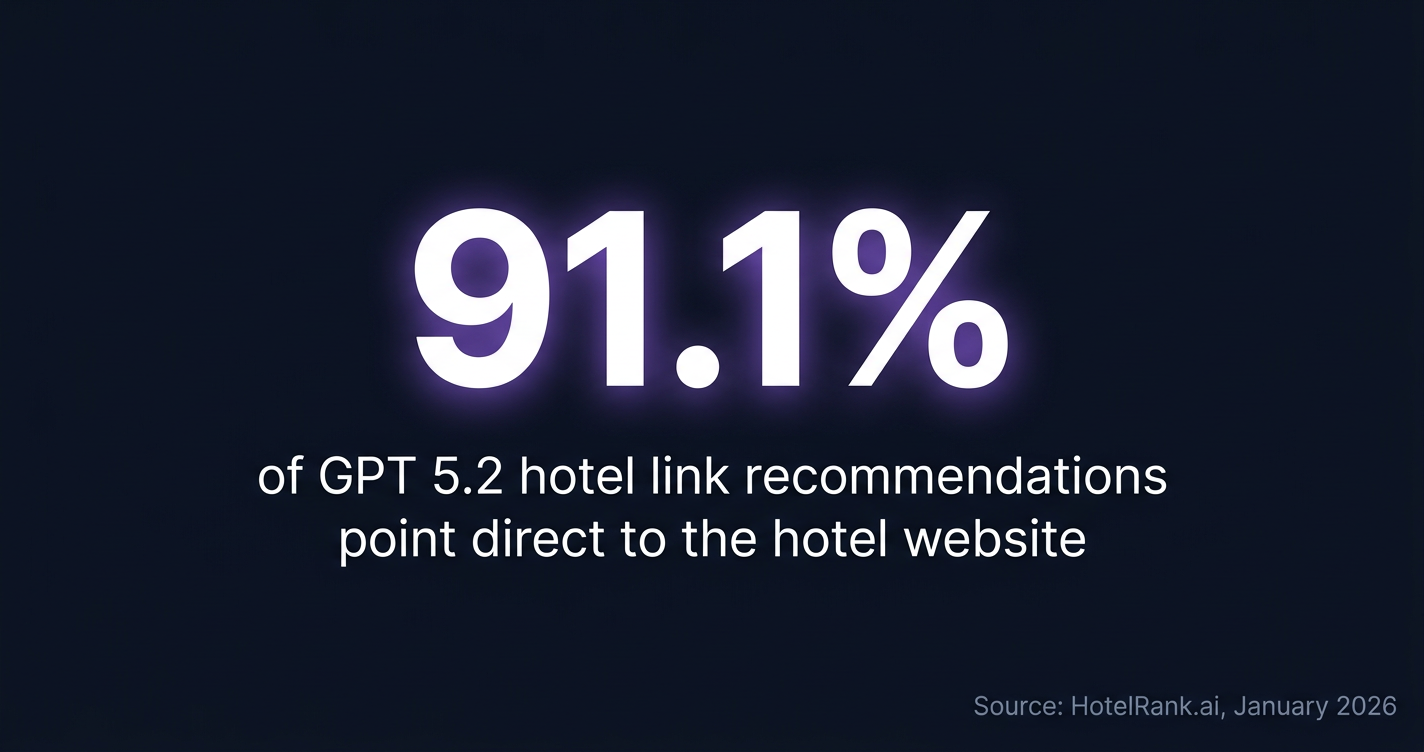
For fifteen years, every new discovery surface has ended up as another middleman. AI looks like it might break the pattern. HotelRank.ai's January 2026 study, covering more than 31,000 hotels and around 10,000 prompts, found that 91.1% of GPT-5.2 hotel link recommendations pointed direct to hotel websites. Even the most OTA-heavy model in the study, Perplexity Sonar, still sent 74.7% of its hotel links direct.
Caveat that headline number before you panic-celebrate: HotelRank measured link destination per recommendation, not actual user clicks, and the study is weighted toward hotel-specific prompts rather than broad "best places to stay in X" exploration. Generic searches plausibly behave differently. Branded searches, where the user already names the property, are exactly where you would expect direct links to dominate. The pattern is still significant. It is just a more specific pattern than the one a billboard would paint.
Strip the caveats and you are left with something commercially important: AI assistants are creating direct-to-hotel handoff opportunities. The harder question is whether the hotel website is ready when the visitor arrives.
AI Reads From OTAs, Sends Users Direct
The dominant industry narrative for the last twelve months has been that AI is the new OTA problem. AI assistants read from Booking.com, Expedia and Tripadvisor, summarise their content, and recommend properties based on what the OTAs say.
Half of that holds up. Cloudbeds analysed 145 top-ranked hotel properties across six destinations in mid-2025 and found that 55.3% of the sources AI cited when answering hotel questions were OTAs. Hotel websites accounted for 13.6% of citations. As an information layer, the OTA still dominates.
Where the user is sent is a different problem. HotelRank tracked the destination of every link the AI recommended across GPT-5.2, Gemini and Perplexity. On all three platforms in their study, the link more often pointed at the hotel's own website than at an OTA.
The two findings sit together cleanly. AI reads from OTAs because OTAs publish the most structured, current, indexable hotel content on the open web. Once the AI has read enough to recommend a hotel, the user gets sent direct. Why? Two structural reasons. First, the cleanest path: the hotel's own site is usually the shortest route to the booking the user asked about, with no affiliate redirect chain in the middle. Second, latency and UX: large OTA pages, with tracking pixels, cookie banners and circular cross-sell, load slowly and clutter the AI's "use this link" suggestion. The model has nothing against OTAs. It just optimises for the user finishing the task.
HotelRank, Cloudbeds, Similarweb and Visibility Labs each measure different cuts of the same surface (link destinations, source citations, ecommerce-wide referral conversions, branded versus non-branded organic). The pattern across them is consistent enough to act on. It is not yet clean enough to over-claim.
Why AI-Referred Visitors May Convert Better
Early ecommerce data suggests AI-referred visitors convert at higher rates than organic search, although hotel-specific benchmarks are still thin.
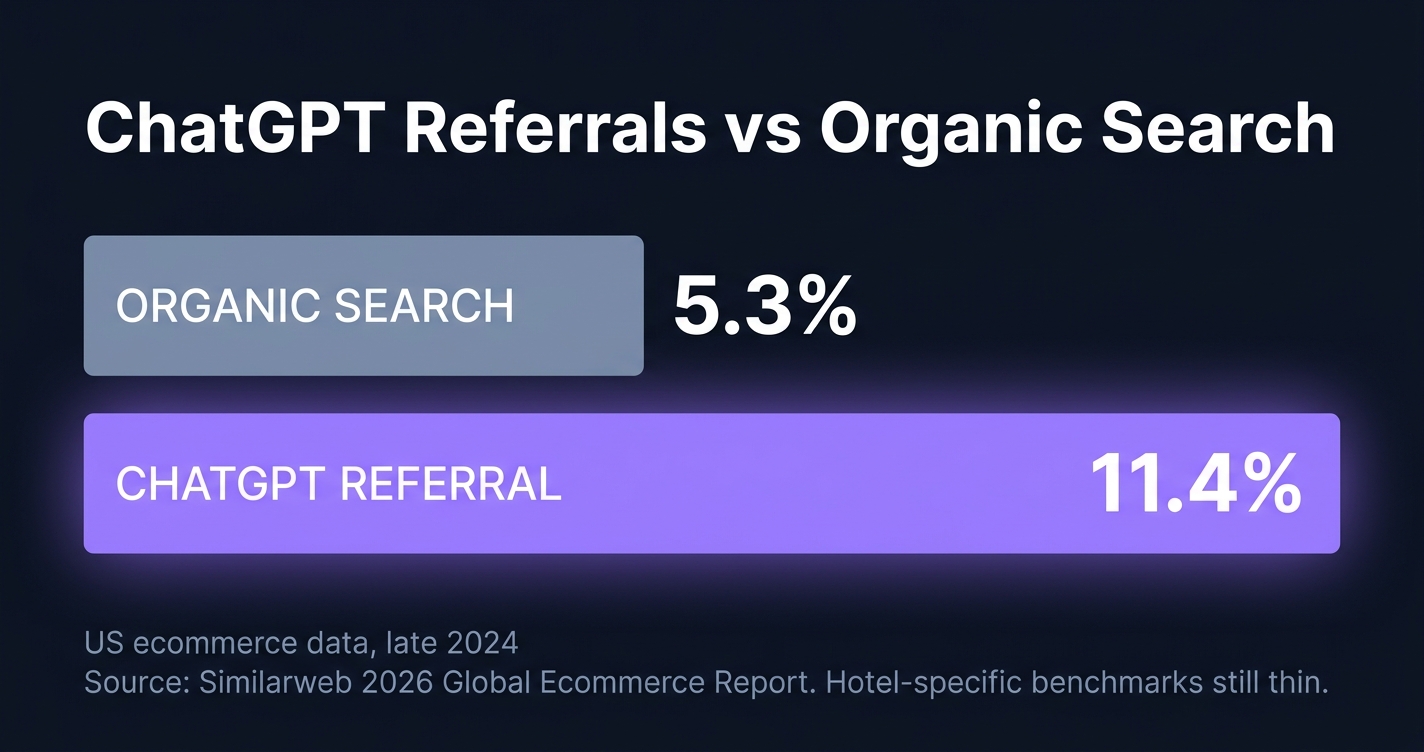
Similarweb's 2026 Global Ecommerce Report, drawing on US ecommerce traffic in late 2024, found that visits referred from ChatGPT converted at 11.4% against 5.3% for organic search. A separate analysis of 94 ecommerce sites by ALM Corp / Visibility Labs found that ChatGPT traffic converted roughly 31% better than non-branded organic, at a more modest absolute level (1.81% versus 1.39%) and on a still-tiny share of revenue. Different methodologies, different cuts of "conversion", same broad direction.
A guest who asked an AI assistant for a recommendation has already been pre-filtered. They named the destination, the dates, the trip type and any constraints they cared about. The AI did the long-list work before the click. When that AI then names a hotel by hand, the user reads it as a recommendation rather than an ad. Click intent runs hotter than paid search.
The volume side is moving. OpenAI reported 900 million weekly active ChatGPT users on 27 February 2026, up from 400 million a year earlier and 800 million in October 2025. The discovery surface added roughly 100 million weekly users in four months. TravelBoom's 2026 Leisure Travel Study found that 83% of US leisure travellers are either using AI for trip planning or have actively expressed interest in doing so, with active use jumping from 38% to 63% in twelve months.
Even if hotel AI-referral conversion lands well below the ecommerce-wide benchmarks, the commercial logic is attractive: high-intent visitors, direct handoff, no OTA commission on whatever booking follows.
A Mixed Picture for Independents (with a Hot Take)
The HotelRank numbers look like good news for independents. For GPT-5.2, HotelRank found that 53.9% of hotel link recommendations went to independent hotels, 37.2% to chains, and 8.9% to OTAs or metasearch. On that cut, independents are over-represented relative to their share of the global hotel market.
Cloudbeds tells a different story. Measuring at the recommendation level rather than the link-destination level, Cloudbeds found that 72.4% of the hotels AI recommended in their dataset were branded properties or part of large groups, with chains showing a clear visibility advantage. The two studies are slicing the same surface differently. Both are right about what they measured.
Here is the take I would lean on. Chains are sleepwalking into a visibility crisis because they have outsourced their personality to corporate templates. AI rewards detail. It rewards a specific page that says specific things about a specific property: the rooftop bar that opens at 5pm, the herringbone floors restored in 2024, the early-check-in policy that actually reflects what reception will say at 11am. Most chain property pages have stripped that detail out for brand consistency. Most independent property pages have kept it because nobody told them to stop.
The independent advantage is conditional. It only applies to independents who publish like an independent. The boutique hotel that templated its website with a generic Squarespace theme in 2022 is just a chain hotel with worse marketing. The opening is real. It just is not automatic.
Where the Handoff Leaks
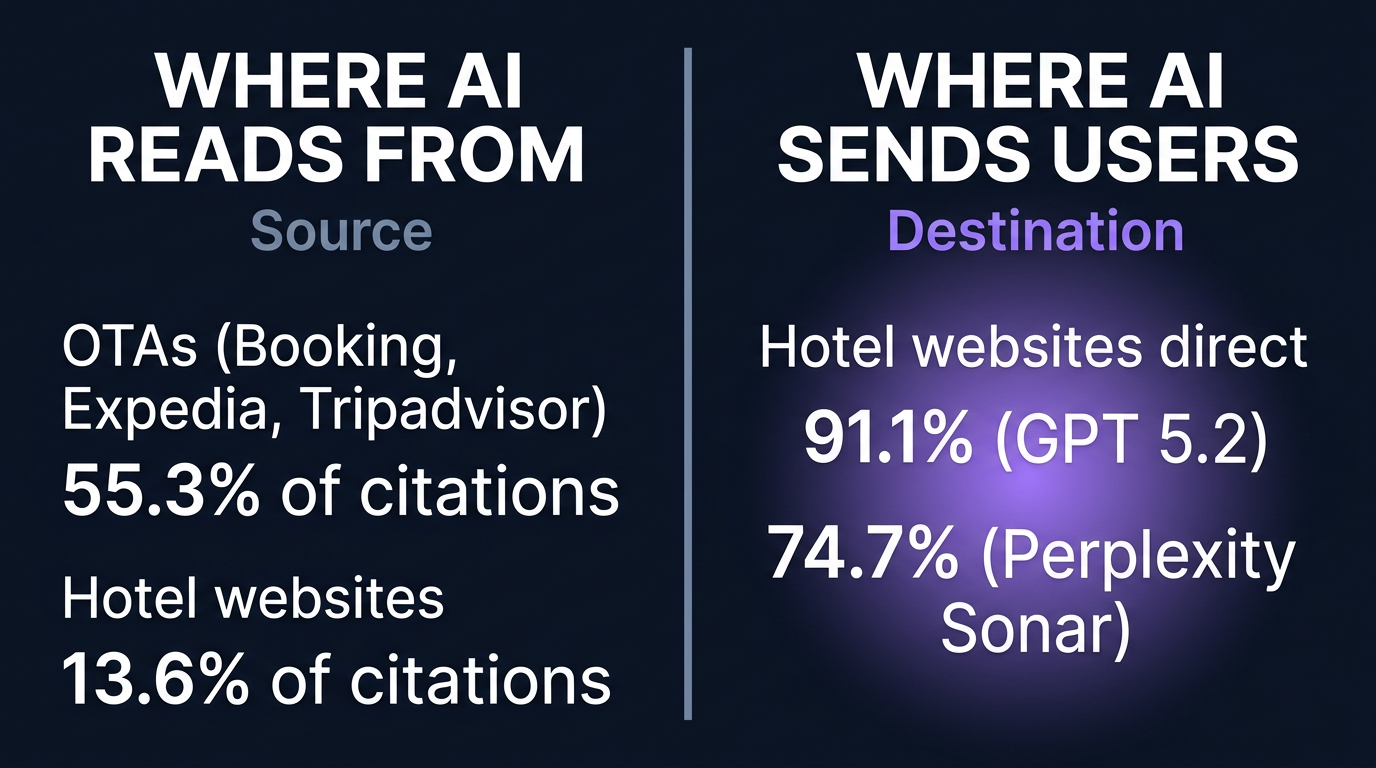
Three failure patterns recur across the properties we look at, and each blocks the AI handoff from converting.
Wrong facts on the website that AI inherits and amplifies. Cloudbeds found that nearly half of hotel brands in their dataset were misclassified by at least one AI platform: wrong star rating, missing amenities, incorrect locations. The grain matters. "EV charging" on the page is not the same as amenityFeature: Tesla Supercharger Level 3 in your structured data, and ChatGPT will skip your property when a Model Y driver asks for a specific plug type. The fix sits in schema markup, the structured data, and the content the website publishes about itself. AI averages its sources. The hotel's own content is one of those sources.
Booking funnels that work for desktop and quietly fail on mobile. SiteMinder's 2025 Changing Traveller research found that 52% of travellers had abandoned an online hotel booking because of a bad digital experience. AI traffic arrives via phones in the wild, on six-month-old Android handsets, on 4G in a hotel lobby. The booking engine that works at 1440 pixels and chokes at 360 will lose the AI-qualified visitor at step three.
Expired offers and broken paid-media landing pages. AI assistants read what is currently on the page. A spring rate that ran in March and never got removed is still being summarised in May, sometimes with the original price, sometimes with the original promotional copy. The user clicks through and finds the offer is gone. They close the tab. The AI does not know the offer expired. Your website never told it.
A useful counterweight on the optimism is Expedia's April 2026 survey: only 8% of travellers feel comfortable booking through an AI platform today, and 68% still prefer booking with a trusted travel brand even when AI booking is available. Discovery is leading completion by a wide margin. The job of the website is not to re-sell the property. By the time the AI-referred guest lands, the AI has done that. The job is to convert the visit before something on the page tells them to leave.
Stiplo Mystery Shop
That is the gap Stiplo Mystery Shop is built to close.
We test whether your site is actually AI-readable. Whether GPT-5.2's crawler can reach it. Whether the JSON-LD schema describes the hotel you actually run. Whether the amenity grid the AI sees matches the page a guest sees. Whether the booking funnel survives the click on a phone in a lobby. The output is screenshot evidence of where the AI-qualified visitor's journey breaks, what the AI is currently saying that contradicts your own site, and what to fix first.
Run a free digital mystery shop for one property.
What to Do This Month
Two things, in this order.
Open ChatGPT, Perplexity and Gemini. Ask each one to recommend a hotel matching your category and city. Read the answer carefully. Note where the AI is right about you, where it is wrong, and what it left out entirely. The gap between what the AI says and what you actually offer is the gap your website needs to close. Most of that closing happens in your structured data and your offer pages, not in your headline copy. For the longer playbook, see How AI Hotel Recommendations Work and the hotel FAQ schema guide.
Then walk the booking funnel on a phone you actually own. Mid-stay dates, two adults, ordinary search. Note where it stutters. The hotels that capture this wave will be the ones whose handoff actually completes, not just the ones whose schema is tidy.
The signals from the major operators in the last six weeks are going in one direction. Hyatt rolled out ChatGPT Enterprise across its global workforce on 20 April 2026, wiring frontier AI into revenue management, marketing operations, real estate research and World of Hyatt personalisation. Wyndham shipped its ChatGPT app on 6 May for 8,400 hotels. AI in hospitality, in the same fortnight, has been wired into both the operating layer and the discovery layer. Independents who publish in detail have an opening before the chains reset their corporate templates.
Frequently Asked Questions
Does AI really link more hotels direct than to OTAs?
In hotel-specific studies published so far, often yes, with caveats. HotelRank's January 2026 study found that GPT-5.2 directed 91.1% of hotel link recommendations to hotel websites, Gemini 75% and Perplexity 74.7%. The skew partly reflects what AI optimises for: the cleanest path from the prompt to the booking, with the fewest affiliate redirects in between. Generic exploratory queries ("good places to stay in Lisbon") plausibly send a higher share to OTAs than branded queries ("the Memmo Alfama"), where the user has effectively pre-selected.
Which AI platform creates the most direct hotel handoffs?
ChatGPT, by a wide margin. OpenAI reported 900 million weekly active users on 27 February 2026, and HotelRank found that GPT-5.2 directed 91.1% of hotel link recommendations to the hotel's own website. Perplexity is more OTA-leaning in its citations but still sent 74.7% of links direct in the same study. Gemini sits between the two, with Google Business Profile feeding heavily into the answer.
How do independent hotels compare to chains in AI recommendations?
Better than they used to, conditional on what they publish. HotelRank found 53.9% of GPT-5.2 hotel link recommendations went to independents. Cloudbeds, slicing differently, found chains held a 72.4% share at the recommendation level. The reconcilable read: chains still get recommended thanks to brand authority and OTA presence, but the link, when it lands, often sends the user to a generic property page that converts poorly. Independents who publish detailed, structured property-level content punch above their weight at the conversion step.
What conversion rate should we expect from AI hotel traffic?
There is no clean hotel-specific number yet. Across US ecommerce in late 2024, Similarweb saw ChatGPT-referred visits convert at 11.4% against 5.3% for organic search. Visibility Labs measured a 31% lift over non-branded organic at much smaller absolute levels (1.81% versus 1.39%). Hospitality benchmarks will likely settle somewhere in between as AI-referred volume scales, and they will diverge sharply between properties depending on schema accuracy and mobile booking flow. The honest answer to "what should we expect" is "track it yourself starting this month, before the volume gets noisy."
How do we know if AI is sending visits to our hotel today?
Most analytics platforms now identify AI-referred sessions in the referrer field. In GA4 the practical move is a Custom Channel Group with chat.openai.com, perplexity.ai, gemini.google.com, copilot.microsoft.com, chatgpt.com and any subdomains as defining hostnames. Volume is small relative to organic and paid in May 2026, but the conversion rate sits at the top of most reports we see. A digital mystery shop adds the diagnostic layer: what AI is saying about the hotel, where the website disagrees, and where the conversion is leaking.
Want to see how your hotel website performs?
A Mystery Shop checks 30 pages for commercial integrity issues in minutes.
Request a free Mystery Shop