The Last Three Clicks: Where Hotel Booking Funnels Lose the Guest
By the time a guest reaches your booking engine, the expensive work is already done. They searched for somewhere to stay, found your hotel, chose it, and decided to book on your own website rather than through an OTA.
Then the booking engine loses them, and not over price. They had already accepted the price. They are lost in the last stretch of the booking itself, the three or four clicks between picking a room and reaching a confirmation screen. It is the most wasteful place to lose a guest, because the hotel has already paid for everything that brought them there, and it is the place hotels examine least.
What the Last Three Clicks Are
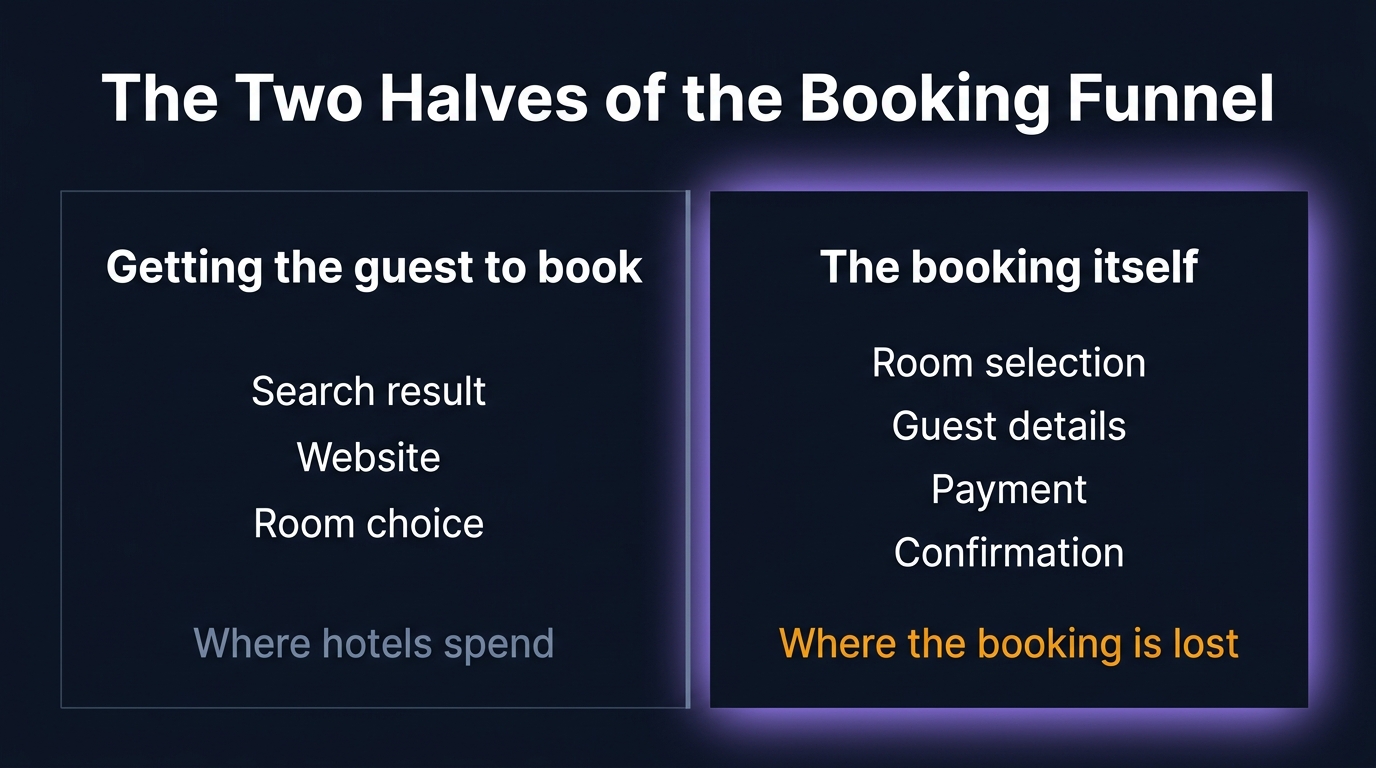
Think of a booking in two parts. Getting a guest to the point of booking is one: the search result, the website, the room they choose. Hotels put most of their budget and attention there. Taking the booking is the other: room selection, guest details, payment, confirmation. That is three or four screens, often running on a separate booking-engine system, and rarely tested the way a guest meets it.
A guest who has reached the second part is the highest-intent traffic a hotel has. At that stage they already intend to book. What happens next depends on whether the booking engine lets them finish, and most of what loses them is friction in the final screens rather than weaker intent.
How a Booking Engine Loses a Guest Who Wanted to Book Direct
The booking engine is usually a separate piece of software, often from a third-party vendor, attached to the website and rarely tested the way a guest experiences it. Most of what goes wrong starts in that gap.
The handoff is the first break. The guest clicks Book Now and lands on a domain that is not the hotel's. It might be a SynXis, Mews, SHR or Bookassist subdomain, often with different branding, a different layout, sometimes an unfamiliar name in the address bar. They came to book the hotel they were just looking at, and now they are somewhere else being asked for card details. The domain change makes the payment step feel less safe at the moment a card comes out.
Then the booking engine asks for things the guest did not expect to give. Account creation is forced before the booking will go through, and Baymard's research finds 19 percent of shoppers abandon a checkout that requires it. Taxes, resort fees and service charges turn up only on the final screen, so the total climbs above the rate the guest agreed to. Unexpected cost is the most-cited reason for online cart abandonment, hit by 39 percent of shoppers in Baymard's data. A guest who watches the price move at the last step does not negotiate it; they close the tab.
The booking engine also breaks in small mechanical ways that go uncaught because the people testing it are not behaving like guests. A date picker that needs pinching and zooming on a phone. A room that was free three steps ago and is gone by checkout. A confirmation page tested on office fibre that crawls on hotel wifi. These faults are small enough to survive years of routine use, and each one quietly costs a booking the hotel had already won.
How Mobile Breaks the Funnel
Around three-quarters of travel bookings are now made on mobile devices. Yet hotel websites convert far worse on mobile than on desktop, and the gap is widest inside the booking engine.
A resized desktop flow can still be a poor mobile checkout. The booking engine fits the small screen but keeps a calendar built for a mouse, form fields with no autofill, a payment step that ignores the phone's own wallet, a confirm button pushed below a fold the guest never scrolls past. The layout resizes cleanly while the interaction underneath it still fails.
A commercial director testing the booking flow usually does it at a desk, on a large screen, with a saved card and a fast connection. The guest is on a phone, on a slower connection, expecting autofill and a wallet payment to work. Those are not the same test, and only one of them decides the booking.
The Surprise-Fee Problem Is Now a Legal One
Drip pricing, the practice of revealing mandatory fees only late in the booking, has always been a conversion problem. Since 2024 it is also a compliance one in several markets. California's Honest Pricing Law (SB 478) took effect on 1 July 2024 and requires the advertised price to be the price paid. The US FTC's federal pricing rule followed in May 2025 along the same direction. A year on, hotel sites are still revealing the resort fee only at the payment step.
The practical test for a hotel is simple. The rate a guest sees on the room page should be the rate they see on the payment screen, give or take taxes that genuinely depend on the booking. If a resort fee or a service charge appears for the first time at checkout, the hotel now carries a conversion leak and a regulatory exposure in the same place.
What a Lost Booking in the Funnel Costs
A funnel failure costs more than it looks, because the guest does not simply vanish. A guest who fails to book direct, having already chosen the hotel, often completes the booking somewhere else: the same hotel, on an OTA, one tab away.
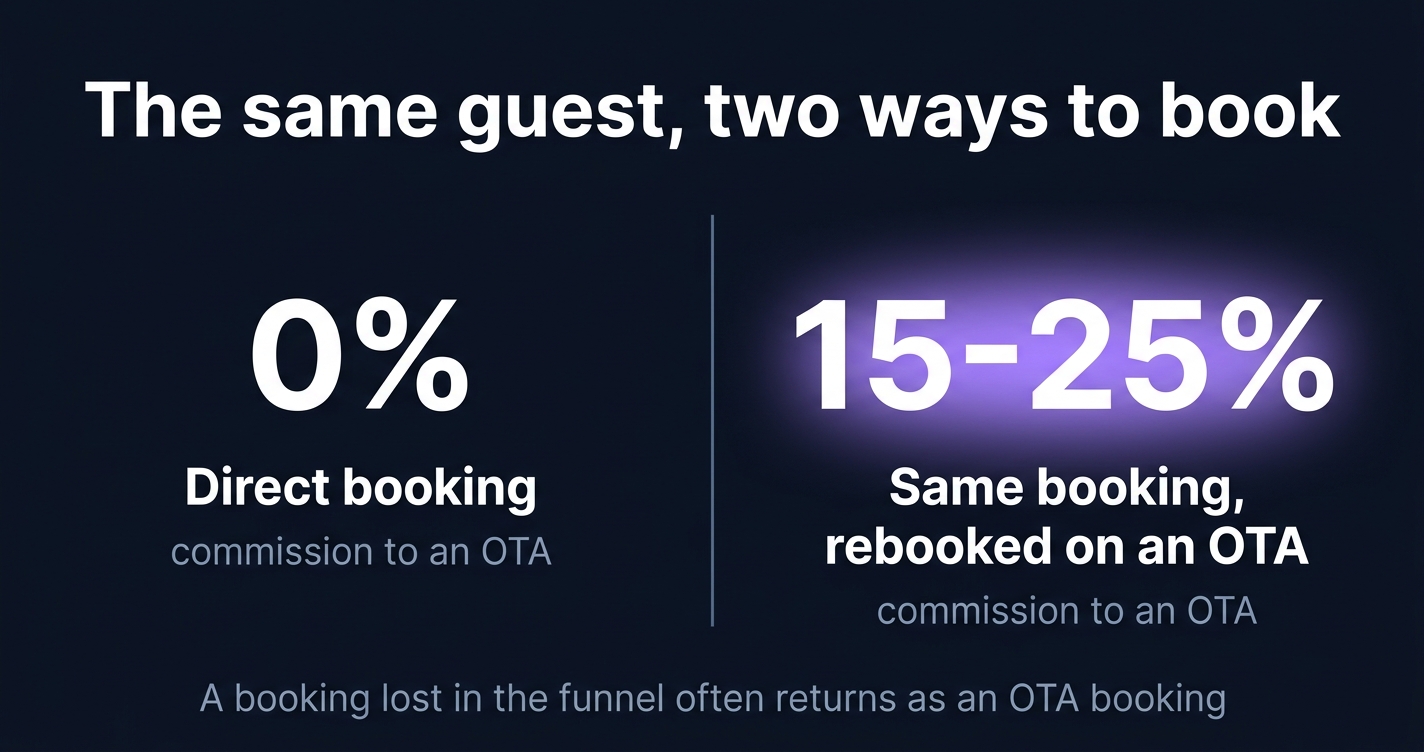
If that guest books the same room through an OTA, what the hotel loses is the margin, not the room night. A direct booking carries no commission. The same booking through an OTA carries a commission of 15 to 25 percent, depending on the platform. The hotel paid to acquire the guest and then pays a commission on top, because the checkout failed.
A second cost surfaces months later. A guest who books direct becomes a guest the hotel has a relationship with: their email, their preferences, a reason to return without paying to reach them again. A guest pushed onto an OTA belongs, in data terms, to the OTA. This matters more as AI assistants send a growing share of hotel traffic straight to the hotel's own site: the hotel earns that direct intent and then loses it at checkout. A funnel failure can cost more than a single commission, because it also forfeits the future stays a direct relationship would have earned.
Why Nobody on Your Team Notices
The most expensive thing about funnel friction is that it is close to invisible from the inside.
Analytics shows a conversion rate and a drop-off. A guest who abandons the booking engine and rebooks on an OTA looks, in the hotel's own data, like a standard drop-off. The booking that followed on Booking.com is not visible to the hotel as the same person.
The handoff to a third-party booking domain makes this worse, because analytics often breaks at exactly that point. The session that began on the hotel's site and the session that continued on the booking engine are frequently counted as two separate visits, so the drop-off looks as though it happened at the handoff rather than three steps later, where it really did.
The booking funnel ends up one of the parts of the commercial operation with the least scrutiny and some of the largest losses. Nobody decided it did not matter. Nothing in the standard reporting points at it.
Stiplo Mystery Shop
Funnel friction is hard to find from the inside, because finding it means testing the funnel from a first-time guest's starting point, on the device a guest actually uses, all the way to a real confirmation screen.
Stiplo Mystery Shop does that. It treats the booking funnel as one of five surfaces a digital mystery shop walks: it attempts a real booking on a phone and a desktop, and records the steps, the fees and the points where the path stalls or breaks. The result is screenshot evidence of where the funnel loses guests, ranked by what it costs.
Run a free digital mystery shop for one property.
Frequently Asked Questions
What is the difference between the website and the booking engine?
The website is what a hotel uses to present itself and persuade a guest to book. The booking engine is the separate system, often supplied by a third-party vendor, that takes the booking: room selection, guest details, payment. Many hotels test the website carefully and the booking engine barely at all, even though the booking engine is where the reservation is actually completed or lost.
How much does a lost direct booking really cost?
More than the booking itself. A guest who abandons the direct booking often rebooks the same hotel through an OTA, which carries 15 to 25 percent commission. The hotel keeps the guest but loses the margin. It also loses the direct relationship: the guest's contact details and the chance to win their next stay without paying to reach them again.
Does funnel friction only matter on mobile?
Mobile is where it does the most damage, because around three-quarters of travel bookings are made on a phone and hotel booking engines tend to convert worst there. But desktop funnels fail too. Forced accounts, surprise fees and lost availability are not mobile-specific problems. The point of testing is to walk the funnel on both.
How do we find the friction in our own funnel?
Walk it like a guest. Use a phone with no saved card, start from a search rather than a bookmark, and book a real stay through to the confirmation screen. Note every step that asks for something unexpected or does not work cleanly. A digital mystery shop does this systematically, on every device, with screenshot evidence at each step.
Want to see how your hotel website performs?
A Snapshot checks 30 pages for commercial integrity issues in minutes.
Get a free Snapshot