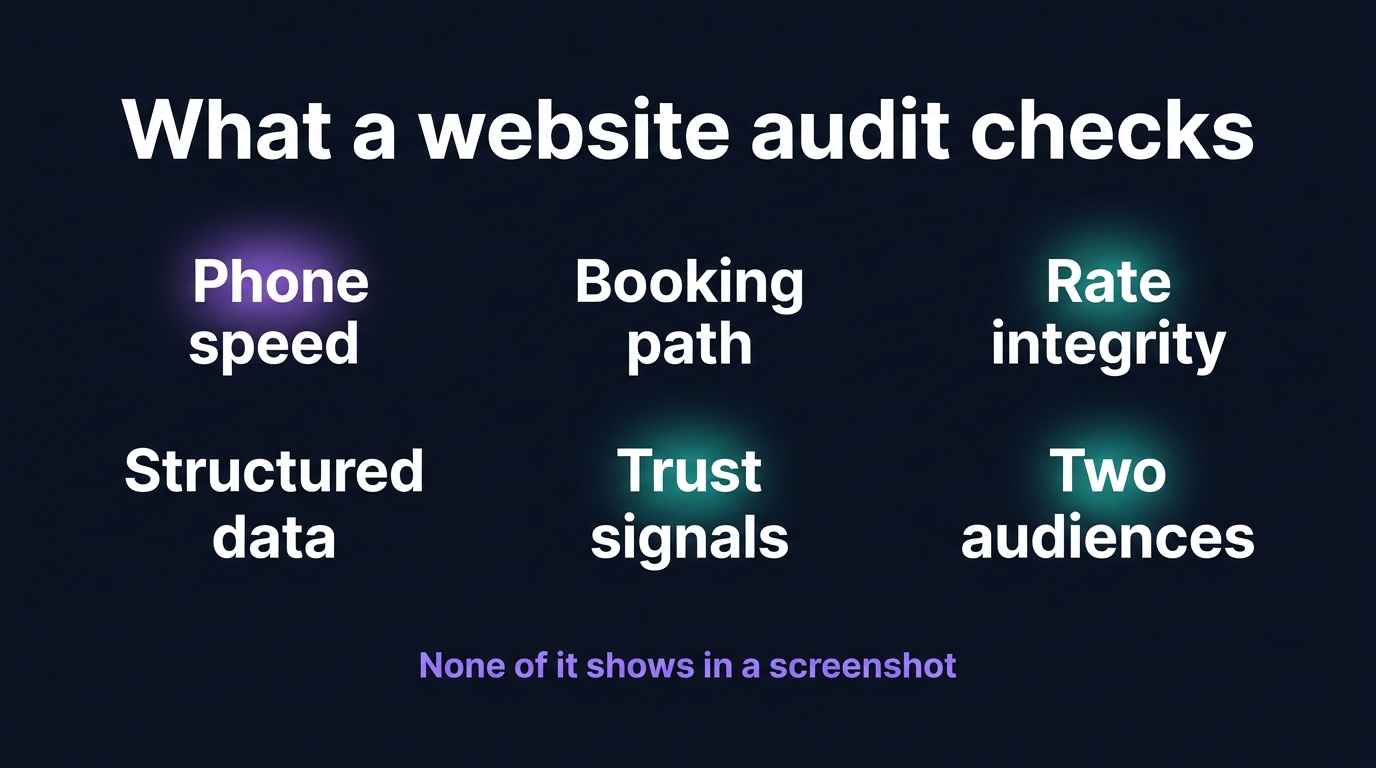
A hotel website can be beautiful and still lose bookings. A website audit checks the things a redesign skips: phone speed, booking-path friction, rate integrity against the OTAs, the machine-readable layer, trust signals and whether AI can read you. Six checks, what passing looks like, and what each fail costs.
A hotel website audit is not a design review. A design review asks whether the site looks good. An audit asks a harder question: does it keep the promises it makes, and does it let a guest finish a booking. A site can be beautiful, recently rebuilt and award-worthy, and still leak bookings every day through a slow phone load, a booking flow with too many steps, or a "from" price that turns into a higher one at checkout. Those leaks do not show up in a portfolio screenshot. They show up in the gap between the traffic a site gets and the direct bookings it converts.
This is what a thorough hotel website audit checks, grouped into six areas. Each has what to look at, what a pass looks like, and what a fail costs you. Most of it you can run yourself on your own phone in an afternoon. It pairs with the wider hotel mystery shop checklist, which follows the guest beyond the site into calls, email and the stay.
1. How fast and usable it is on a phone
Most hotel browsing happens on a phone, often while the guest is already nearby and deciding. Mobile is nearly 68 percent of global travel and hospitality website traffic, on Statista's reading of Contentsquare data for 2023 (Statista). Yet most teams judge their own site on a fast office connection and a desktop screen, which is the one experience their guests are not having.
What to check: open your homepage on a real phone, on mobile data, and time how long it takes to be usable. Google's Core Web Vitals give the bar worth aiming at, on Google's own measurement, each judged at the 75th percentile of visits: a largest contentful paint of 2.5 seconds or less, an interaction to next paint of 200 milliseconds or less, and a cumulative layout shift of 0.1 or less (web.dev). The free PageSpeed Insights tool reports all three.
What passing looks like: the page is usable fast, nothing jumps around as it loads, and the rate and the book button are visible without hunting.
What failure costs: a slow or janky phone homepage loses the guest before they ever reach the booking engine, after your search visibility did the hard work of getting them there. The usual culprits are heavy hero images and the booking widget itself, both fixable without a rebuild.
2. The booking path
The booking flow is where intent becomes revenue or gets abandoned. Online shopping cart abandonment averages just over 70 percent across e-commerce (Baymard Institute), and a booking flow with needless steps does nothing to beat that. The cause is usually friction the team stopped noticing: an account wall, fields a system should already know, a date picker that fights the thumb.
What to check: complete a real booking on a phone, from homepage to confirmation, and count the steps and the form fields. Baymard's checkout research finds most checkouts need only about 8 form fields, while the 2024 average was 11.3, and 17 percent of users have abandoned a purchase because the checkout was too long or complicated (Baymard Institute).
What passing looks like: a guest can get from intent to confirmation quickly, on a phone, without creating an account or re-typing details the system already has.
What failure costs: every extra field and dead-end is a place to leave, and a guest who abandons your funnel often finishes the booking on an OTA instead, at the 15 to 25 percent commission an OTA takes.
3. Price and offer integrity
This is the check that a design review never does and the one guests notice most. The promise a website makes has to survive contact with the booking engine.
What to check: take the headline rate or package on your homepage and follow it into the booking engine for real dates. Does the "from" price hold, or does it climb. Then check the same room and dates on Booking.com and Expedia to see where your direct rate stands.
What passing looks like: the price a guest is promised is the price they are charged, and your direct rate is at least as good as the OTA rate for the same room.
What failure costs: a guest who clicks a low price and lands on a higher one feels misled and leaves. One common version: the homepage promotes a package at "from €189", but the booking engine opens on the flexible rate at €231 because the package is not preselected, so the first number a guest sees is already broken. The gap to the OTAs is real too: the 123compare.me World Parity Monitor found that in 2025 at least one OTA showed a lower price than the hotel's own site in 75 percent of searches, with mobile worse than desktop (123compare.me, 2025). You cannot always win the headline rate, but you should know where you stand and compete on value where you cannot.
4. The machine-readable layer
Behind the page a guest sees is a layer they never do: the structured data, or schema, that describes your hotel to machines, what it is, where it is, and what it offers. A guest does not read it. Search engines use it to read your facts with less guesswork, and it supports search features like rich results. It is not required for AI, but the cleaner your data, the easier any system finds it to represent you correctly.
What to check: whether your homepage carries Hotel schema with the address and location coordinates, whether rate pages carry Offer schema, and whether what the schema says matches what the page says. Google's Rich Results Test shows which Google rich results your markup is eligible for, and the Schema Markup Validator checks the markup itself more broadly. Our hotel schema markup guide covers the types that matter and how to check them.
What passing looks like: the key facts about your hotel are present in the code, valid, and consistent with the visible page and with your Google Business Profile.
What failure costs: missing or wrong schema makes search engines and assistants more likely to get your facts wrong, or to lean on a property whose data they can read more cleanly. A common one is a site relaunch that quietly drops the address and coordinates from the page code, so the hotel's own pages stop confirming where it is. It is one of the cheapest things on this list to fix and one of the most commonly broken.
5. Trust signals
A guest deciding whether to book direct is also deciding whether to trust you with a card. Small signals carry that decision, and an audit checks they are present and current.
What to check: is the site served securely, are the photos real and current rather than stock or years old, is there a clear way to contact a human, are reviews or ratings visible where they reassure rather than hidden, and does the booking page look like somewhere you would enter card details. Three dim photos from before the last refurbishment quietly undercut the same trust a redesign was meant to build.
What passing looks like: the site looks maintained, the property looks like itself as it is today, and nothing on the booking page makes a careful guest hesitate.
What failure costs: a guest who hesitates on trust has a frictionless alternative one tap away on an OTA they already trust, which is part of why so many direct-ready guests still book through a third party.
6. Readable by guests and by machines
A hotel website now has two readers: the guest, and the machine deciding whether to show you to the next guest. An audit checks the site works for both, because it is easy to build a site a person loves that a crawler cannot read, or to block the very assistants you want recommending you.
What to check: whether your important content is in text a crawler can read rather than locked inside images or scripts, and whether your robots.txt reflects what you actually intend for search and AI crawlers rather than blocking them by accident. That last one is a single file with an outsized effect, covered in is your robots.txt blocking AI recommendations. The wider idea, that your site serves a human and a machine at once, is the subject of your hotel website has two audiences now.
What passing looks like: the content that matters is readable by both a guest and a crawler, and nothing in your site's configuration is quietly hiding you from the surfaces you want to appear on.
What failure costs: a site that reads beautifully to a person but poorly to a machine slowly loses ground on both search and AI, for reasons that never show up on screen.
What a redesign often misses
It is worth being clear about the difference, because the instinct when a site underperforms is to rebuild it. A redesign changes how the site looks and feels. An audit changes whether it converts and whether it is read correctly. They are not the same project, and a redesign can quietly reintroduce every leak on this list: a beautiful new hero image that loads slowly, a fresh booking flow with one more step than the last, a rebuilt page that dropped its schema in the move.
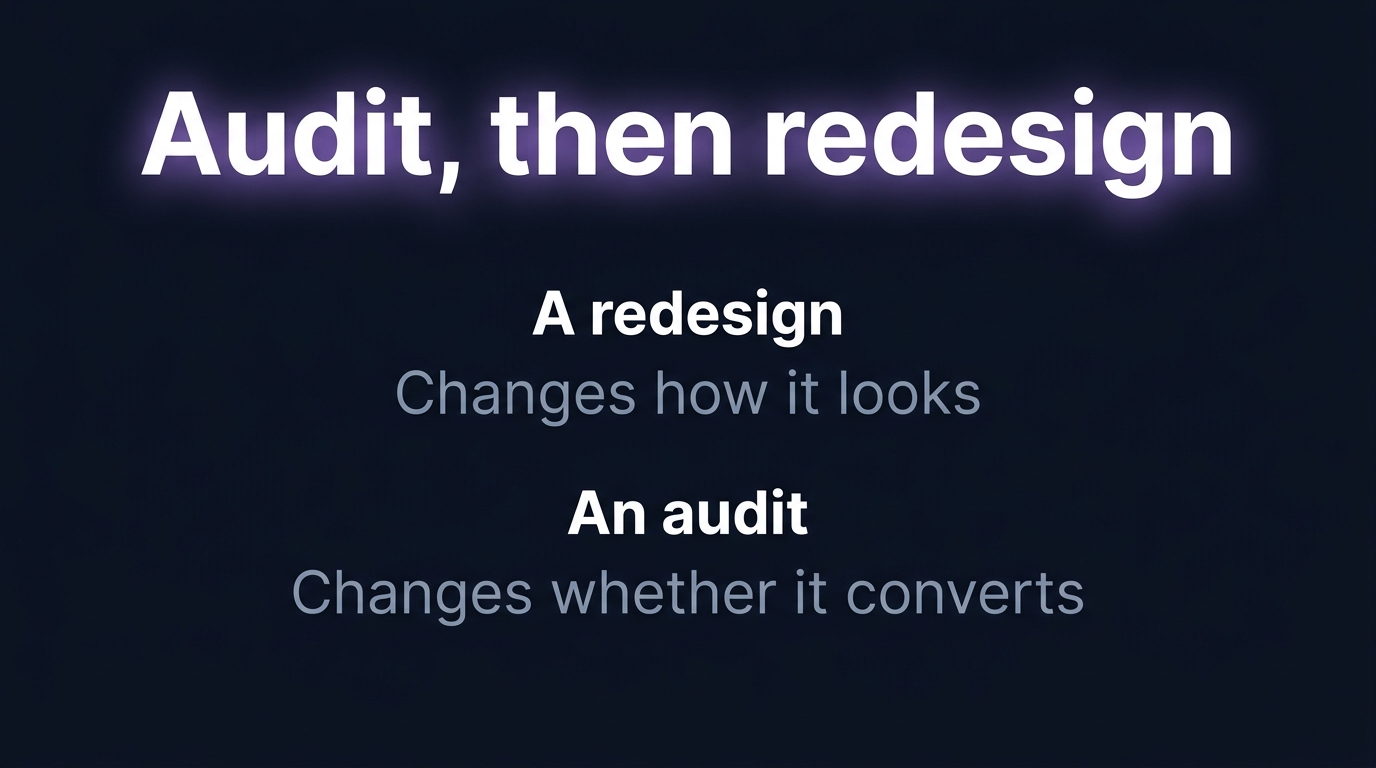
The sensible order is to audit first, fix what the audit finds, and let the audit define the brief if you do then redesign. A redesign that starts from a list of real, measured problems is worth the money. A redesign that starts from "the site feels dated" tends to produce a site that feels new and performs the same.
How to run it yourself
You do not need a budget to start. Block an afternoon, use your own phone on mobile data, and work down the six areas. Load the homepage and time it. Run PageSpeed Insights and the Rich Results Test. Complete a real booking and count the fields. Check your headline rate against the booking engine and against two OTAs. Look at your photos and your trust signals as a first-time guest would. Write down each pass and fail as you go, with a screenshot where it helps.
Most teams find the surprises are in the parts nobody owns: the rate that slipped out of parity, the schema that a site move dropped, the booking step that crept in. None of it is visible from the lobby, and most of it is fixable without a rebuild.
When to bring in a tool or service
Run it by hand and you will find plenty. The reason to bring in a tool is when the manual version stops scaling: when you run more than one property, when you want it checked on a schedule rather than once, or when you need a repeatable, evidence-backed record to put in front of an owner or a GM review.
Stiplo Mystery Shop runs the digital side of this audit for you on a schedule, with a screenshot trail behind every finding, so a leak shows up in a report instead of in a guest quietly giving up. If you are also weighing whether to hire help for the wider search picture, our guide to hotel SEO services covers what to look for and what to ask.
Where AI fits in 2026
The same checks that make a site convert for a guest tend to make it easier for an AI search tool to read, and that is increasingly where a guest starts. A fast, crawlable site with consistent facts is one those tools can find and represent correctly; a slow, script-locked site is one they struggle with, so a hotel a machine cannot read cleanly is less likely to be surfaced or described accurately. Not every model works the same way, but the booking-path and rate checks are for the human guest, while the speed and crawlability checks help both. Our hotel SEO in the age of AI guide covers how the two surfaces relate.
Frequently Asked Questions
What is a hotel website audit?
A structured check of whether your website keeps its promises and converts, rather than how it looks. It covers phone speed, the booking path, rate and offer integrity against the OTAs, the structured data that search engines and assistants read, trust signals, and whether the site is readable by both a guest and a crawler. It is different from a design review, which judges appearance.
How is a website audit different from a redesign?
A redesign changes how the site looks and feels. An audit measures whether it works: whether it loads fast on a phone, whether a guest can finish a booking, whether the price holds, whether the machine-readable layer is intact. A redesign can reintroduce the same problems an audit would catch, which is why auditing first, then letting the findings shape any redesign brief, is the better order.
Can I audit my hotel website myself?
Yes, most of it. With your own phone, the free PageSpeed Insights and Rich Results Test tools, and an afternoon, you can check all six areas and write down the fails. A tool or service is worth it when you run several properties, want it checked regularly, or need an evidence-backed record for an owner review.
What are the most common hotel website problems?
The recurring ones are a slow or awkward phone experience, a booking flow with more steps and fields than it needs, a direct rate that loses to the OTAs or a "from" price that climbs at checkout, and missing or broken structured data, often dropped during a previous site move. None are visible from the lobby, and most are fixable without a rebuild.
Does a fast website help with AI visibility?
Indirectly, yes. A fast, crawlable site with clean structured data is easier for an AI assistant to read and represent correctly, and the assistants increasingly decide which hotels a guest sees first. The booking-path checks are for the human guest; the speed, schema and crawlability checks help both the guest and the machine.
<!-- stiplo:seo-cluster-uplinks -->Related from Stiplo
- run a free hotel website audit on one property: the checks in this guide, run for you with the evidence behind each finding.
- the hotel visibility glossary: plain-language definitions of the terms in this guide.