What a Digital Mystery Shop Actually Checks on Your Hotel
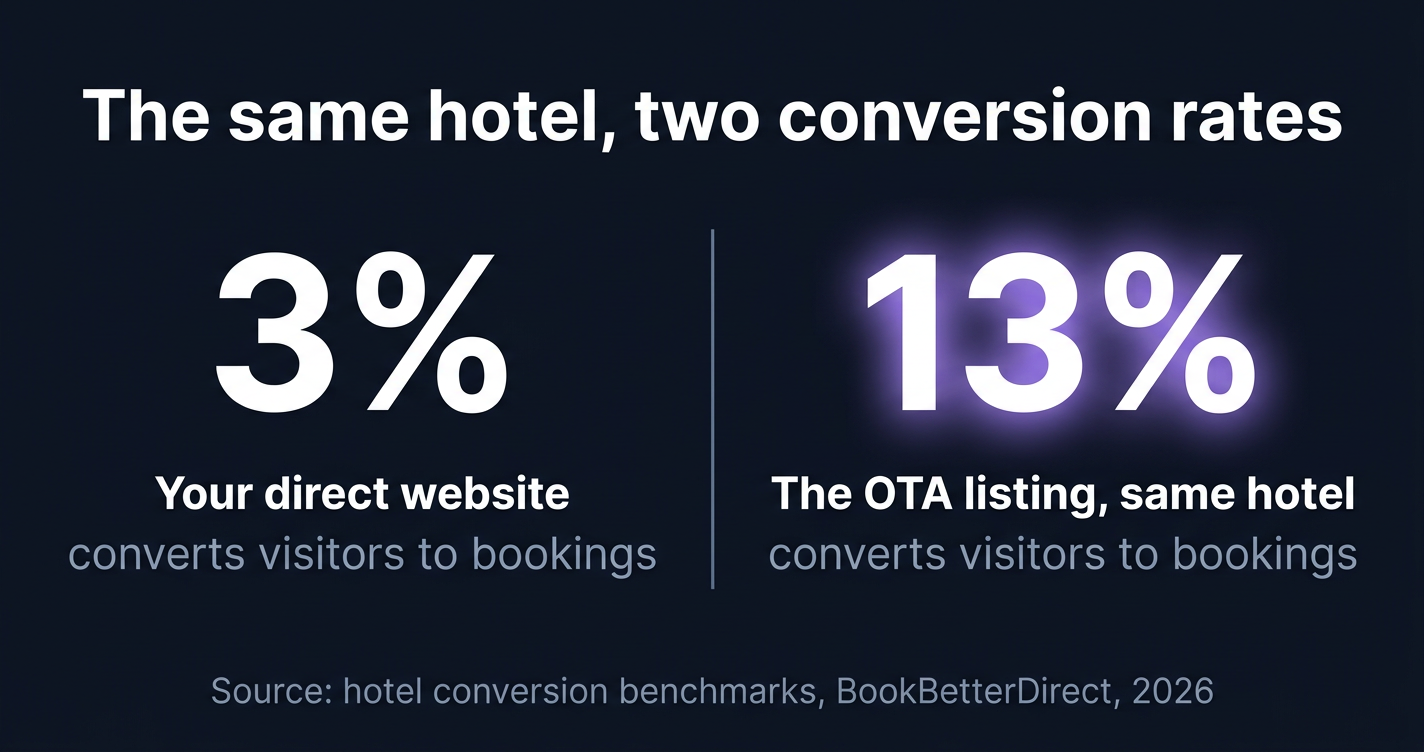
A hotel's own website turns visitors into bookings at 2 to 4 percent. The OTA listing for the same hotel converts at 12 to 15 percent. Same hotel, same nights. The gap is friction on the surface the hotel controls outright.
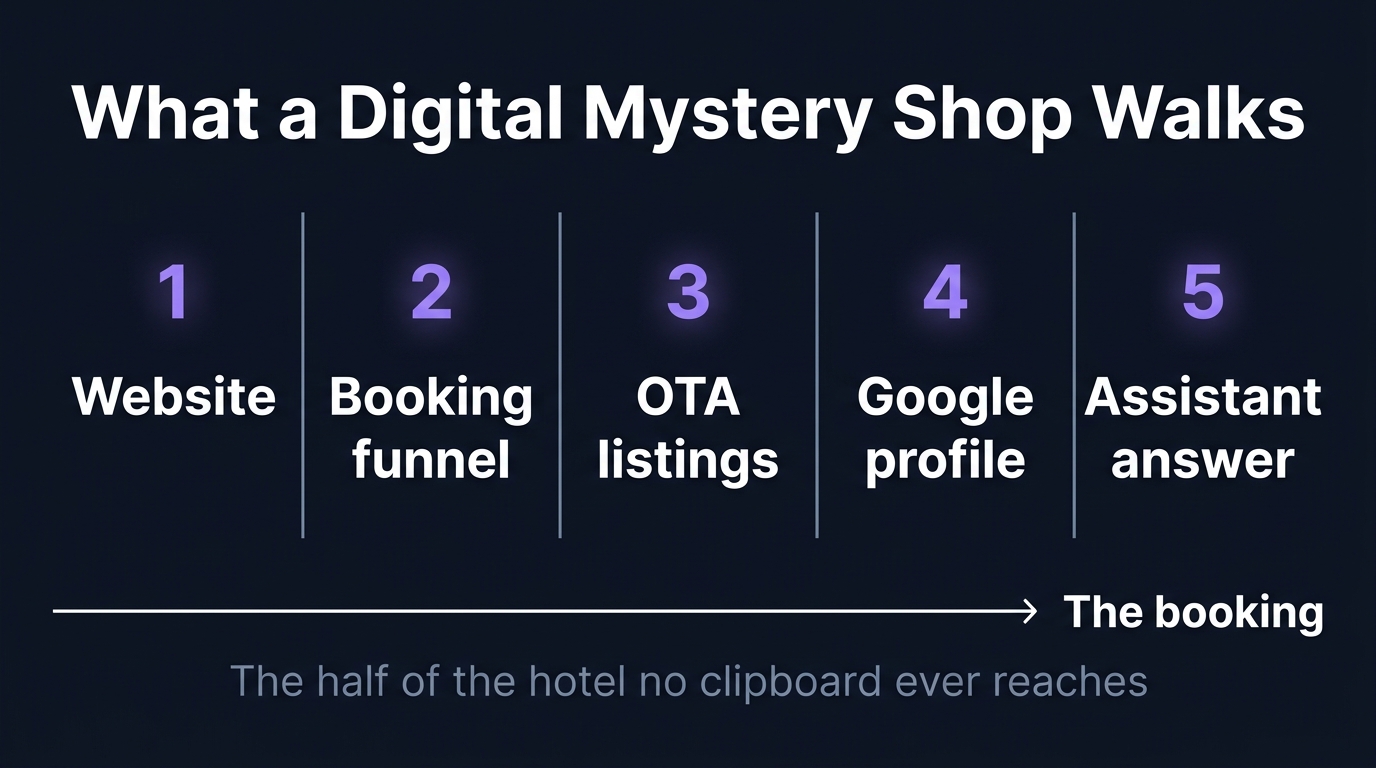
A four-star hotel will pay several hundred pounds for a person to spend a night in the building and grade the welcome, the room, the breakfast and the way the front desk handles a complaint at eleven at night. Money well spent on the half a guest experiences after they arrive. In the hotels we look at, the other half (website, booking engine, OTA listings, Google profile, the answer an assistant gives when a traveller asks where to stay) gets nothing close to the same attention. That is the half where the booking actually happens, and no clipboard reaches it.
A digital mystery shop walks the booking journey the same way a guest does. We have made the case before that a person can no longer do this manually. This piece breaks down the five steps a digital shop covers, and the way each one tends to fail.
Why Hotels Lose Bookings on Their Own Website
The OTA has spent fifteen years and a great deal of money stripping friction out of its booking path. Most hotels have not. SiteMinder's 2025 Changing Traveller report, a survey of 12,000 travellers, found 52 percent have abandoned a hotel booking because of a bad digital experience rather than a bad price.
So the booking is lost on the channel the hotel controls outright, and usually for reasons that have nothing to do with the rate. There are five steps to walk.
Surface One: A Hotel Website Audit, From the Guest's Side
A digital mystery shop opens the website cold, on a phone, the way a first-time guest does. Three-quarters of travel bookings are now made on a mobile device, and an internal team that uses the site every day will not see it the way a first-time guest does. The website is the channel the hotel fully owns, and the one two audiences now judge: guests, and the systems that recommend hotels to them.
The pages a booking depends on get walked one by one. The homepage: does it load quickly, render correctly on a mid-range phone, and make the next step obvious. The offers and packages pages: are the offers current, correctly priced and actually bookable, or is a spring rate still on the page in November. The room pages: do they exist for every room type, with accurate descriptions, real photographs and a visible price.
An expired promotion, a dead link, a language switcher that returns a 404, a campaign offer code that broke six days into a three-week campaign, a booking page slow enough that a guest leaves before it renders: none of these reach a revenue report. The report shows the booking that did not happen, never the broken link behind it.
Surface Two: The Hotel Booking Funnel, Click by Click
The second leg of the journey is the booking funnel: the stretch from Book Now to the payment screen. Click Book Now and the guest is often handed from the main site to a separate booking-engine subdomain or third-party domain (SynXis, Mews, SHR, Bookassist), and trust drops in that gap. A digital mystery shop attempts the booking itself, on a phone and a desktop, and records what changes at every step.
These failures only show up when someone tries to book, which is one reason they survive so long. The rate shown on the room page does not carry into the engine. Account creation is forced before the booking will go through, and Baymard's research finds 19 percent of online shoppers abandon a checkout that makes them create an account. Taxes and fees appear only on the final screen, so the price the guest agreed to is not the price they are asked to pay. The date picker needs pinch-and-zoom on a phone. A room that was available three steps ago is gone at checkout.
Mobile is where this does the most damage. Hotel websites convert far worse on a phone than on a desktop, and most of that gap is friction in the funnel, not weaker intent.
Surface Three: What the OTAs Show That Your Hotel Does Not
The third leg is one the hotel does not own but is measured against constantly. A guest comparing options sees the direct site and the Booking.com listing side by side, and a digital mystery shop looks at exactly that.
Two things get measured here: rate parity and content parity. Rate parity is the direct rate against the rates on Booking.com and Expedia for the same room, the same dates and the same guest profile. The 123Compare.me World Parity Monitor found that in the first half of 2025, at least one OTA undercut the hotel's own site in 75 percent of searches. Content parity is whether the OTA listing describes the same hotel the website does. OTAs invest heavily in their listings, and a Booking.com page often carries more photographs, a fuller amenity list and a longer description than the hotel's own room page.
Both gaps push the guest to the OTA. The hotel then pays 15 to 25 percent commission on a guest who arrived on its own website first, when a direct booking would have cost it a fraction of that. The booking was not lost. It was handed to an OTA and bought back at a premium, with nothing in the analytics to show it happened.
Surface Four: Whether Google Has Your Hotel Right
On Google, the basics have to be right: the Business Profile, the map listing, the price panel. Most guests meet the hotel there before they reach the website, so an error on Google is the first thing they see.
Most of what goes wrong is basic and avoidable: an old phone number, opening hours that were right two summers ago, a thin description, photographs a renovation has made obsolete, a property that does not match cleanly in Google's hotel data so the price panel shows the wrong room or none at all. Google's own guidance is that missing or mismatched details can stop a property matching correctly, which keeps it out of the hotel results and off the map.
The name, star rating, location and amenity list a hotel publishes on Google, on Bing and across its OTA listings is the material that search engines and assistants reuse. Consistent structured data keeps that material agreeing with itself. When the sources disagree, a search engine has no way to know which version is right, and the hotel does not get the benefit of the doubt.
Surface Five: What an Assistant Says When Asked About You
This is the newest of the five steps and the least mature commercially. Travellers are starting to skip Google and ask an assistant where to stay: in this city, near this place, for this kind of trip. A digital mystery shop asks the same questions and records what comes back.
It checks whether the hotel can be read at all, because a misconfigured robots.txt or firewall rule can quietly remove it from AI answers. Once that hurdle clears, the question is whether the answer the assistant gives is even right; hotels routinely show up with the wrong star rating, missing amenities, or stale promotions. And when an assistant does recommend a hotel, it points the traveller to the hotel's own site far more often than to an OTA. That is a direct-handoff opportunity no clipboard audit would think to test.
The volume is what makes this worth checking now: ChatGPT alone reached 900 million weekly users by February 2026, up from 400 million a year earlier. The channel loses fewer bookings than the other four today, but the curve is steep. A hotel that wants to check it without waiting can use our five-minute AI visibility check.
Stiplo Mystery Shop
Stiplo Mystery Shop runs this across all five surfaces and turns it into a report the commercial team can act on. Every break in the guest journey comes with a screenshot and a place in a ranked list, so the team starts with the one costing the most bookings.
A physical mystery shopper still has a job: the welcome, the room, the way service recovers when something goes wrong. Send someone to grade those. But send them to a hotel whose digital booking journey has already been walked, so the booking they are grading actually happened.
Run a free digital mystery shop for one property.
Frequently Asked Questions
What does a digital mystery shop check that our analytics does not show us?
Analytics shows that bookings are being abandoned. It does not show the step that broke. A digital mystery shop attempts the booking and captures the cause: the offer that would not price, the rate that changed at checkout, the OTA that undercut you, the assistant quoting the wrong star rating. It connects a traffic number to the room that did not get booked.
How is a digital mystery shop different from an SEO audit?
An SEO audit measures whether a hotel can be found and ranked. That sits upstream of this problem. A digital mystery shop starts where a guest who has already found the hotel tries to book it, and grades that. A hotel losing reservations on its own booking path will not find the cause in an SEO report.
Does a digital mystery shop replace our physical mystery shopping programme?
No. The two cover different halves of the same journey. Physical mystery shopping grades the stay: arrival, room, service, departure. A digital mystery shop grades everything before the stay: whether the guest could find, trust and complete a booking at all. Run the digital shop first to find the leaks, then send the physical shopper to grade the experience of guests who made it through.
How often should a hotel run one?
Often, because the steps it checks change constantly. An offer breaks, an OTA shifts a rate, a booking-engine update changes a step, a profile goes stale. A physical shop is a quarterly snapshot. The digital path can break on a Tuesday and stay broken until someone looks. Monthly or continuous checking catches it while it is still cheap to fix.
Which surface should we look at first?
The booking funnel, in most cases. It is the step closest to the money: a guest there has already decided to book and is being lost on mechanics rather than price. The honest answer is that you do not know until you walk all five, because the most expensive break is rarely the one a team expects.
Want to see how your hotel website performs?
A Snapshot checks 30 pages for commercial integrity issues in minutes.
Get a free Snapshot