A buyer's guide to hotel SEO services: the real scope of the work, realistic pricing, when an agency is worth it versus a tool or your own team, the red flags that signal a bad fit, and the questions to ask before you sign anything.
If you are reading this, you have probably decided that your hotel needs help with search, and you are trying to work out whether to hire someone, what it should cost, and how to tell a good provider from a bad one. That is a harder question than it looks, because hotel SEO sits in an awkward gap. Generic SEO agencies understand search but not the way hotels are bought and sold. Hotel marketing agencies understand the trade but often treat search as an afterthought behind paid media and brand. And the work itself is partly invisible, which makes it easy to sell and hard to check.
What follows covers what hotel SEO services actually include, what they tend to cost, when hiring makes sense against doing it yourself, the red flags worth walking away from, and the questions to ask before you sign. Where it helps to know how search actually works for a hotel, the detail sits in our Hotel SEO in the age of AI guide.
What hotel SEO services actually include
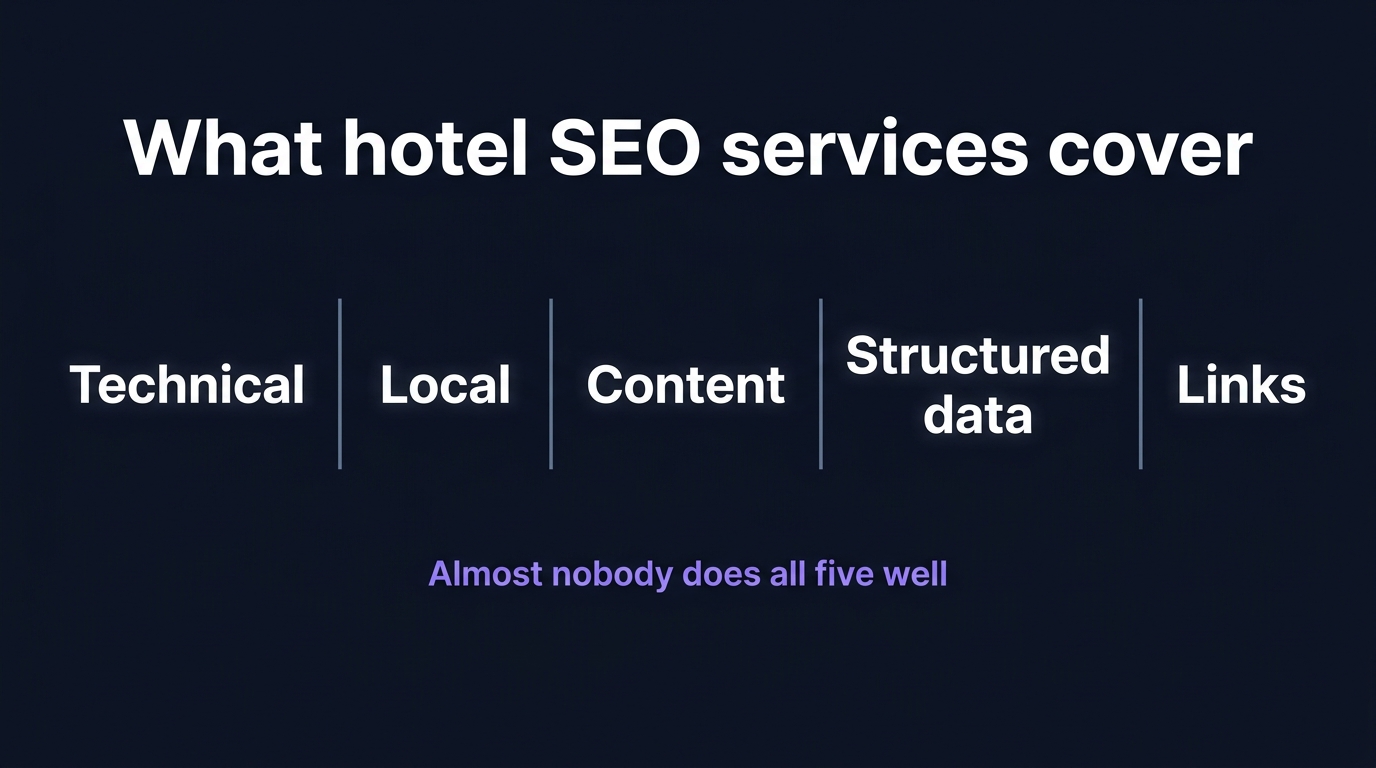
"SEO" is a broad word, and the work splits into a few distinct areas. A provider worth hiring will be clear about which of these they do, because almost nobody does all of them well.
Technical SEO is the health of the site itself: how fast it loads on a phone, whether search engines can crawl it, whether the booking engine pages are reachable, whether the structure is clean. For a hotel this matters more than it sounds, because booking widgets and heavy hero images are exactly the things that slow a site down and bury content search engines need to read.
Local SEO is the work of appearing in the map and the local pack for nearby searches, and it runs largely on your Google Business Profile rather than your website. For many independent hotels this is the highest-return area, because "hotels near [a place]" is a high-intent search where a smaller property can sometimes outrank a chain, when its proximity, relevance, reviews and profile completeness are stronger. We cover it on its own in the local SEO for hotels playbook.
Content is the pages and posts that answer what guests search before they book: the area, getting to you, what is walkable, the events that bring people to town. Good content is written for the guest first and the search engine second. Thin pages built only to hold keywords are the kind of thing that ages badly.
Structured data, also called schema, is the machine-readable summary of your hotel in the site's code. It reduces the guesswork search engines do about your name, location, rooms and amenities, and it supports search features like rich results. It is not required for AI visibility, but data a machine can read cleanly is easier for any system to represent correctly, and it is disproportionately useful for hotels because so much of a hotel's information is structured already. Our hotel schema markup guide covers the types that matter.
Links and reputation are the slow, off-site signals: credible local sources linking to you, reviews building over time. This is the hardest area to do honestly and the easiest to fake badly, which is why it is where most of the red flags live.
A good provider will tell you which of these they are taking on and which they are leaving to you. A provider who answers "all of it" to every question is usually selling a retainer, not a plan.
What hotel SEO services cost in 2026
Pricing varies more than any honest article can pin to a single number, because it depends on your market, the state of your site, and who you hire. But the shapes are predictable enough to plan around. Treat the bands below as rough shapes rather than quotes: real ranges overlap and run wider in both directions.
A freelancer or small specialist commonly works on a monthly retainer in the low four figures, roughly €1,000 to €2,500, or on a fixed-scope project for a specific job such as a technical fix or a schema rollout, often somewhere between €1,500 and €8,000. You get focused attention and lower cost, at the price of narrower capacity.
A boutique agency sits higher, usually mid four figures a month, in the region of €2,500 to €7,500, and brings a small team across the areas above. This is the common choice for an independent or small group that wants the work managed rather than done in-house.
A full-service hotel marketing agency is higher again, often €5,000 to €15,000 or more a month, and bundles SEO inside a wider remit of paid media, brand and sometimes revenue. The risk here is that search becomes a line item that nobody owns, which is worth raising before you sign.
Two things matter more than the headline figure. The first is whether the price is a retainer or a scope. A retainer buys ongoing effort, which is right for content and local work that compounds. A scope buys a defined job with a defined end, which is right for a one-off technical or schema fix. Paying a monthly retainer for what is really a one-off project is a common way to overspend. The second is what the money is actually doing month to month. "SEO retainer" with no deliverables you can see is the line item most likely to quietly underperform, because the work is invisible and the reporting is often built to look busy rather than to show results.
Three ways to cover the work
These are not exclusive, and the right answer usually mixes them.
Do it yourself when the work is well-defined and you have someone who can own it. A great deal of hotel SEO is completing your Google Business Profile, fixing inconsistent business details, asking for reviews and writing honest local pages. None of that needs an agency. The local SEO playbook is a runbook a marketing coordinator can work through.
Hire when the work needs a skill you do not have or a sustained effort you cannot staff: a real technical rebuild, an ongoing content programme, or untangling a site that has been through a few agencies already. Hire for the specific thing, and judge the provider on whether they can name it precisely.
Use a tool when you need to know where you stand, on a schedule, without paying for a person each time. A tool is good at the repeatable, measurable parts: is the site fast on a phone, is the schema present and valid, do the business facts agree across the web, are the AI assistants describing you correctly. It does not replace a strategist, but it tells you what to brief one on, and it is the cheapest way to check that an agency you are already paying is moving the things they claim to move.
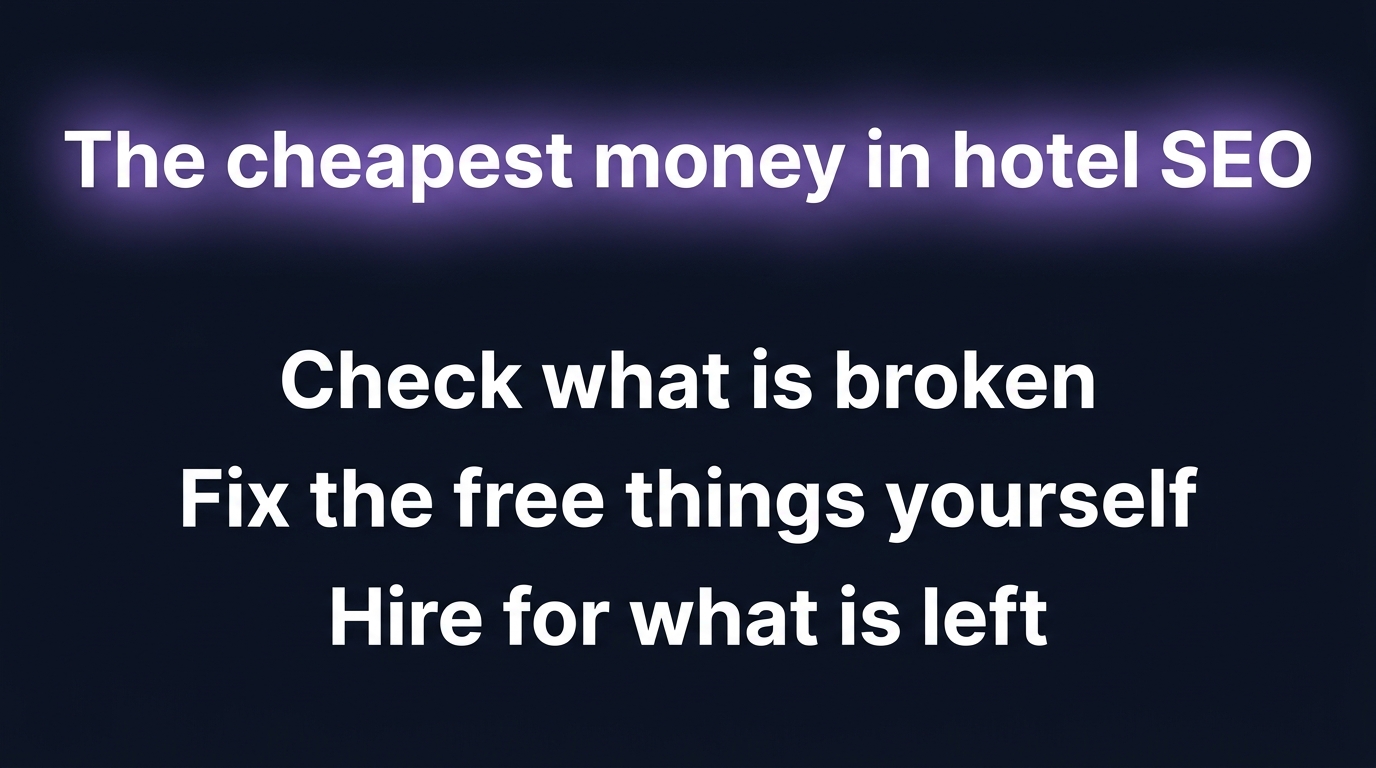
The honest order for most hotels is to run a check first, fix the free and obvious things yourself, then hire for whatever is left that genuinely needs a specialist. Hiring before you know what is broken means paying an agency to spend the first month telling you.
Red flags before you sign
Some of these are dealbreakers and some are just worth a hard question. All of them are common.
- A guarantee of a number-one ranking. Nobody controls Google's results, and Google's own guidance is deliberately vague about the exact levers. A guaranteed position is either meaningless small print or a sign the provider plans to rank you for a search nobody makes.
- No hotel experience. A hotel's search is bound up with OTAs, rate parity, seasonality and the booking engine. An agency that has never worked with a property will miss most of what matters and learn on your budget.
- Buying links or reviews. Both break platform policies and put at risk the very profile and rankings you are paying to build. If a provider's link plan is a list of directories, or their review plan involves gating or incentives, that is the work that gets a property penalised.
- Being locked out of your own assets. Your Google Business Profile, your analytics and your website should be yours, in your accounts, with the provider given access. A provider who sets these up under their own ownership is holding your property hostage to the contract.
- Reporting that shows activity, not outcomes. A monthly deck full of "tasks completed" and rising impressions tells you the agency was busy. Whether you appear for the searches that matter, and whether direct bookings moved, is the report that counts. If you cannot get that, the work probably cannot show it.
- Silence on AI. A 2026 provider who has nothing to say about how your hotel appears in ChatGPT, Gemini and Perplexity is missing part of the picture. The two surfaces are linked, and a provider who ignores AI visibility leaves real ground uncovered. More on why in our GEO for hotels guide.
The questions to ask before you sign
Take these into the first real conversation. The answers tell you more than the proposal does.
- Which of the areas above are you doing, and which are you leaving to us?
- Is this a retainer or a scope, and what specifically will be different in ninety days?
- Which accounts will the Google Business Profile, analytics and site live in?
- How will you report whether we appear for our priority searches, and whether direct bookings moved?
- What is your plan for links and reviews, exactly?
- How do you handle our visibility in AI assistants, not just Google?
- Have you worked with a hotel like ours, and can we speak to them?
A good provider answers these plainly and is relieved you asked. A provider who gets vague or defensive is telling you how the engagement will go.
Audit before you spend
The cheapest money in hotel SEO is the money you do not spend because you knew what was wrong before you hired anyone. Most of the gap between a hotel and its search visibility is not strategy, it is unfixed basics: an incomplete profile, missing or broken schema, a slow phone experience, business facts that disagree across the web, a direct rate that loses to the OTAs on the hotel's own listing. It is common to find a profile still showing the restaurant hours from before a refurbishment, or an expired spa package still surfacing in search months after the offer ended. You can find most of those in an afternoon, and a provider worth hiring will want that list in front of them on day one anyway.
This is where Stiplo Mystery Shop comes in. It checks the digital signals behind your search visibility the way a guest and a search engine see them, with screenshot evidence behind each finding, so you walk into any agency conversation already knowing what is broken and what to ask for. The judgement calls still need a strategist. Discovering the obvious does not. If you want the related, deeper audit of the site itself, our hotel website audit guide covers what a thorough one checks.
Where AI fits in 2026
It is tempting to treat AI visibility as a separate purchase from SEO, but for the AI search features that retrieve from the web they are largely the same project. When a feature like Google's AI Overviews, or an assistant in search mode, answers a travel question, it pulls from pages it can find and rank, so the work that ranks you in Google also feeds those answers. A page that ranks for the sub-questions a system breaks a prompt into is more likely to be one it draws on. Not every model works this way, and rankings do not translate neatly into AI visibility, but the foundations are shared: a crawlable, clear, accurate site is easier to find and to trust as the source on your hotel. So a provider who handles your SEO well is already doing much of the groundwork, as long as they know to check it. The part that needs separate attention is verification: AI answers shift by model and by day, so they need testing rather than tracking like a fixed position. Our five-minute AI visibility check is the quick version of that test.
Frequently Asked Questions
How much do hotel SEO services cost?
It depends on your market, the state of your site and who you hire, but the shapes are predictable: a freelancer or specialist in the low four figures a month (roughly €1,000 to €2,500) or a fixed-scope project (often €1,500 to €8,000), a boutique agency in the mid four figures (around €2,500 to €7,500) a month, and a full-service marketing agency higher again (often €5,000 to €15,000 or more) with SEO bundled in. Treat those as rough ranges, not quotes. The figure matters less than whether you are paying a retainer for ongoing work or a scope for a one-off job, and whether the reporting shows outcomes rather than activity.
Do I need a hotel-specific SEO agency, or will any agency do?
Hotel search is shaped by OTAs, rate parity, seasonality and the booking engine, none of which a general agency will know. You do not strictly need a hotel specialist, but you do need someone who understands those forces, and a generalist will be learning them on your budget. Ask for a hotel reference before you sign.
Can I do hotel SEO myself?
A large part of it, yes. Completing your Google Business Profile, fixing inconsistent business details, asking for reviews and writing honest local pages need no agency. The local SEO for hotels playbook is written to be worked through by an in-house marketer. Hire for the parts that need a specialist skill or a sustained effort you cannot staff.
What is the difference between hotel SEO and hotel local SEO?
Local SEO is specifically about appearing for nearby searches, in the map and the local pack, and runs mostly on your Google Business Profile. Hotel SEO is the wider picture of ranking your website in search overall. For most independent hotels local SEO is the higher-return slice, which is why a good provider starts there.
How quickly should hotel SEO services show results?
Slower than anyone selling them will imply. Completing a profile and fixing inconsistent details can move local visibility within weeks in a quieter market. Content and links compound over months. In a competitive city it is a long game. A provider who promises a fixed date for page one is guessing, and a provider who cannot show you movement after ninety days is one to question.
Should hotel SEO include AI visibility?
In 2026, yes. The work that ranks you in Google is most of the work that gets you into an AI answer, so a provider doing SEO well is already part-way there. What they should add is verification, checking what ChatGPT, Gemini and Perplexity actually say about you, because those answers move in a way rankings do not.
<!-- stiplo:seo-cluster-uplinks -->Related from Stiplo
- compare a free Mystery Shop, a DIY audit, and an agency: by what you are trying to do.
- the hotel visibility glossary: plain-language definitions of the terms in this guide.