Five things changed in hotel marketing between 2024 and 2026 that most year-old advice misses. Here is what they are, how to allocate a tight budget against them, and a 90-day plan for a small team.
Most hotel marketing advice you will find online was written for 2023 or 2024, and it still reads well, because the bones have not changed. You still need a fast website, a clean booking flow, reviews, email, and a reason for a guest to book direct. What has changed is the ground underneath those tactics: where guests start their research, what a booking actually costs you, and which signals move you up the page. Get the foundations right and then adjust for those four shifts, and you have a 2026 strategy. Copy a 2024 plan wholesale and you will spend money in the wrong places.
This is for the person who owns the marketing decisions at an independent hotel, without a large digital team behind them. It covers what changed, how to split a limited budget against it, what to stop doing, and a 90-day plan to get moving. Where a claim rests on a number, the source is named and dated, because a strategy built on a stat someone half-remembered from a webinar is not a strategy.
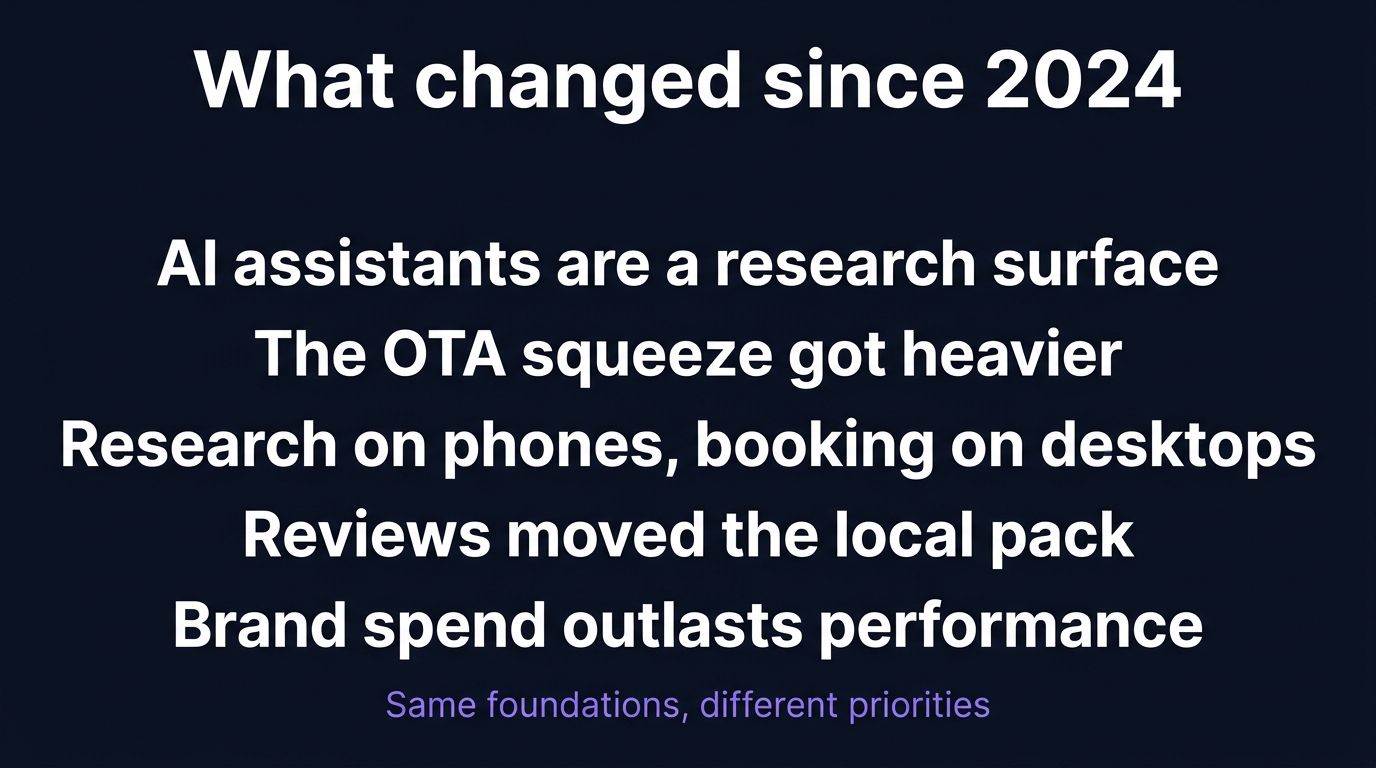
What actually changed since 2024
Five, and each one moves where your time and money should go. They are concrete enough to act on this quarter.
The headline is that the front door to travel research moved. On Phocuswright's traveller research, generative AI assistants (ChatGPT, Gemini, Perplexity and the rest) rose from a 6 percent to a 15 percent share of how US travellers research trips in about a year, while search engines fell from 51 percent to 36 percent over the same window (Phocuswright, Travel Forward 2026). Search is still the biggest single surface by a distance. But a marketing plan that treats AI assistants as a thing to worry about next year is already a year behind.
The other four changes are quieter and more practical. Here they are in order of how much they should change your spending.
Shift 1: AI assistants are a research surface, not a future one
A meaningful share of your future guests now ask an assistant for hotel ideas before they ever open Google or Booking.com. That is the Phocuswright finding above, and it is worth being precise about what it means. It does not mean AI is "sending you traffic" in the way a Google click does. It means an assistant is reading about your hotel from your website, your Google listing, the OTAs and review sites, and then deciding whether to mention you when someone asks for a place to stay in your area. If the facts it can find are thin, wrong, or contradict each other, you get left out of the answer.
What to do: make your hotel easy for an assistant to read and trust. That means structured data on your website, a complete Google Business Profile, and consistent facts (name, location, star rating, amenities) everywhere a machine might look. None of this is exotic, and most of it also helps with normal search. Our guide to hotel AI visibility covers the specifics.
What to ignore: any tool or agency promising to "rank you number one in ChatGPT." Assistants do not have a stable ranking you can buy your way into. They pull from sources and synthesise an answer that varies by phrasing, location and the day. The work is to be accurate and well-described across the sources they read, not to game a leaderboard that does not exist.
Shift 2: The OTA squeeze got quieter and heavier
For an independent hotel, the cost of a booking through an online travel agency (OTA) like Booking.com or Expedia is the single biggest economic fact in your marketing. The headline commission rates did not jump in 2025. The squeeze came in through the side door instead.
Both major OTAs spent 2025 pushing guests toward their merchant model, where the OTA collects payment rather than the hotel. Expedia's full-year 2025 merchant gross bookings grew 13 percent against 1 percent for the older agency model, a shift the company discloses in its own results (Expedia Group Q4 and full-year 2025 release, SEC). On the Booking.com side, "Payments by Booking.com" adds a payment-processing fee of roughly 1 to 3.1 percent on top of the standard commission, depending on country and payout method (SiteMinder, Booking.com fees explained). So the effective cost of an OTA booking crept up even where the commission line stayed flat.
What to do: model every OTA booking as commission plus payment and visibility fees, which for many independents lands in the mid-teens to mid-twenties as a share of the booking. Calculate it for your own channel mix rather than trusting a round number. Then treat a direct booking as costing a fraction of that (a card fee and your own acquisition cost, often in the low single digits). That gap is the whole argument for spending on direct. It is not about hating OTAs, which are a fine acquisition channel for guests who would never have found you otherwise. It is about not paying OTA economics for a guest who already knows your name.
What to ignore: rate-parity panic. Parity rules vary by market and by contract. In the European Economic Area, Booking.com's rate-parity requirements have been removed under the Digital Markets Act (European Commission, 2024); in other markets, check your OTA terms before discounting the headline rate. Either way, chasing the OTA on headline price is usually a losing game. Compete on what you can control instead: a better-value package, a perk that only shows up when you book direct, a loyalty rate, a clearly better booking experience.
Shift 3: Guests research on phones and still book on bigger screens
Mobile drives around 70 percent of global travel and hospitality website traffic, on Statista's reading of ContentSquare data for 2024 (Statista). Treat that as a broad-category benchmark rather than a hotel-only figure, but the direction is not in doubt. The part that catches hotels out is the other half of the sentence: desktop still converts at a higher rate for travel, so a large share of bookings are still completed on a laptop even though the research happened on a phone.
Where to spend the effort: design for a research-on-mobile, decide-anywhere reality. Your phone experience has to load fast, show the price and the book button without a hunt, and answer the questions a guest has while they are lying on the sofa scrolling. Your desktop experience has to make the final booking effortless. Both matter. A site that is gorgeous on desktop and painful on mobile loses the guest before they ever reach the booking engine.
The trap: thinking you can pick one. You cannot. But you can stop obsessing over desktop pixel-perfection while your mobile homepage takes six seconds to load and buries the rate.
Shift 4: Reviews are the local-search lever, not citations
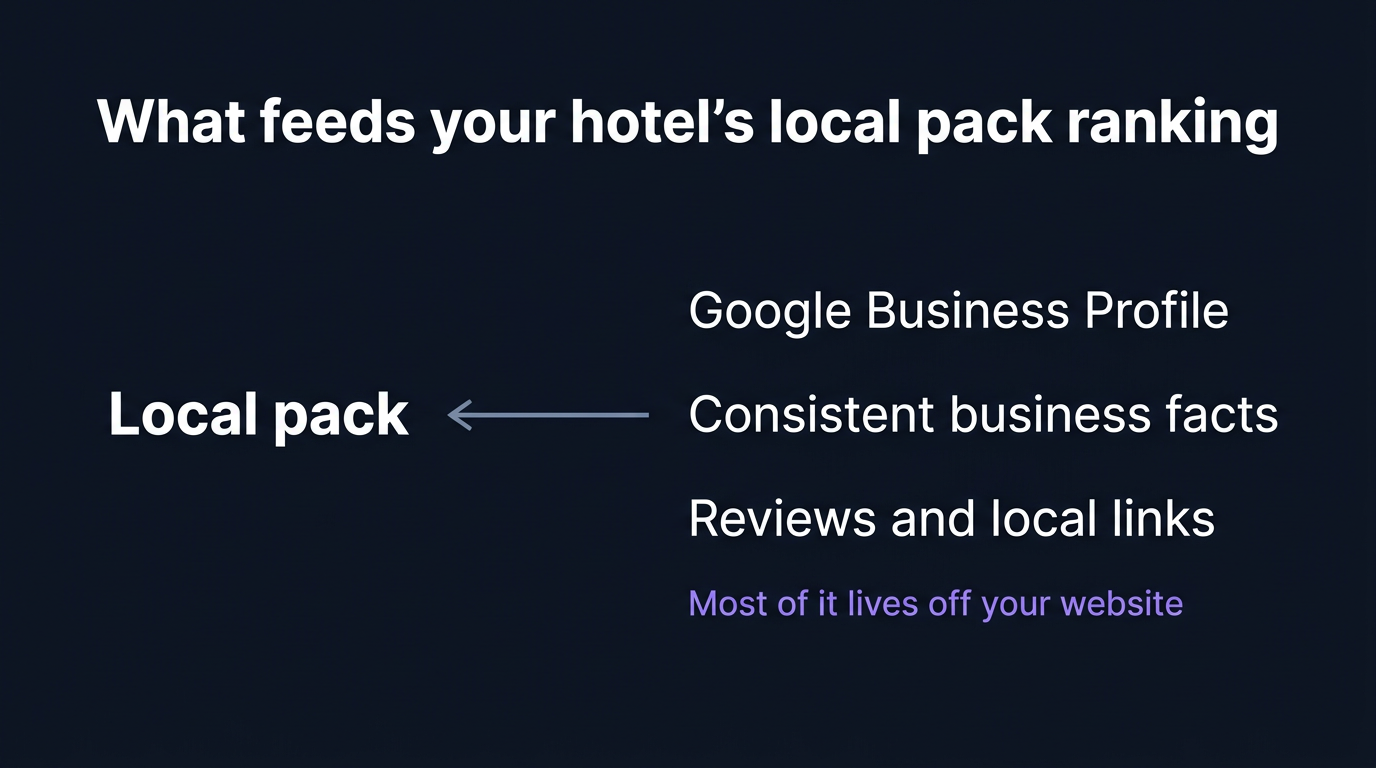
For years the local-SEO playbook for hotels leaned heavily on citations, which are mentions of your name, address and phone number across directories. They still matter for consistency. But the lever that moves the local pack (the map and short list of hotels that appears above the normal results) has shifted toward reviews, and toward recent ones in particular.
This is an observation, not a law Google has published. The strongest version of it comes from Whitespark's Darren Shaw, who argued in May 2025 that Google has "cranked the dial" on review recency and put it among his top five local ranking factors for the year (Whitespark, May 2025). The intuition holds up: a steady flow of recent reviews tells Google your hotel is active and current in a way a static directory listing never could.
The cheap win: build a quiet, constant review habit. Ask every guest, make it one tap, and respond to what comes back. A hotel adding a handful of genuine reviews every week will, over a season, out-signal a competitor sitting on a big but stale pile. This is the cheapest lever on this list, which is why it belongs near the top of a tight budget. The mechanics sit inside the broader hotel SEO picture, and the map-and-local-pack specifics are in our local SEO for hotels playbook.
Do not: buy reviews, or use any service that offers them. It is against Google's review policy, it is obvious to guests, and one cluster of suspiciously similar five-star reviews does more damage to trust than fifty honest four-stars.
Shift 5: Brand spend outlasts performance spend
This one is my opinion. There is no clean industry number that settles it, so treat it as a budget principle rather than a measured fact.
Performance marketing (paid search, metasearch, retargeting) resets to zero the moment you stop paying. Brand marketing (your content, your reputation, the reason a guest types your name into Google instead of "hotels in the area") keeps working after the spend stops. For an independent hotel with a finite budget, I think the mistake of the last few years was over-indexing on performance because it is measurable, and under-investing in the brand because it is slower to show up in a dashboard.
The economics underneath this are real even if the comparison is not measured: a guest who books direct because they already trust you costs you a card fee, while the same guest acquired through an OTA costs you a large double-digit share of the booking. Brand is what produces the first kind of guest. I am not telling you to switch off performance. I am telling you that if the two are fighting for the last few thousand in your budget, brand is the one that compounds.
A 2026 allocation for a tight budget
Here is a starting split, and I want to be honest about the assumptions baked into it, because an allocation with no stated context is fake precision. This is for an independent property of roughly 30 to 80 rooms, with a modest annual marketing budget (think low tens of thousands, not millions), selling mostly leisure stays, and currently leaning too hard on OTAs. If that is not you, the shares move. Read the reasoning, not the percentages.
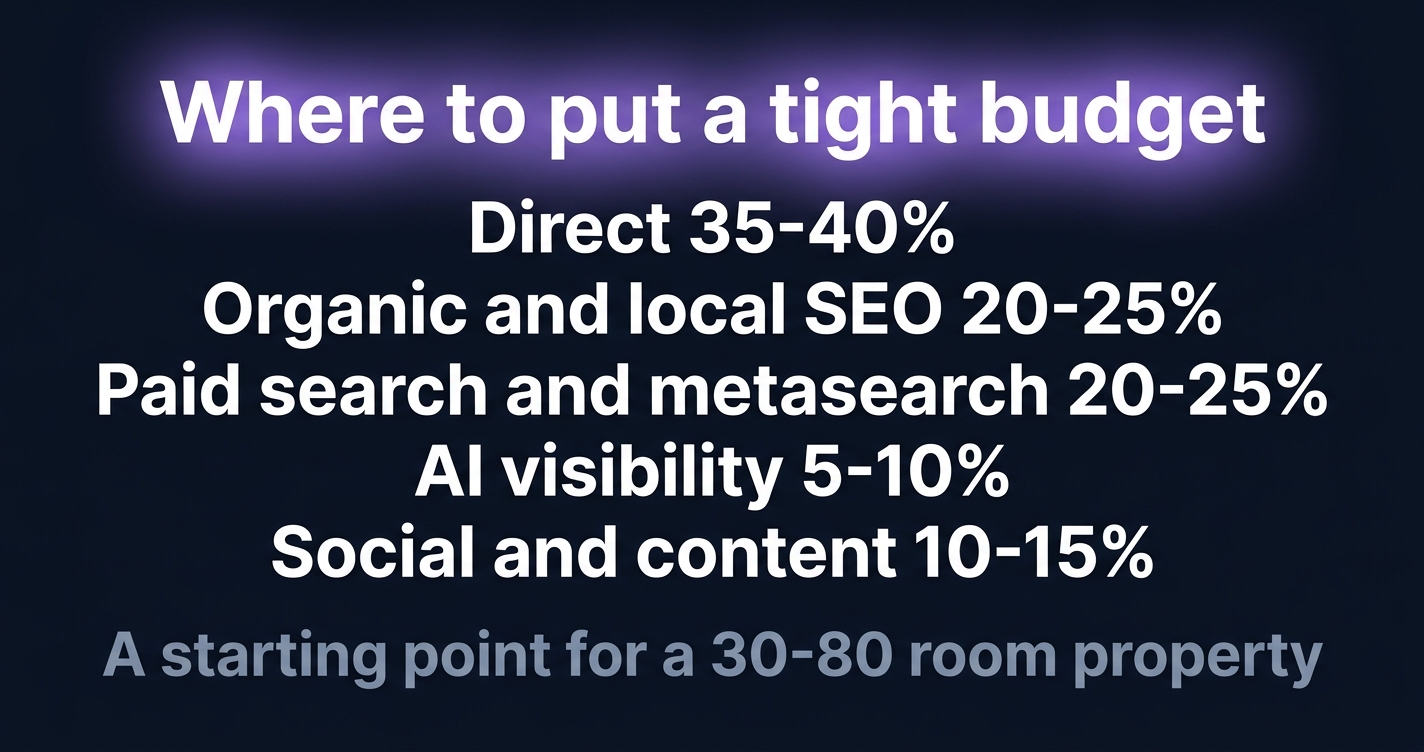
- Direct (email, loyalty, brand site, content): 35 to 40 percent. This is where the compounding happens and where every booking is cheap. It is the largest slice on purpose. Most of the review and AI-readability work from the shifts above lives here too.
- Organic and local SEO: 20 to 25 percent. Mostly time rather than cash. Reviews, Google Business Profile, structured data, the local pack. The highest return per pound on this whole list.
- Paid (search, metasearch): 20 to 25 percent. Still worth it, especially metasearch and defending your own brand terms so an OTA does not buy clicks on your name. Keep it measured and cut what does not show a return.
- AI visibility: 5 to 10 percent. Small but deliberate. Mostly the accuracy and structured-data work, which overlaps with organic. The point is to stop being invisible to a research surface that is no longer marginal.
- Social and content production: 10 to 15 percent. Feeds both brand and the assets the other channels need. Resist the urge to make this the whole plan because it is the fun part.
Defend each one in your own context before you spend. If your direct channel is already strong, move money to where the gap is. And if you are currently taking more than half your bookings through OTAs, bias harder still toward direct and local SEO until that dependency comes down, because every point you claw back from an OTA is worth far more than a marginal gain anywhere else on the list.
What to cut
Some things still sitting in a typical 2024 plan should go.
- Print, unless it has a specific local job. A glossy ad in a regional magazine that nobody can attribute a booking to is nostalgia, not marketing.
- The generic social calendar. Posting daily because a guide said to, with no offer and no point, costs real hours and earns nothing. Post when you have something to say or sell.
- Untracked influencer activations. A free stay in exchange for posts that you never measure is a donation. If you do it, agree the deliverable and the tracking up front.
- Any agency that cannot show outcomes. If your monthly report is a list of activities ("we posted 12 times, we sent 3 emails") rather than results (bookings, revenue, direct share), you are paying for activity, not marketing.
A 90-day starting plan
For a small team with no slack, here is where to start. It is sequenced so the cheap, high-return work happens first.
Weeks 1 to 2: see the gaps. Run your priority searches in a private browser window and note where you appear in the local pack. Ask ChatGPT, Gemini and Perplexity to recommend a hotel like yours in your area and note whether you are mentioned and whether the facts are right. Run a mystery audit of your own booking flow on a phone, or audit your AI visibility for one property for free. You cannot fix what you have not seen.
Weeks 3 to 6: fix the foundations. Complete the Google Business Profile. Get structured data onto the website. Set up a one-tap review request for every departing guest and start responding to reviews. Clean up the mobile homepage so the price and book button are obvious. These are the foundations every shift above depends on.
Weeks 7 to 12: build the direct engine. Get an email welcome and pre-arrival sequence working. Put a genuine reason to book direct on the website (a perk, a rate, a package). Start a light, honest content habit aimed at the questions guests actually ask. Defend your brand terms in paid search. By the end of the quarter you have a direct channel that compounds, not just a set of one-off fixes.
Frequently Asked Questions
What is the biggest change to hotel marketing in 2026?
The arrival of AI assistants as a real research surface. Generative AI rose from a 6 percent to a 15 percent share of how US travellers research trips between late 2024 and the second half of 2025, while search engines fell from 51 percent to 36 percent (Phocuswright). Search is still the largest channel, but the shift is fast enough that being accurate and well-described across the sources AI reads is now part of the basic job, not an experiment.
How much should an independent hotel spend on marketing?
There is no universal number, and anyone who gives you one without asking about your size, occupancy and channel mix is guessing. As a rough orientation, many independent properties run total marketing in the range of a few percent of room revenue, but the more useful question is the split, not the size. Put the largest share into your direct channel, because that is where bookings are cheapest and the spend compounds.
How do I market to AI travel assistants?
You do not advertise to them. You make your hotel easy to read and trust: structured data on the website, a complete and consistent Google Business Profile, accurate facts across the OTAs and review sites, and reviews that reflect what the place is actually like. Assistants synthesise from those sources. The work is accuracy and coverage, not a paid placement.
Should I keep my OTA contracts?
For most independents, yes. OTAs reach guests who would never find you otherwise, and that reach has real value. The strategy is not to leave them, it is to stop paying OTA economics for guests who already know you. Use the OTAs for discovery, then earn the repeat booking direct with a better experience and a genuine reason to come back to your own site.