Twelve things a hotel mystery shop should check in 2026, from whether ChatGPT recommends you to whether a guest can finish a booking on their phone. What to check, what passing looks like, and what failure costs.
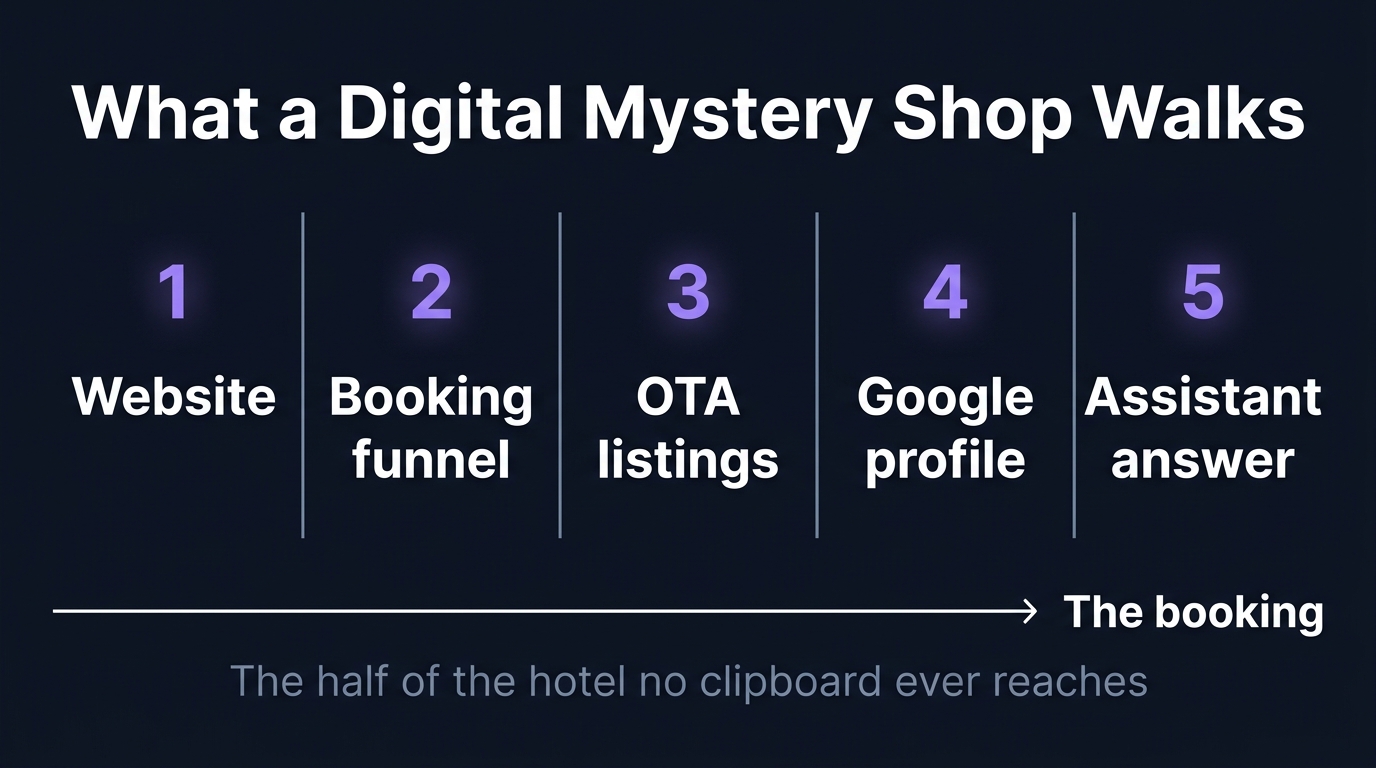
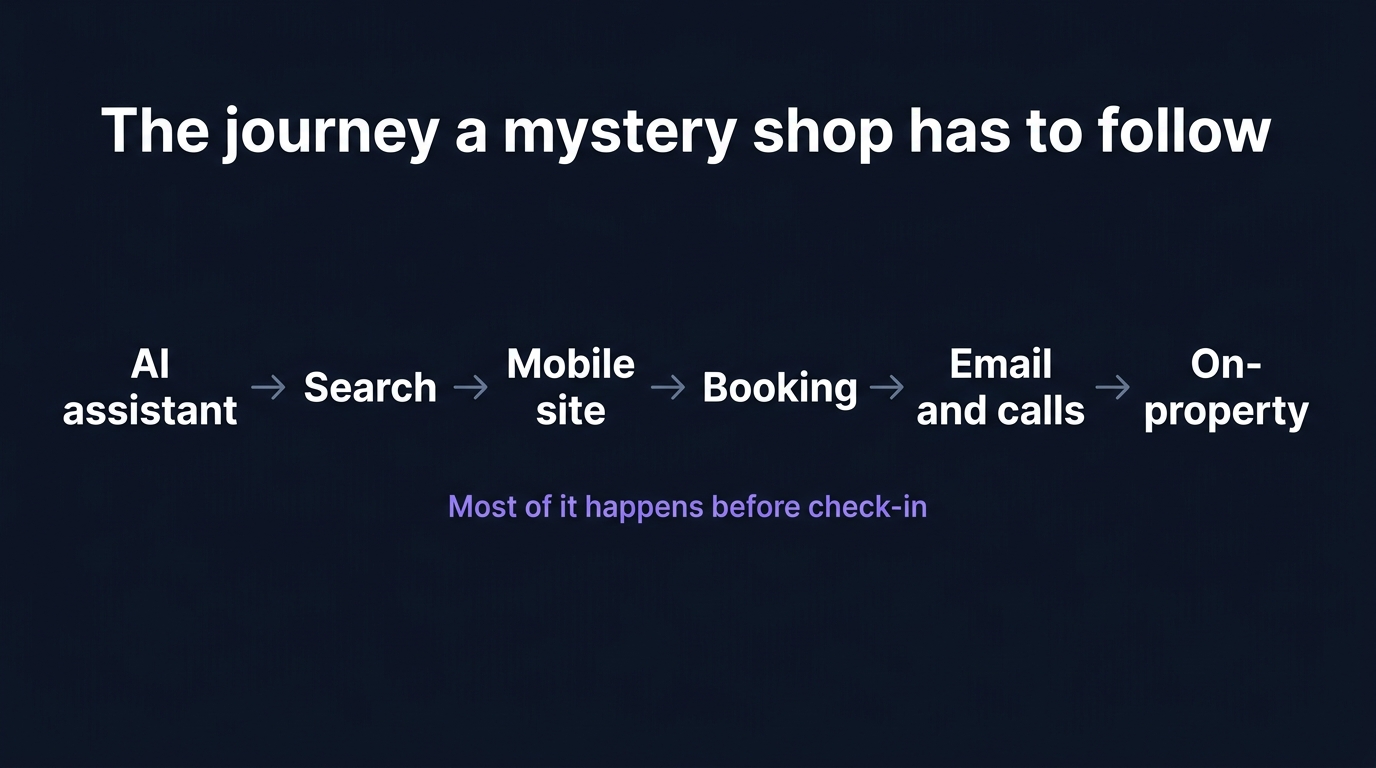
A mystery shop used to mean sending a well-briefed stranger to stay a night and report back on the check-in, the room and the breakfast. That still has value. It tells you how a stay feels. What it cannot tell you is whether a guest ever gets that far. A guest's experience of your hotel now starts long before they walk through the door, often before they have even decided to book, and a 2026 mystery shop has to follow the whole path. That path runs through an AI assistant, a Google search, a phone screen, a booking engine and an inbox before anyone arrives.
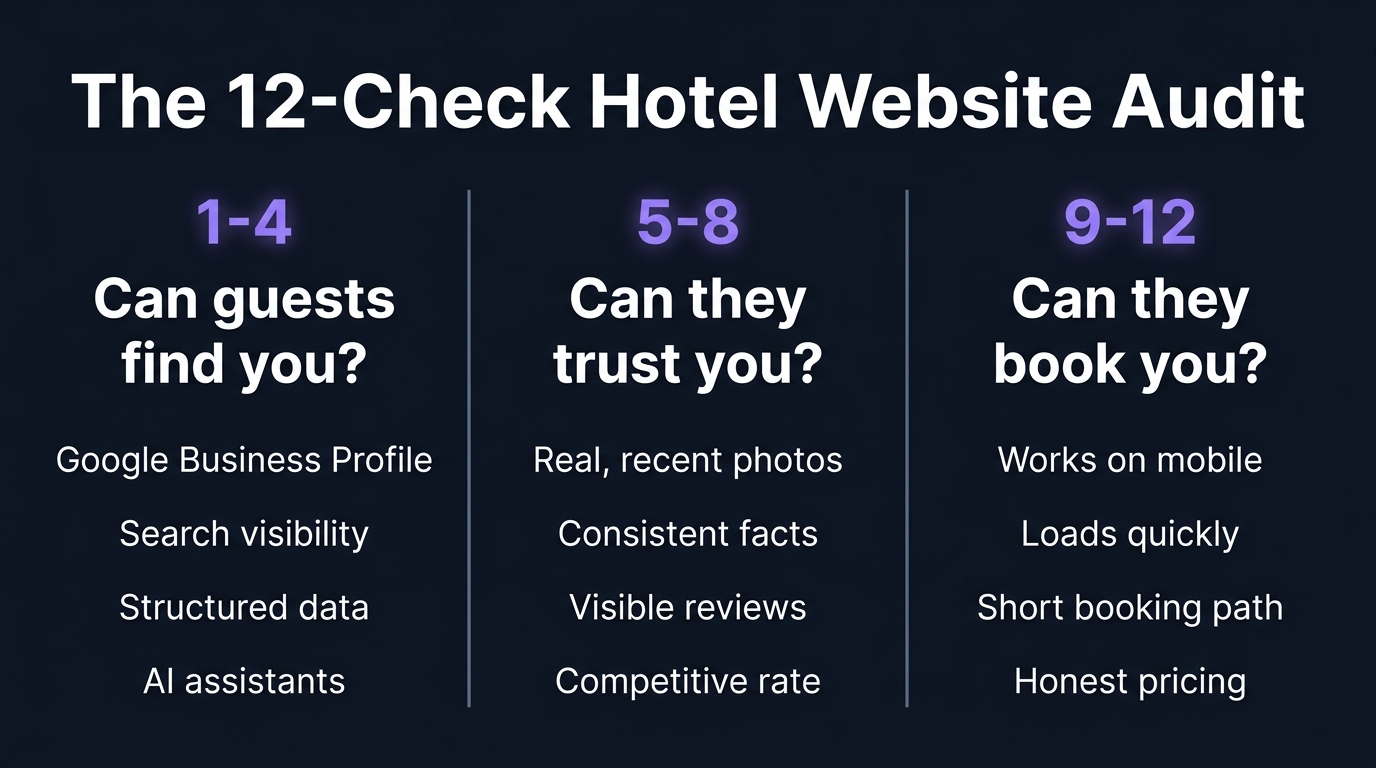
Run these twelve checks in roughly the order a guest meets them. Each has what to look at, what a pass looks like, and what a fail actually costs you in bookings or reputation. You can run most of it yourself in an afternoon. For the full picture of what a modern audit covers, see what a 2026 mystery audit actually is.
The 12 checks
1. Does AI recommend your hotel?
What to check: whether ChatGPT, Gemini and Perplexity mention your hotel when someone asks for a place to stay like yours. This is worth doing properly rather than typing one question and drawing a conclusion, because these models can vary between runs. A repeatable check fixes the prompts (a small set such as "recommend a boutique hotel near [your landmark]" and "best [your category] hotels in [your area]"), fixes the location and uses a logged-out or private session so the answer is not personalised to you, names the model and the date, and runs each prompt three to five times. Repeating the prompts is what lets you tell a stable absence from a one-off.
What passing looks like: you are mentioned for relevant queries, and the facts (location, category, a stand-out feature) are right.
What failure costs: invisibility on a surface that, per Phocuswright, grew from a 6 percent to a 15 percent share of US travel research in about a year. If the assistant has wrong facts about you, that is worse than silence. More on closing the gap in our AI visibility guide.
2. Is your search result correct and complete?
What to check: your Google listing and the local pack (the map and short list above the normal results) for your priority searches. Look at the name, category, photos, rating and whether the booking and website links are right.
What passing looks like: you appear for "hotels in [your area]" and your branded search, the information is current, and the listing looks like somewhere you would book.
What failure costs: a thin or wrong listing loses the guest at the moment they are closest to choosing. The fixes sit in your hotel SEO and in Hotel schema, the machine-readable summary that helps search and assistants read you correctly.
3. Does the website work on a phone?
What to check: open your homepage on a real phone, on mobile data rather than office Wi-Fi. Time how long it takes to be usable. See whether the price and the book button are visible without hunting, and whether the hero image and headline tell a guest where they are and why they would stay.
What passing looks like: it loads fast, the rate and the booking call-to-action are immediately obvious, and the page answers the first question a guest has.
What failure costs: mobile is nearly 68 percent of global travel and hospitality website traffic, on Statista's reading of Contentsquare data for 2023 (Statista). A slow or confusing phone homepage loses guests before they ever reach the booking engine, and many teams miss it because their own default test is a fast desktop connection.
4. Does the homepage offer match the booking engine?
What to check: take the headline rate or package on your homepage and follow it into the booking engine for real dates. Then check the same room and dates on Booking.com and Expedia.
What passing looks like: the price a guest is promised is the price they are charged, and your direct rate is at least as good as the OTA rate for the same room.
What failure costs: a guest who clicks a "from" price and lands on a higher one feels misled and leaves. And the OTA gap is real: the 123compare.me World Parity Monitor found that in 2025 at least one OTA showed a lower price than the hotel's own site in 75 percent of searches, with mobile worse than desktop (123compare.me, 2025). You cannot always win on the headline rate, but you should know where you stand and compete on value where you cannot.
5. Can a guest book on their phone quickly?
What to check: complete a real booking on a phone, from homepage to confirmation, and count the steps and the form fields. We hold a hotel booking funnel to a 90-second mobile-completion bar. That number is Stiplo's own standard, not an industry figure, and we set it on purpose: Baymard Institute's checkout research finds most checkouts need only about 8 form fields, while the 2024 average was 11.3, and 17 percent of users have abandoned a purchase because the checkout was too long or complicated (Baymard Institute). A funnel a guest can finish in 90 seconds is one that has cut that excess out.
What passing looks like: a guest can get from intent to confirmation fast, on a phone, without creating an account or re-typing details a system should already know.
What failure costs: every extra field and dead-end is a place to abandon. Online cart abandonment averages over 70 percent across e-commerce (Baymard Institute, 2025), and a clumsy hotel funnel sits at the bad end of that range.
6. Does the welcome email actually arrive?
What to check: sign up to your own newsletter or create a booking and watch what lands. Does a confirmation or welcome email arrive, is it correct, and does it look like you sent it on purpose?
What passing looks like: a prompt, correct, on-brand email that a guest is glad to receive.
What failure costs: a broken or missing welcome is a wasted first impression with a guest who just raised their hand. Email is the cheapest direct channel you have, and it starts here.
7. How is the phone answered?
What to check: call reception as a prospective guest at a busy time. Note the wait, the warmth and competence of the answer, and whether anyone tries to win the booking rather than just quote a rate.
What passing looks like: answered quickly, helpfully, by someone who treats the call as a chance to earn a direct booking.
What failure costs: a phone call is a high-intent guest choosing to talk to a human. A long hold or a flat answer sends them back to the OTA.
8. How fast and good is the email enquiry response?
What to check: send a real enquiry through your website or to your reservations inbox. Time the first response and judge its quality.
What passing looks like: a fast, personal, useful reply that moves the guest toward booking.
What failure costs: a slow or robotic reply to a direct enquiry hands a ready-to-book guest to whoever answers first.
9. Do the pre-arrival communications land?
What to check: after booking direct, watch what arrives before the stay. Confirmation, any pre-stay email, directions, upsell offers.
What passing looks like: clear, well-timed messages that build anticipation and quietly sell a room upgrade or an add-on.
What failure costs: silence between booking and arrival is a missed chance to increase the value of a stay you have already won, and to set the tone before the guest arrives.
10. Is the arrival experience smooth?
What to check: the in-person check-in. This is the part traditional mystery shops do well, so keep it brief here: was it quick, warm and competent?
What passing looks like: a guest feels expected and welcomed, not processed.
What failure costs: the arrival sets the mood for the whole stay and, increasingly, for the review that shapes how the next guest finds you.
11. Do the in-stay digital touchpoints work?
What to check: the Wi-Fi sign-in, any hotel app, and in-room QR codes. Do they work on a phone, and do they help rather than annoy?
What passing looks like: Wi-Fi that connects without a fight, and digital touchpoints that make the stay easier.
What failure costs: a broken QR menu or a captive Wi-Fi portal that loops is a small, daily irritation that shows up in reviews and chips away at a stay you have otherwise got right.
12. Does the post-stay follow-up happen?
What to check: after checkout, see whether a review request and any loyalty or rebooking prompt arrive, and how well-timed they are.
What passing looks like: a well-timed, easy review request and a genuine reason to come back direct.
What failure costs: this is where reviews and repeat bookings are made or lost. Reviews support your local search visibility and are one of the public trust signals an assistant may summarise, so a missing review request quietly weakens checks 1 and 2 next quarter.
Digital touchpoints and in-person ones
It is worth being honest about which half of this list a traditional provider covers, because it explains where the gaps usually are.
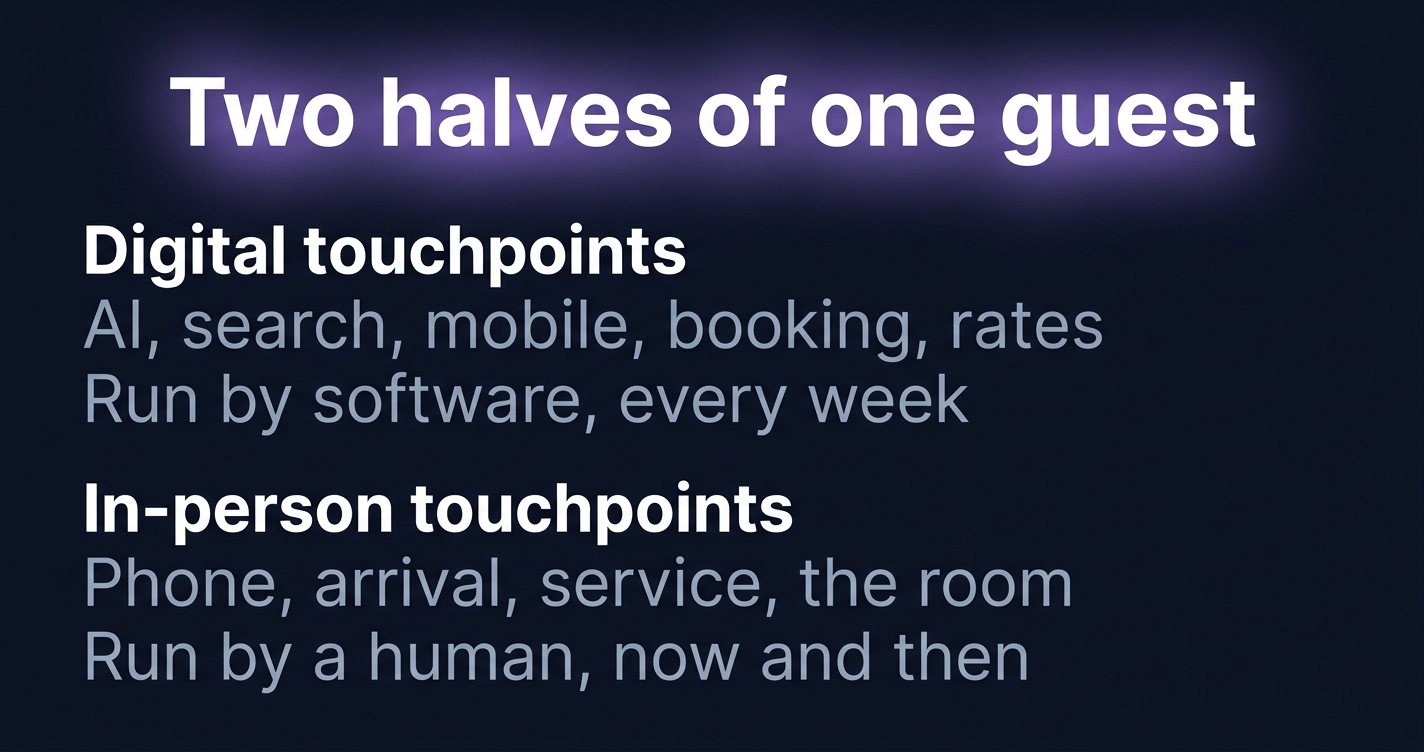
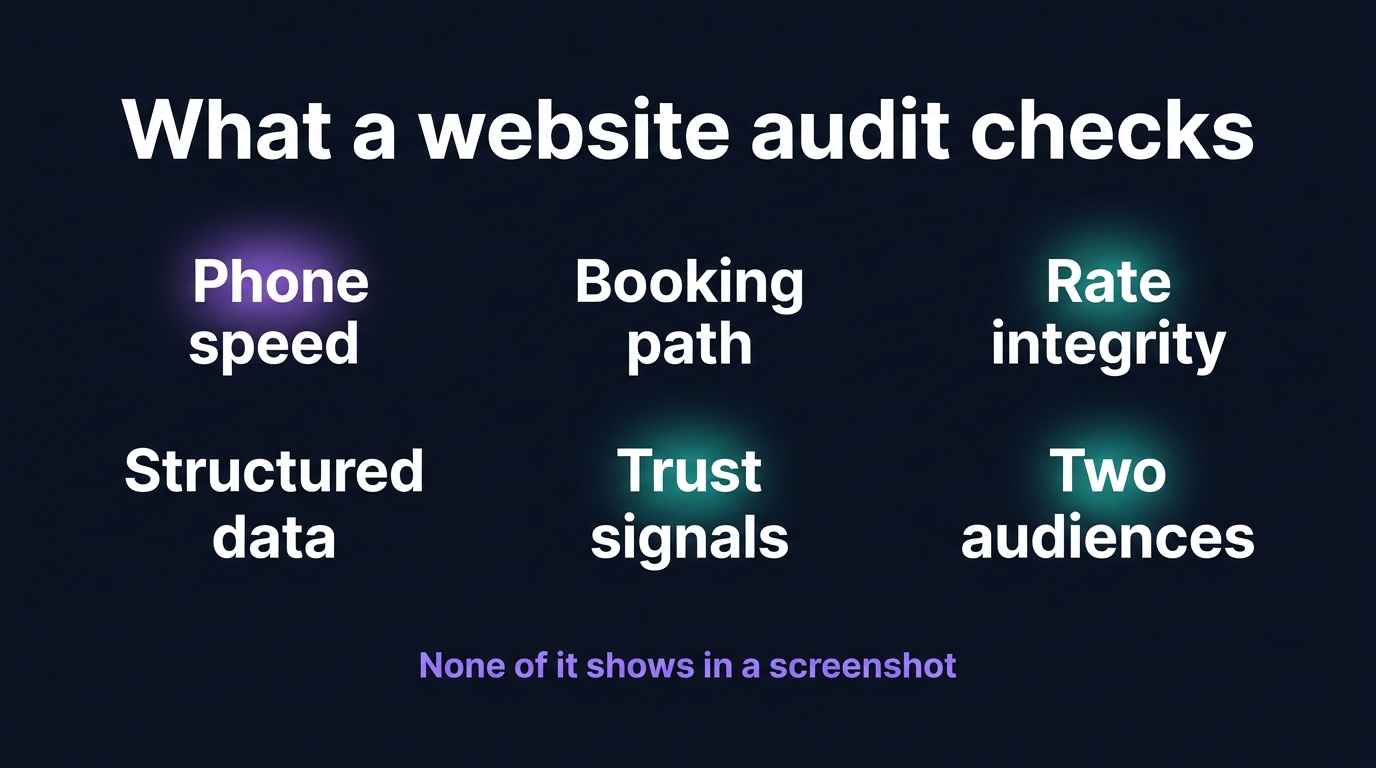
Established hotel mystery-shop firms are built around the in-person and human-service touchpoints: the phone call, the pre-arrival contact, the arrival, the on-property service. Some now add a "website and booking" touchpoint, but they tend to evaluate it the way a guest rates a friendly front desk, not the way an engineer audits a conversion funnel. The systematic digital checks, the booking-funnel friction, the mobile speed, the rate integrity against OTAs, and whether AI assistants can find and correctly describe you, sit outside what those programs were designed to do. AI-visibility auditing in particular is so new that the providers offering it in 2026 are mostly specialist tools, not the mystery-shop companies hotels have used for years.
Both halves give you the full picture. The in-person checks tell you how a stay feels. The digital checks tell you whether a guest ever gets that far. For most independent hotels the digital side is the bigger blind spot, simply because nobody has been checking it.
It is common to find a hotel paying for an annual mystery-shopping programme while no one on the team has tried to book a room on their own phone in months. The in-person side is watched closely. The digital side is usually nobody's job.
How to run this yourself in an afternoon
You do not need a budget to start. Block out an afternoon, use your own phone, and work down the list. Ask the three assistants about a hotel like yours. Run your priority searches in a private browser window. Book a room on your phone and time it. Sign up to your own newsletter. Call your own reception and send your own enquiry. Write down each pass and fail as you go.
Most hotels already know how their lobby feels. Far fewer know whether a guest can find them, book them and trust them before they arrive. That is usually where the surprises are, and the afternoon costs you nothing but the time.
When to bring in a tool or service
Run it by hand and you will find plenty to fix. The reason to bring in a tool is when the manual version stops scaling: when you run more than one property, when you want it checked every week rather than once, or when you need a repeatable, evidence-backed record to put in front of an owner or a GM review.
That is where Stiplo Mystery Shop fits. It runs the digital side of this checklist for you, automated and repeatable, with a screenshot trail behind every finding. It does not replace a traditional mystery-shop provider, and it is not meant to. A traditional provider covers the in-person experience a piece of software cannot judge. Stiplo covers the digital touchpoints across the journey, the ones most hotels are not checking at all. Use the digital check for the recurring funnel and visibility issues, and a traditional provider for the human-service ones.
Frequently Asked Questions
How often should a hotel mystery shop run?
The in-person side suits a quarterly or twice-yearly rhythm, because the service experience does not change week to week. The digital side benefits from running more often, monthly or even weekly, because the things it checks (your booking flow, your rates against the OTAs, whether AI assistants still recommend you) move constantly and without warning. A broken booking step or a new price gap can appear any day.
What is the difference between a mystery shop and a quality audit?
A quality audit usually measures your hotel against a fixed set of brand or service standards, often from a checklist the property already knows about. A mystery shop measures the real experience as a guest meets it, unannounced, which is why it catches things a known audit misses. This checklist is written for the mystery-shop version: experience the journey as a guest would, then write down what actually happened.
Can mystery shopping be automated?
The digital part can. Checking AI-assistant recommendations, search visibility, mobile speed, booking-flow friction and rate integrity is exactly the kind of repeatable, evidence-based work software does well, and does the same way every time. The in-person part (the warmth of a welcome, the feel of a room) still needs a human. The sensible 2026 setup is software for the digital touchpoints and a person for the human ones.
How much does a hotel mystery shop cost?
A traditional in-person mystery shop for a single property can easily run into the hundreds per visit once you include the stay, the reimbursement and the reporting. The digital side can be run for nothing if you do it yourself with this checklist, or as a low-cost recurring service if you want it run for you and tracked over time. The cost question is really about cadence: a one-off human visit versus a continuous digital check.
Should I mystery shop my competitors?
Running the digital half of this list against two or three local competitors is one of the most useful things you can do, and it costs only time. Ask the assistants which hotels they recommend in your area and see who shows up instead of you. Compare booking flows and rates. It tells you exactly where you are losing the guest before they ever consider you.
Does Stiplo Mystery Shop replace a traditional mystery-shop provider?
No, and it is not trying to. Stiplo covers the digital touchpoints across the guest journey, the booking flow, the rates, the search and AI visibility, automated and repeatable. A traditional provider covers the in-person experience that needs a human to judge. They cover different halves of the same guest, and most hotels are only checking one of them.